






Most people don’t find out they have chronic inflammation until a doctor mentions it somewhere between a cholesterol reading and a blood pressure number that’s crept a little too high.
There is no fever. No swelling you can see. No obvious signal that anything is wrong. That is exactly what makes chronic low-grade inflammation so dangerous. It operates in the background for years, sometimes decades, quietly accelerating damage to blood vessels, brain tissue, and metabolic systems while life proceeds as normal. By the time it shows up in a clinical marker, it has often been doing its work for a very long time.
What changed my understanding of this topic, both professionally and personally, was not a single study. It was accumulating evidence from thousands of them, pointing to the same uncomfortable conclusion: the standard American diet is, in many respects, a sustained inflammatory stimulus. And the solution is less dramatic, and more practical, than most people expect.
If you are already curious about the broader relationship between what you eat and how your body ages and heals, the complete guide to food as medicine provides the scientific framework this article builds on.
What inflammation actually is (and when it goes wrong)
Inflammation is not the enemy. That is the first thing worth clarifying.
When you cut your finger or catch a cold, your immune system deploys an inflammatory response to contain the damage and initiate repair. It is fast, targeted, and designed to shut off once the threat is neutralized. This is acute inflammation. It saves lives.

The problem is a different version entirely. Chronic low-grade inflammation is the immune system stuck in a low-level activation state with no clear threat to fight. There is no off switch triggered because there is no single event to resolve. Instead, something in the environment is continuously signaling danger. And in modern life, that something is often food.
Researchers at Harvard’s T.H. Chan School of Public Health have tracked inflammatory biomarkers across large population cohorts for decades. The consistent finding: people eating diets high in ultra-processed foods, refined grains, industrial seed oils, and added sugars show significantly elevated levels of C-reactive protein (CRP), interleukin-6, and tumor necrosis factor-alpha. These are the chemical messengers that sustain the inflammatory response. Elevated chronically, they correlate with increased risk for cardiovascular disease, type 2 diabetes, depression, Alzheimer’s, and several cancers.
The mechanism is not mysterious. It is biology responding logically to a prolonged chemical environment it was never designed for.
The dietary drivers most people underestimate
Everybody knows that fried fast food is not a health food. But the more insidious inflammatory drivers are the ones that have been successfully marketed as neutral or even beneficial.
Refined vegetable oils, particularly those high in omega-6 fatty acids like soybean, corn, and sunflower oil, dominate processed food manufacturing. On their own, omega-6s are not harmful. The problem is ratio. The human body evolved on a dietary omega-6 to omega-3 ratio of roughly 4:1. The average American now consumes somewhere between 15:1 and 20:1. That imbalance shifts the body’s baseline toward pro-inflammatory arachidonic acid pathways.
Refined carbohydrates and added sugars are another layer. Beyond spiking blood glucose and driving insulin resistance, they promote the formation of advanced glycation end products (AGEs), compounds that accumulate in tissues, stiffen blood vessels, and generate significant oxidative stress. Every spike and crash of the blood sugar cycle nudges the inflammatory dial upward.
And then there is the gut. Ultra-processed foods disrupt the gut microbiome in ways that compromise the intestinal lining, a phenomenon sometimes called increased intestinal permeability. When that barrier is compromised, bacterial fragments can enter systemic circulation, triggering immune activation that has no business happening there. The gut connection is one of the more important pieces of this puzzle, and it’s worth understanding in depth at the gut healthdeep dive in this cluster.
What an anti-inflammatory diet actually looks like
Here is the part where people expect a complicated protocol. It is not.
Anti-inflammatory eating is not a specific diet with branded rules. It is a dietary pattern defined by consistent choices that lower the body’s inflammatory load over time. The research converges on a clear set of principles.
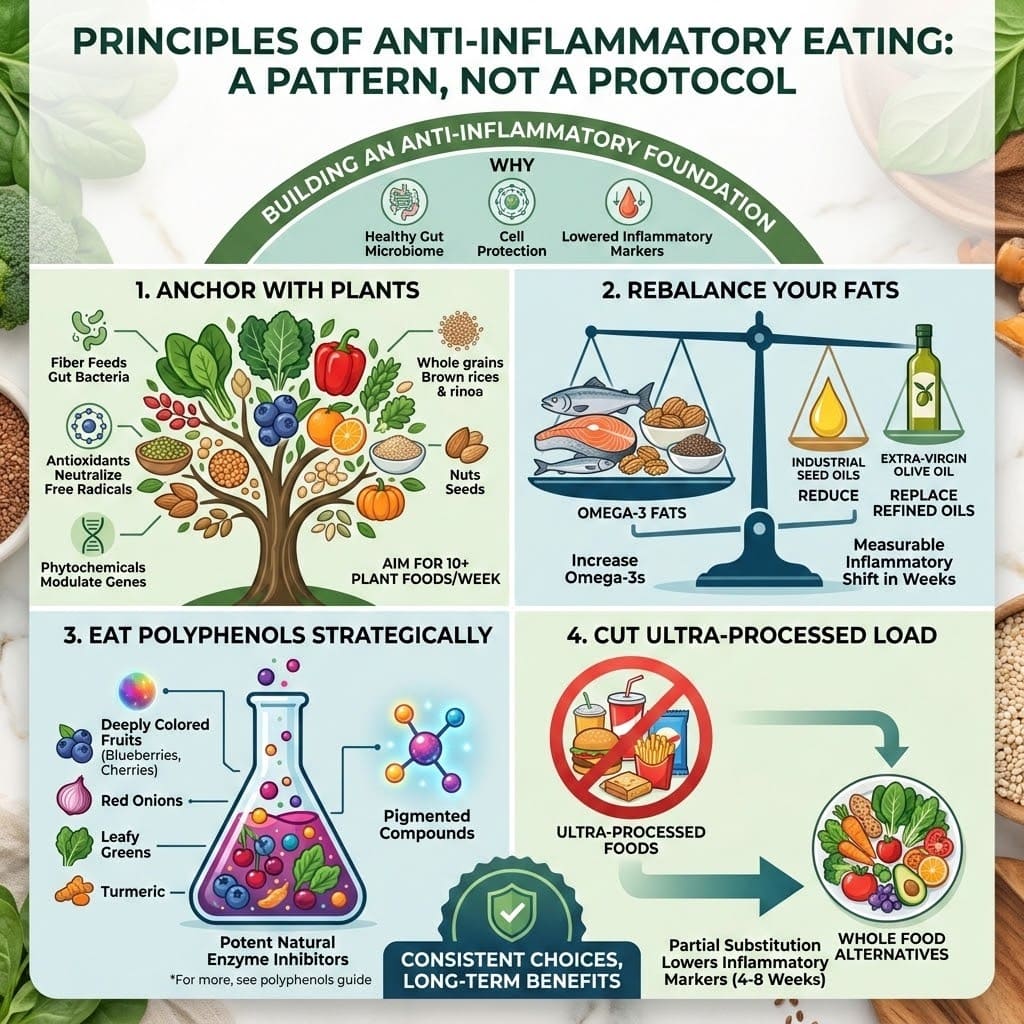
Anchor every meal in plants. Vegetables, fruits, legumes, whole grains, nuts, and seeds are the dietary backbone of every well-studied anti-inflammatory eating pattern. They deliver fiber that feeds gut bacteria, antioxidants that neutralize free radicals, and phytochemicals that directly modulate inflammatory gene expression. Aim for ten or more different plant foods per week. Diversity matters as much as volume.
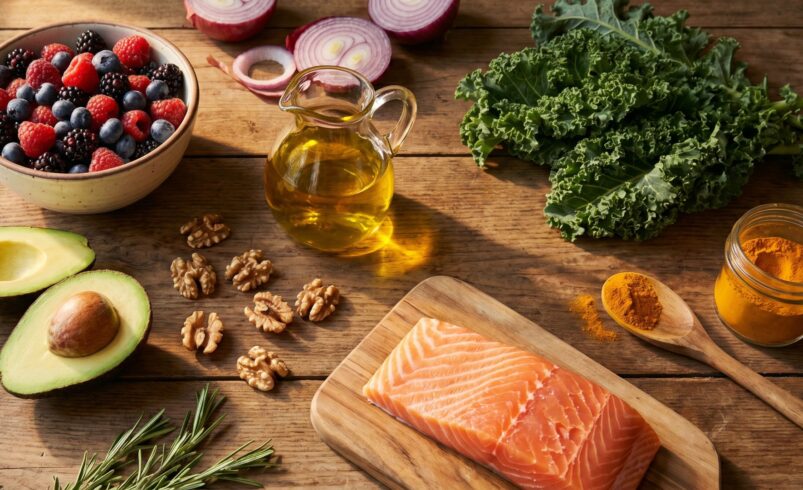
Rebalance your fats. Increase omega-3 intake through fatty fish (salmon, sardines, mackerel), walnuts, flaxseeds, and chia seeds. Replace refined seed oils with extra-virgin olive oil where possible. This single shift, done consistently, measurably changes the body’s inflammatory baseline within weeks.
Eat polyphenols strategically. The pigmented compounds in deeply colored fruits and vegetables, dark chocolate, green tea, and herbs are some of the most potent natural inhibitors of inflammatory enzymes known to nutritional science. Blueberries, cherries, red onions, leafy greens, and turmeric are all high-yield additions. If you want to go deeper on this specific category, the guide to polyphenols and their health effects covers the science in detail.
Cut the ultra-processed load. This does not require perfection. Research suggests that even partial substitution of ultra-processed foods with whole food alternatives produces measurable reductions in inflammatory markers within four to eight weeks.
A practical comparison: pro-inflammatory vs. anti-inflammatory choices
| Category | Pro-inflammatory | Anti-inflammatory |
| Cooking fat | Soybean, corn, sunflower oil | Extra-virgin olive oil, avocado oil |
| Protein | Processed deli meats, fast food | Wild salmon, sardines, legumes, tempeh |
| Carbohydrates | White bread, pastries, sugary drinks | Oats, quinoa, lentils, sweet potato |
| Snacking | Chips, cookies, crackers | Walnuts, blueberries, dark chocolate (70%+) |
| Beverages | Soda, sweetened coffee drinks | Green tea, water, black coffee in moderation |
| Flavor | Pre-made sauces with added sugar | Fresh herbs, turmeric, ginger, garlic |
This is not a rigid prescription. It is a directional guide. The research on dietary patterns is clear that no single meal or food determines inflammatory status. It is the accumulation of daily choices over months and years.
The timeline: how fast does it work?
One of the most common questions I hear is some version of: if I change my diet, how long before I feel a difference?
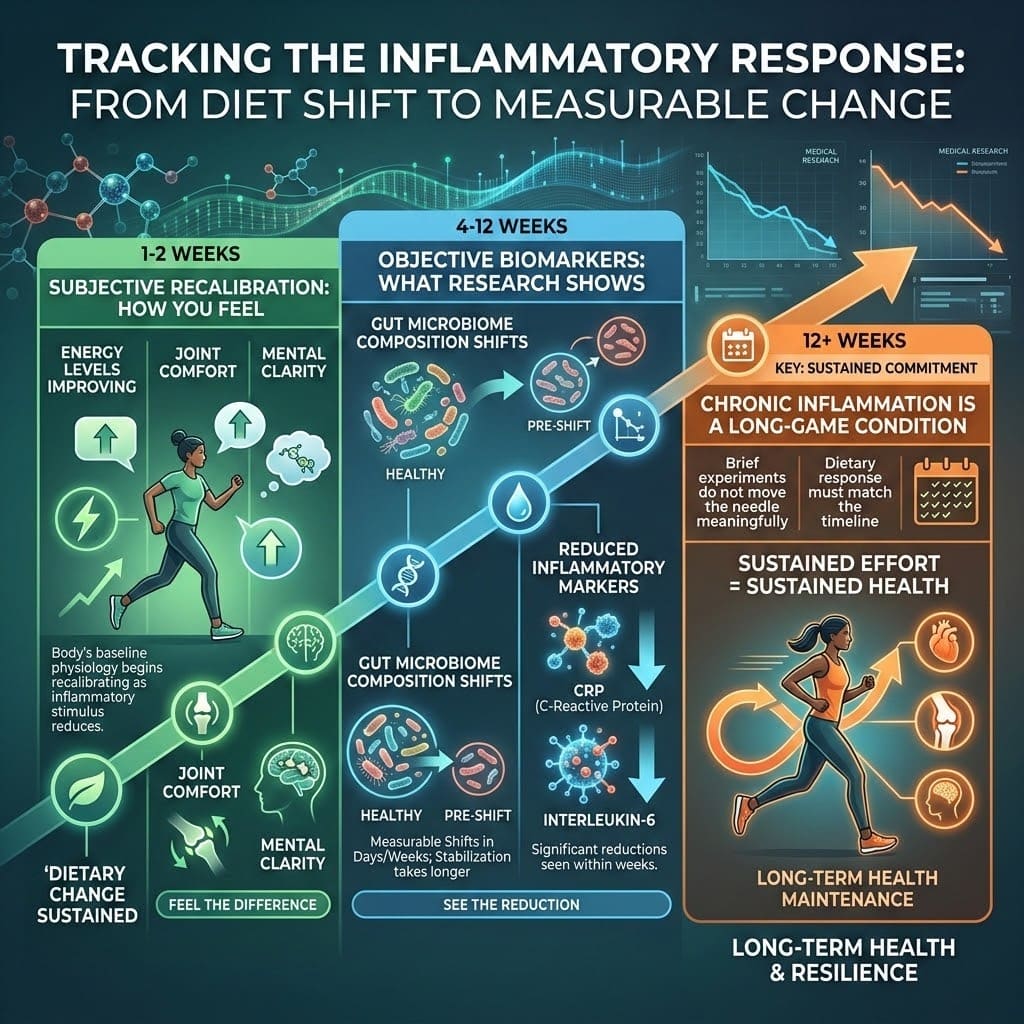
The honest answer depends on what you are measuring. Studies using objective inflammatory biomarkers typically see significant reductions in CRP and interleukin-6 within four to twelve weeks of sustained dietary change. Gut microbiome composition shifts measurably within days to weeks of dietary modification, though stabilization takes longer.
Subjectively, many people report improvements in energy, joint comfort, and mental clarity within two to four weeks of genuinely shifting their dietary pattern. That is not placebo. It is the body’s baseline physiology recalibrating as the inflammatory stimulus is reduced.
The key word in all of this is sustained. Brief dietary experiments do not move the needle meaningfully on chronic inflammation because chronic inflammation is, by definition, a long-game condition. The dietary response has to match that timeline.
The part nobody talks about
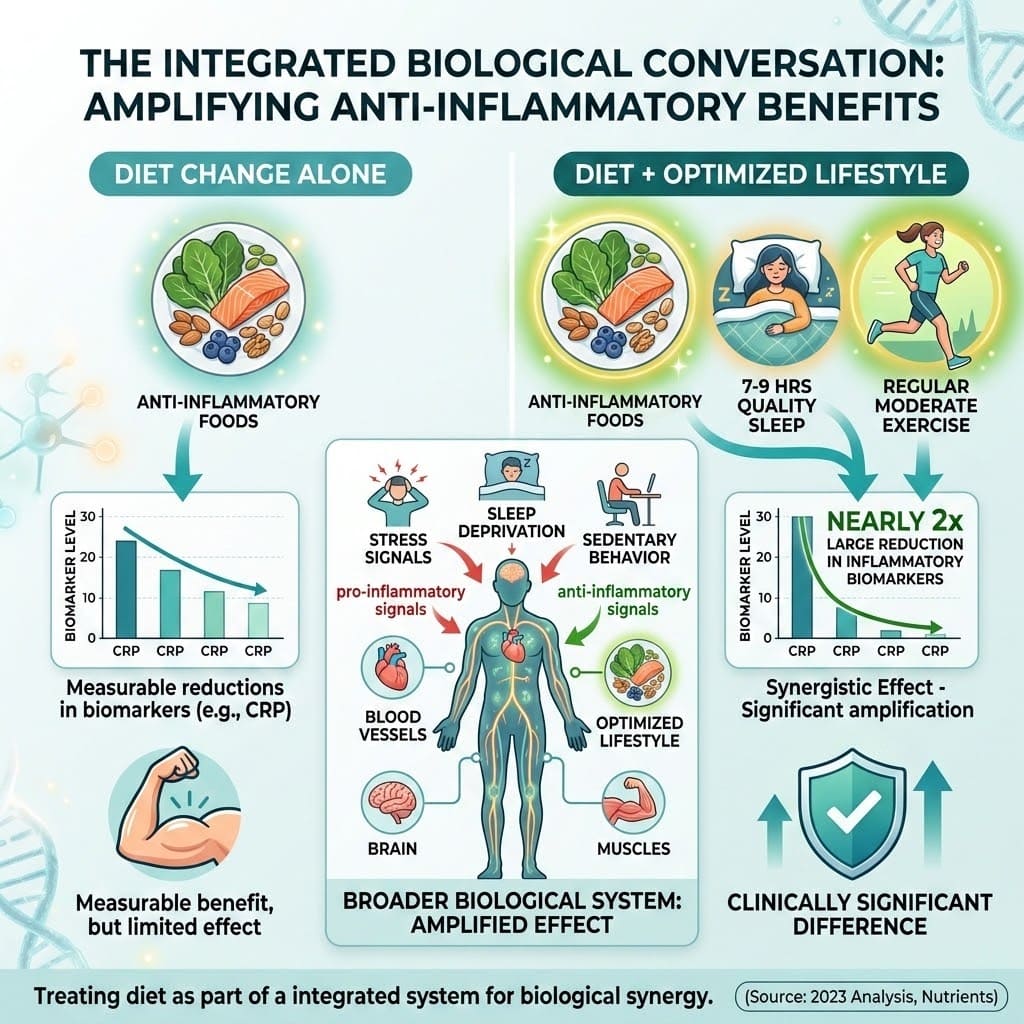
Stress, sleep deprivation, and sedentary behavior are also potent pro-inflammatory signals. Cortisol dysregulation from poor sleep activates the same inflammatory pathways as a poor diet. So does the absence of regular movement.
This is not a reason to abandon the dietary focus. It is a reason to treat it as part of a broader biological system. The research consistently shows that anti-inflammatory dietary changes provide measurable benefit even in the absence of other lifestyle improvements. But the effect is amplified significantly when diet is accompanied by seven to nine hours of quality sleep and regular moderate exercise. These things are not separate levers. They are part of the same biological conversation.
A 2023 analysis published in the journal Nutrients confirmed that individuals who combined anti-inflammatory dietary patterns with adequate sleep showed inflammatory biomarker reductions nearly twice as large as those who changed diet alone. That is a clinically significant difference.
What nobody tells you about starting
The transition away from highly processed food is not just a nutritional shift. It is a sensory and habitual one. Ultra-processed foods are engineered to be hyperpalatable, activating reward pathways in ways that whole foods, at least initially, do not replicate.
That recalibration takes time. Most people who successfully transition to anti-inflammatory eating report that the desire for ultra-processed food diminishes noticeably after three to four weeks. The gut microbiome shift is part of the reason. Gut bacteria that thrive on fiber and polyphenols produce metabolites that influence food preference and satiety signaling. You are not just changing what you eat. You are gradually changing what your body asks for.
Starting with addition rather than elimination is often more successful. Aim to eat fatty fish twice a week. A daily handful of walnuts is another simple addition worth making. One green vegetable per meal that previously had none rounds out the plan. These are not dramatic changes. Over six to twelve months, they accumulate into a genuinely different dietary pattern, and a measurably different inflammatory profile.
The science here is not abstract. It is some of the most actionable evidence in modern nutritional medicine. The question worth sitting with is: which one small addition could you make today, and whether that’s where a meaningful shift might quietly begin.