





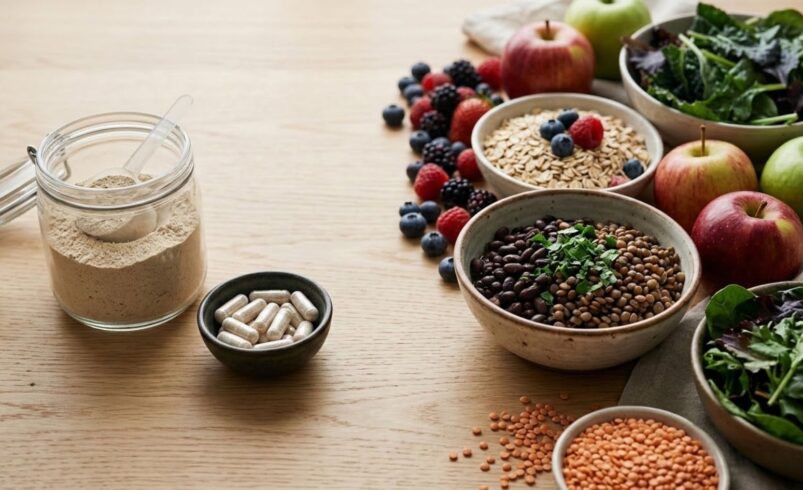

There is a scoop of fiber powder sitting in a jar on my counter right now, and a bowl of black beans in my fridge, and the honest truth is that they are not competing for the same job. That is the part the supplement industry would prefer you not think about too hard. Walk into any store in 2026 and you will find an entire wall of fiber powders, gummies, and capsules promising to fix your gut, flatten your blood sugar, and shrink your waistline. Some of it is genuinely useful. A lot of it is convenience sold at a markup. Sorting the two apart is the whole point of this piece. For the wider story on why most Americans fall so short on fiber to begin with, that context sets the table. Now let us settle the powder-versus-plate debate honestly.
What a supplement actually gives you
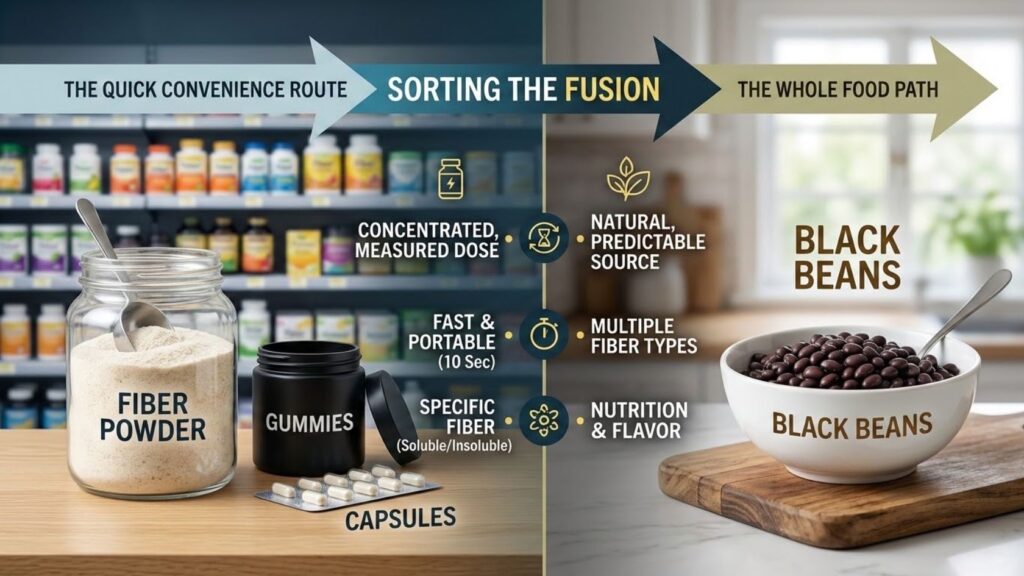
Let us be fair to the powders first, because they are not villains. A fiber supplement does one thing extremely well: it delivers a concentrated, predictable dose of a specific fiber, fast. If you know you need more soluble fiber for cholesterol or regularity, a measured scoop of psyllium is reliable, portable, and takes ten seconds. No cooking, no shopping, no chopping.
For certain people, that convenience is not a luxury. It is the difference between hitting a fiber goal and missing it entirely. Busy parents, frequent travelers, folks recovering from illness, anyone whose life makes a vegetable-heavy plate genuinely hard to pull off day after day. In those cases, a supplement is not cheating. It is a smart bridge.
What a supplement quietly leaves out
Here is where the marketing gets quiet. A fiber powder gives you fiber. A whole food gives you fiber plus a few hundred things a lab cannot bottle.
When you eat an apple, a cup of lentils, or a bowl of oats, the fiber arrives wrapped in vitamins, minerals, antioxidants, polyphenols, and a diversity of fiber types that a single-ingredient scoop cannot match. Your gut microbiome thrives on that variety. Feeding it one isolated fiber over and over is a bit like going to the gym and only ever training one muscle. It works, technically, but you are leaving most of the benefit on the table.
There is also the matter of how differently your body treats these two forms. A whole food makes you chew, slows you down, fills you up, and delivers its fiber alongside water and structure. A powder stirred into juice skips most of that. Same fiber on the label, meaningfully different experience in your body.
The honest head-to-head
Rather than crown a single winner, it helps to see where each one actually shines.
| Factor | Fiber supplement | Whole foods |
| Convenience | Excellent, fast and portable | Requires shopping and prep |
| Nutrient variety | One isolated fiber | Fiber plus vitamins, polyphenols, more |
| Satiety and fullness | Modest | Strong, thanks to chewing and volume |
| Cost over time | Adds up quickly | Beans and oats are pennies per serving |
| Microbiome diversity | Limited | Broad and varied |
| Best use case | Filling a specific gap | Building the everyday foundation |
Read that table and the verdict writes itself. This was never a real cage match. Whole foods are the foundation. Supplements are the patch for the gaps whole foods cannot cover in your particular life.
The trap of the “fiber-fortified” everything
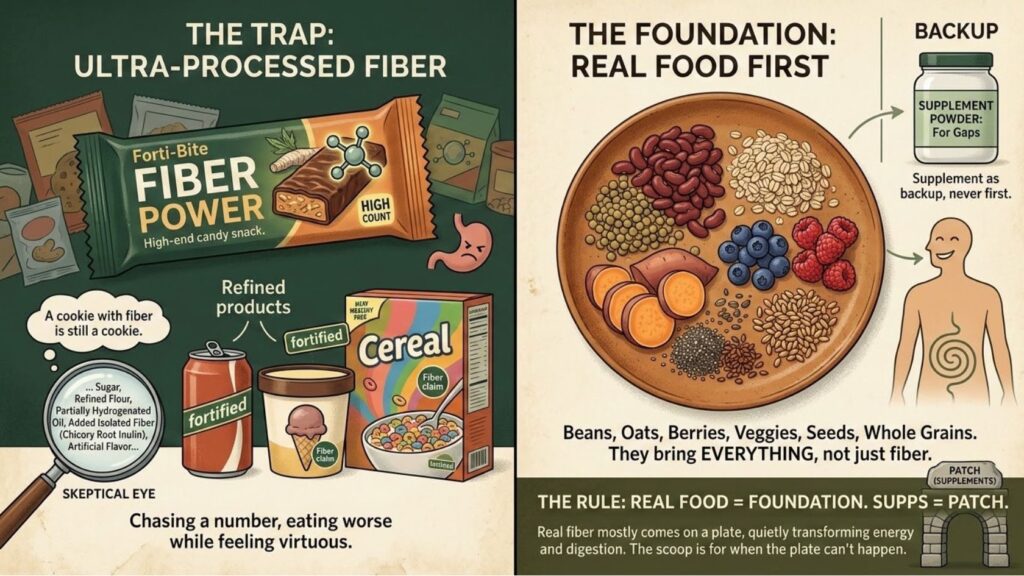
One 2026 trend deserves a skeptical eyebrow. Fiber is now being added to everything: sodas, snack bars, ice cream, breakfast cereals waving big fiber numbers on the front of the box. Marketers figured out that “high fiber” sells, so they started bolting isolated fibers like chicory root inulin onto ultra-processed junk.
Be careful here. A fiber-fortified cookie is still a cookie. The added fiber does not neutralize the sugar, the refined flour, or the general processing. As one food scientist told me when I was reporting on label claims, “Adding inulin to a candy bar does not make it health food. It makes it a candy bar with a better marketing budget.” That line is worth taping to your pantry door. Chasing the fiber number on a package is a great way to eat worse while feeling virtuous.
So what should you actually do?
Build your fiber on real food first. Beans, lentils, oats, berries, vegetables, seeds, and whole grains should carry the load, because they bring everything, not just the fiber. Then, if you still fall short, or if you have a specific goal like taming cholesterol or smoothing out regularity, layer a targeted supplement on top. Foundation first, patch second. Never patch first.
And whichever route you lean on, ramp up slowly and drink plenty of water, because your gut needs time to adjust either way. If you want the full method for building the habit without the bloating, easing into more fiber the smart way walks through it step by step. If a sensitive stomach is your real hurdle, the gentler options in FODMAP-friendly fiber choices matter even more than the powder-versus-plate question.
The supplement aisle is not the enemy, and neither is the produce section. The mistake is letting a jar of powder convince you that you have outsourced a job that food was always meant to do. Real fiber, the kind that quietly transforms your energy and digestion over months, mostly comes on a plate, not in a scoop. The powder is there for the days the plate cannot happen, which is a fine and useful thing, as long as you never confuse the backup for the main event. So let me ask you this: when you reach for that scoop, is it filling a genuine gap in your day, or is it quietly letting the easy option replace the better one?