








The word showed up on my feed sometime last year, half meme and half movement: fibermaxxing. The idea is simple enough to fit on a sticky note. Eat as much fiber as humanly possible, feed your gut, fix everything. And honestly, the instinct is not wrong. After decades of America treating fiber as an afterthought, watching people get genuinely excited about lentils and psyllium is a strange kind of progress. But here is what the trend videos rarely show you: the guy doubling his fiber overnight and then spending the next two days doubled over, bloated and miserable and wondering what went wrong. For the full picture on why so many Americans were deficient in the first place, that backdrop explains the hunger for this trend. This piece is about doing it without the wreckage.
More is not automatically better
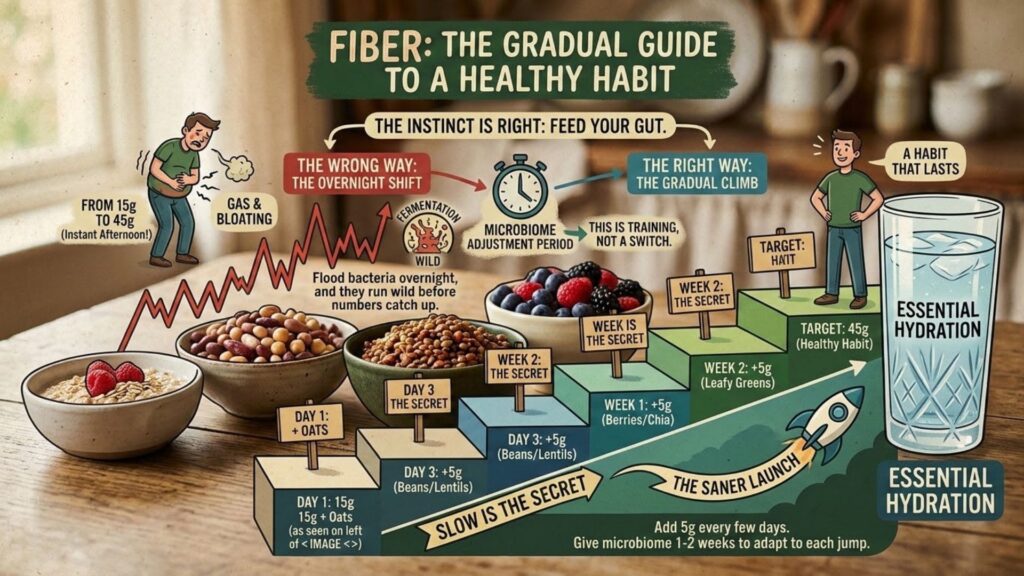
Let us start with the mistake at the center of almost every fiber horror story. People treat fiber like a switch they can flip, going from 15 grams a day to 45 in a single enthusiastic afternoon. Your gut does not work that way.
Fiber feeds bacteria, and those bacteria are a living population that grows to match its food supply. Flood them overnight and the fermentation runs wild before their numbers can catch up. The result is gas, cramping, and bloating that turns a healthy habit into a punishment. The fiber was never the problem. The speed was.
Slow is the whole secret
If there is one rule to tattoo onto this entire topic, it is this: add fiber gradually and let your gut catch up. Think of it like training for a race. You do not run a marathon on day one. You build mileage week by week, and your body adapts to each new level before you push higher.
A sane approach looks boring on paper, which is exactly why it works. Add roughly 5 grams of fiber every few days, hold there until things feel normal, then climb again. Give your microbiome one or two weeks to adjust to each jump. It is not glamorous, and it will never go viral, but it is the difference between a habit that lasts and a one-week experiment you abandon in frustration.
Water is the silent partner
Here is the step almost everyone skips, and it wrecks more fibermaxxing attempts than any other. Fiber needs water to work. Soluble fiber especially absorbs liquid to form the gel that does all the good stuff, and if the water is not there, that same fiber turns into a dry, cement-like problem moving slowly through your system.
The irony is brutal. People add fiber to fix constipation, forget to add water, and make themselves more clogged than before. Then they blame the fiber and quit. So drink more than you think you need, particularly on days you are leaning on psyllium or chia. Water is not optional here. It is half the mechanism.
A simple ramp-up timeline
Everyone wants a plan they can actually follow, so here is a gentle framework. Adjust the numbers to your own starting point and comfort.
| Phase | Timeframe | What to do |
| Baseline | Week 1 | Track current intake honestly, no changes yet |
| First bump | Weeks 2 to 3 | Add ~5g daily, mostly from whole foods, up your water |
| Steady climb | Weeks 4 to 6 | Add another 5g, introduce one new fiber source at a time |
| Fine-tune | Week 7 onward | Reach your target range, notice which foods you tolerate best |
Notice how unhurried that is. Six-plus weeks to build a habit that most people try to slam into place in a weekend. The slow version is the one that sticks.
Listen to the signals, not the trend
Your body will tell you how it is handling the ramp, if you pay attention. A little more gas early on is normal as your bacteria shift. Persistent pain, severe bloating, or worsening constipation is not, and it means back off and slow down. This is where the whole thing gets personal, because fiber tolerance is genuinely individual. What sails through my gut might not sit well in yours.
If you have a sensitive stomach or a diagnosed condition like IBS, the ordinary rules bend, and the source of your fiber starts to matter as much as the amount. The gentler, better-tolerated options in FODMAP-friendly fiber choices are the smarter place to start than a giant scoop of raw inulin. And if you are curious about which specific fibers behave which way, the breakdown of inulin, acacia, and psyllium explains why some feel gentle while others hit like a freight train.

The payoff is worth the patience
Here is what makes the slow road worth it. When you ramp fiber the right way, the benefits arrive without the drama. Steadier digestion. Calmer energy. Fewer cravings. A gut microbiome that actually flourishes instead of throwing a tantrum. Rush it, and you get none of that, just discomfort and a story about how “fiber does not agree with you,” which is almost never true.
As one gastroenterologist I interviewed framed it, “The people who succeed with fiber are almost never the most aggressive. They are the most patient. The gut rewards consistency, not intensity.” That, in one sentence, is the whole philosophy.
Fibermaxxing is not wrong. The enthusiasm is great, the goal is sound, and getting Americans excited about feeding their gut is genuinely good news. The only thing worth fixing is the pace. Treat fiber like a habit you are building rather than a challenge you are conquering, and your body will meet you halfway instead of fighting you the whole way. The tortoise really does win this one. So before you dump that giant scoop into tomorrow’s smoothie, ask yourself the question most people skip: are you trying to feed your gut, or just impress an algorithm?