






There is something almost absurd about the image. A person wrapping their hands around a warm mug, breathing in the steam, seeking a quiet moment at the start of the day. Indeed, somewhere in that ritual, invisible to the naked eye, billions of plastic fragments are being released directly into the drink they believe is healing them.
This is not speculation. Furthermore, This is peer-reviewed science from one of Canada’s most prestigious engineering departments.
The study that changed how we see teabags
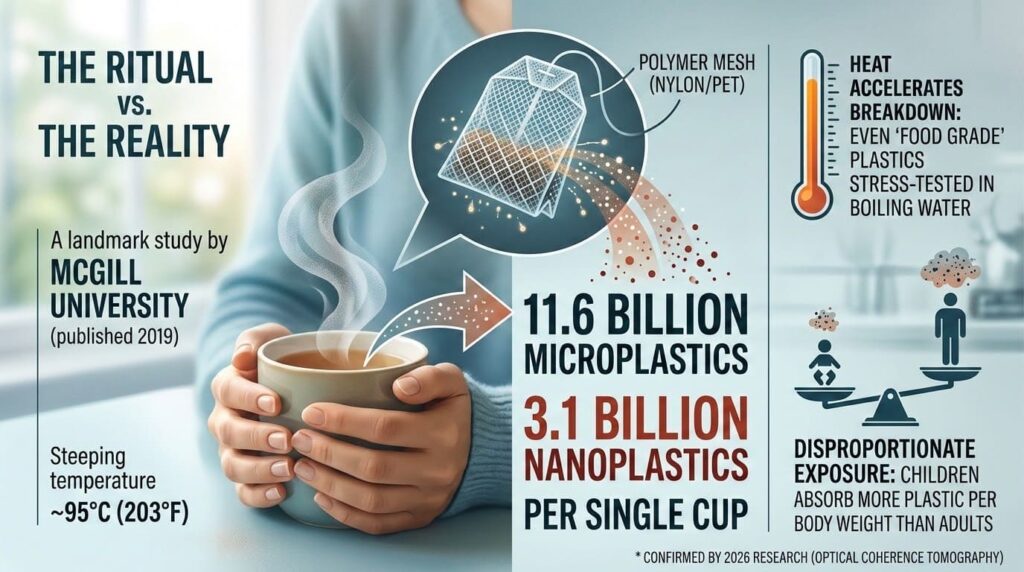
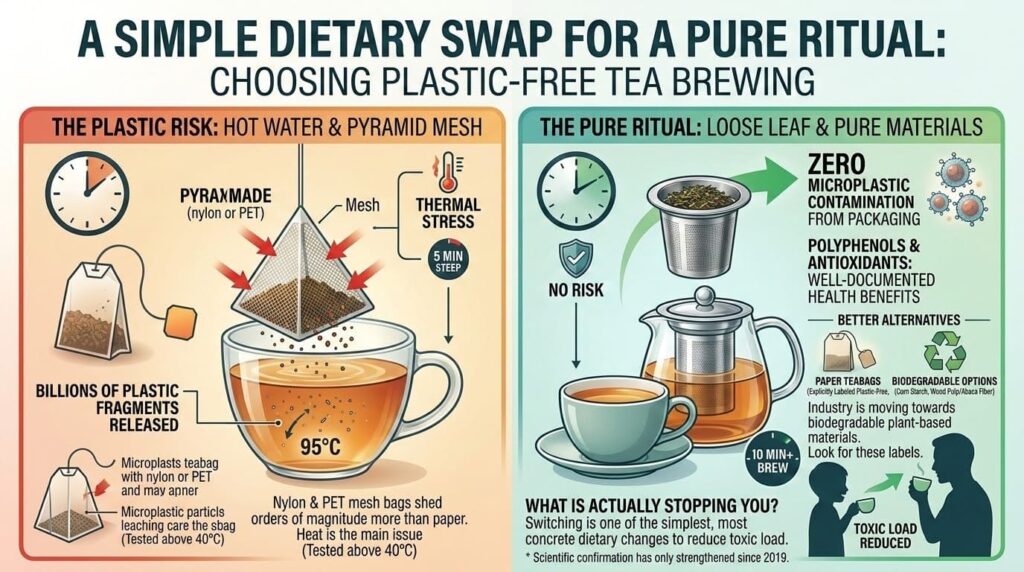
In 2019, researchers at McGill University published a landmark study in the journal Environmental Science & Technology that quietly upended the wellness world. Steeping a single plastic teabag at brewing temperature releases approximately 11.6 billion microplastics and 3.1 billion nanoplastics into a single cup of the beverage.
Read that number again. Not millions. Billions. Per cup.
The team, led by chemical engineer Nathalie Tufenkji, used advanced spectrometry tools. They confirmed that the particles were made of nylon and polyethylene terephthalate (PET). These are two of the most common food-contact plastics on the market. The plastic levels released from teabag packaging are several orders of magnitude higher than those previously reported in other foods.
That last point deserves attention. Additionally, We already knew plastic was creeping into the food supply. What no one had fully quantified until this study was how aggressively it leaches out the moment heat is applied. And heat, of course, is precisely what makes tea, tea.
Why temperature is the real problem?
Even “food grade” plastics can begin to break down and release particles when heated above 40°C (104°F), a temperature far below that of a freshly brewed cup of tea. Moreover, This is the detail that gets lost in conversations about plastic safety. The FDA approval of a material for food contact is typically tested under ambient or refrigerated conditions. Brewing tea is a completely different physical scenario. You are essentially stress-testing a polymer mesh in boiling water, repeatedly, every single day.
A 2026 study published in Environmental Science: Processes and Impacts confirmed these concerns using optical coherence tomography, finding that nylon teabags steeped in hot water for five minutes released between 16,000 and 24,000 microplastic particles per milliliter. The same research highlighted a troubling demographic dimension: the estimated daily intake of microplastics indicates a higher exposure for children compared to adults, ranging from 0.201 to 0.349 mm³ per kilogram of body weight per day in children versus 0.046 to 0.080 mm³ in adults.
Children, because of their body weight ratio, are absorbing more plastic per kilogram than adults. In fact, That is not a minor footnote. That is a public health signal.
The elegant teabag trap
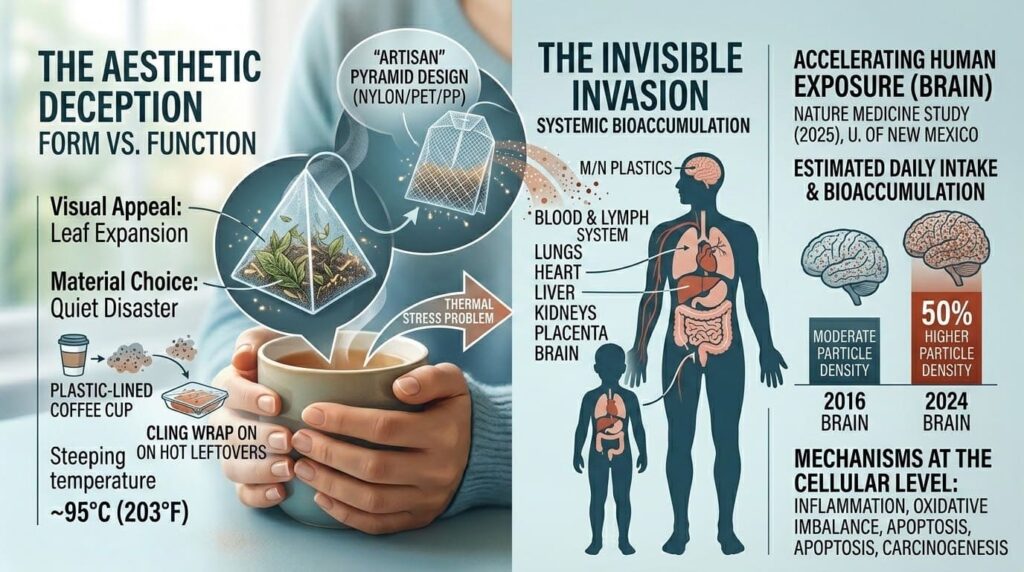
Here is what makes this story genuinely interesting from an industry perspective. Similarly, The shift toward plastic teabags was itself marketed, at least in part, as a premium upgrade. Pyramid-shaped bags made of nylon mesh became the hallmark of “artisan” and “luxury” tea brands, allowing the leaves to expand fully. The visual appeal was real. The brewing logic was sound. The material choice was a quiet disaster.
Furthermore, Traditionally, teabags were made from paper, but synthetic fibres like nylon, PET, and polypropylene are now commonly used, especially in silk or pyramid-shaped teabags.
This is a pattern we see across the food and wellness industry. An aesthetic or functional upgrade can carry a hidden environmental and biological cost that only reveals itself years later. Still, Plastic-lined coffee cups, cling wrap on hot leftovers, heat-sealed protein bar packaging. The thermal stress problem is everywhere, and we are only beginning to measure it systematically.
Where does the plastic actually go?
Until recently, the honest answer was: we are not sure. Therefore, That is no longer an acceptable answer. Microplastics have been found circulating in blood and lymph, embedded in vital organs such as the lungs, heart, liver, and kidneys. They have even been found in compartments once thought nearly impermeable, including the placenta and the brain.
A study published in Nature Medicine in early 2025 brought this home in a visceral way. Researchers at the University of New Mexico measured microplastics in the brains, livers, and kidneys of people who died in 2016 or 2024, finding that plastic concentrations in the brain were higher than those found in the kidney or liver. More alarming still: microplastic levels in the brains of people who died in 2024 were about 50 percent higher than in those who died in 2016.
That upward curve is not random. For example, It mirrors the acceleration of global plastic production. We are bioaccumulating our industrial choices.
Once inside the human body, microplastics and nanoplastics can interact with macromolecules and damage intracellular structures, resulting in several physiopathological conditions including inflammation, oxidative imbalance, apoptosis, and carcinogenesis. As a result, The mechanisms are increasingly understood at the cellular level. What remains murkier is the long-term clinical outcome, but the biological logic is not reassuring.
What you can actually do
I will be direct here: switching your teabag is one of the simplest, most concrete dietary swaps you can make right now. The evidence is not ambiguous on the source of the exposure, even if the downstream health outcomes are still being studied.
Loose leaf tea brewed in a stainless steel, ceramic, or glass infuser carries no risk of microplastic contamination from packaging. Indeed, Paper teabags are not risk-free, but they shed far fewer particles than their nylon or PET counterparts. If you prefer the convenience of bags, look for options explicitly labeled as plastic-free, sealed without synthetic adhesives.
The industry is responding, albeit unevenly. Furthermore, Some manufacturers have moved toward biodegradable materials: corn starch pyramids and bags made from wood pulp and abaca, a natural plant fiber. These options exist. They are just not always marketed as aggressively as the shiny mesh pyramid bags that line the shelves at upscale grocery stores.
A ritual worth protecting
Tea is one of the oldest health practices in human history. Additionally, Its polyphenols, antioxidants, and anti-inflammatory compounds are genuinely well-documented. I am not suggesting anyone abandon their morning cup. I am suggesting that the vessel matters as much as the leaves inside it.
The McGill study was published in 2019. It is now 2026. The science has only strengthened since then. New confirmation comes from multiple labs, new methodologies, and new findings about where these particles actually end up inside the human body. What has not kept pace is the regulatory response and, frankly, the public awareness.
We spend considerable energy debating supplements, food dyes, seed oils, and ultra-processed ingredients. Moreover, The plastic leaching silently from a teabag into 95°C water, every morning, deserves at least the same conversation.
Additionally, If we are serious about reducing our toxic load, we have to be willing to interrogate even the rituals that feel the most wholesome.
So here is the question worth sitting with: if switching to loose leaf tea is the most consistent dietary change you could make today, what is actually stopping you?