








Nobody talks about zinc the way they talk about tongkat ali. There is no podcast episode titled “The Zinc Revolution.” No fitness influencer built a following on it. It is unglamorous, inexpensive, and so fundamental to human biology that it gets taken for granted, which is exactly why so many men are quietly deficient in it while spending serious money on herbal supplements that cannot compensate for a gap this basic.
Here is the thing about zinc that stopped me cold when I first dug into the research. A zinc-deficient man cannot produce optimal testosterone regardless of what else he does. Not with ashwagandha. Tongkat ali will not compensate either. Even a perfect sleep schedule changes nothing. The biochemistry simply does not cooperate when this mineral is missing. Zinc sits directly inside the testosterone production pathway, not adjacent to it.
If you have been exploring what actually moves the needle on hormonal health, the complete picture of natural testosterone support starts with foundations like this one before it reaches anything more exotic.
Why zinc is not optional for male hormones?
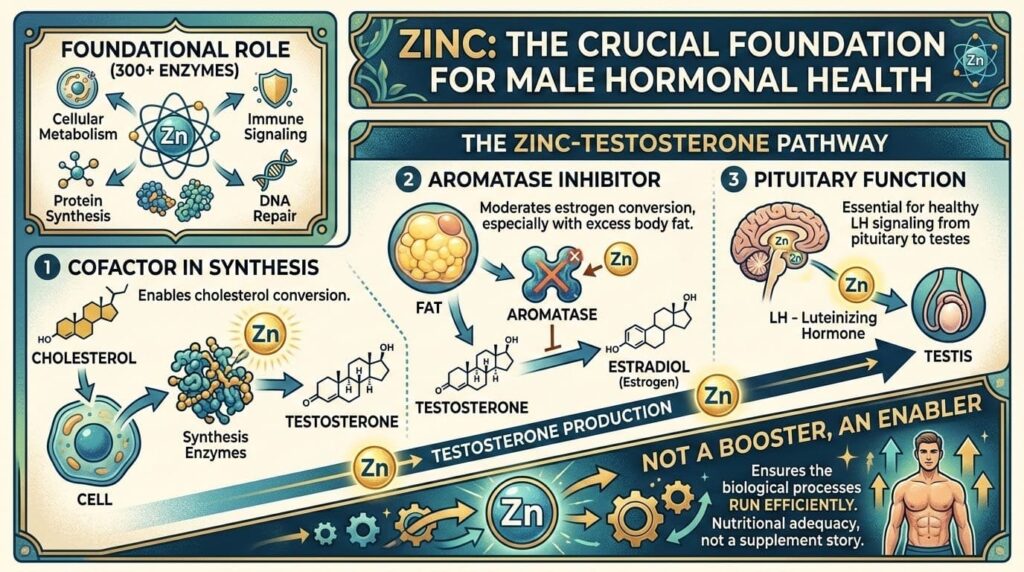
Zinc is involved in more than 300 enzymatic reactions in the human body. That number is not rhetorical. It reflects how genuinely foundational this mineral is to cellular metabolism, immune signaling, protein synthesis, and DNA repair. In the context of testosterone specifically, zinc plays several distinct roles.
First, it acts as a cofactor in the enzymatic conversion of cholesterol into steroid hormones. Testosterone is a steroid hormone. That conversion process requires zinc to function properly. A deficient system is a constrained one.
Second, zinc appears to inhibit aromatase, the enzyme responsible for converting testosterone into estradiol, a form of estrogen. Elevated aromatase activity is one of the less-discussed reasons why some men, particularly those carrying excess body fat, maintain lower testosterone levels. Adipose tissue is rich in aromatase. Zinc helps moderate that conversion.
Third, zinc is required for the healthy function of the pituitary gland, which produces luteinizing hormone (LH). LH is the signal that tells the testes to synthesize testosterone in the first place. Disruptions upstream affect everything downstream.
The net picture is not a supplement story. It is a nutritional adequacy story. Zinc is not boosting testosterone from the outside. It is enabling a process that cannot run efficiently without it.
The Wayne State study that changed how i think about this
The research that put zinc and testosterone on the map for most nutrition scientists was a study conducted at Wayne State University in the 1990s. Researchers induced zinc deficiency in a group of healthy young men by restricting dietary zinc intake, then tracked what happened to their testosterone levels over a period of twenty weeks. The decline was substantial, roughly 75% from baseline.
They then took a group of marginally zinc-deficient elderly men and supplemented them with zinc for six months. Testosterone levels nearly doubled.
That is not a small effect. That is a dramatic hormonal response to correcting a nutritional deficiency that should not have been there in the first place. The study, published in the journal Nutrition, remains one of the most cited pieces of evidence linking micronutrient status to male hormonal health, and for good reason. It did not test whether zinc could boost testosterone in replete men. It showed what happens when zinc is missing, and what happens when that absence is corrected.
That distinction matters enormously. Zinc is not a testosterone booster in the conventional supplement sense. It is a deficiency corrector. For men who are already zinc-sufficient, additional supplementation is unlikely to produce dramatic hormonal changes. For men who are not, the effect can be significant.
Who is actually at risk of zinc deficiency
This is where the conversation gets practical, and where a lot of men get surprised.
Zinc deficiency in the United States is not rare. It is not a problem confined to developing countries or extreme dietary restriction. It is quietly common among specific populations that overlap substantially with men interested in performance and hormonal health.
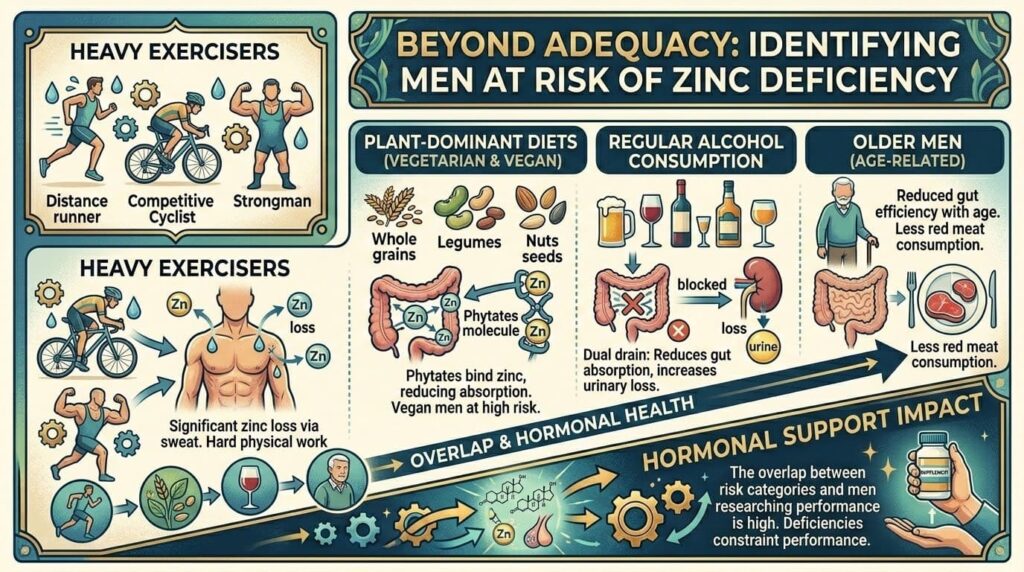
Men who exercise heavily and sweat regularly lose meaningful amounts of zinc through sweat. Distance runners, competitive cyclists, high-volume strength trainers, and anyone doing hard physical work in heat are burning through zinc faster than a sedentary person with the same diet. Many are not compensating for that loss through food intake alone.
Men following plant-dominant or vegetarian diets face a structural absorption problem. Whole grains, legumes, nuts, and seeds contain phytates, compounds that bind zinc in the digestive tract and significantly reduce how much actually reaches circulation. A vegetarian eating adequate zinc on paper may be absorbing considerably less than that number suggests. Vegan men are at particularly elevated risk.
Men who drink alcohol regularly face a two-sided problem. Alcohol reduces zinc absorption from food and increases urinary zinc excretion. The combination creates a drain that casual drinking can sustain over months and years without obvious symptoms.
Older men absorb zinc less efficiently as a function of age-related changes in gut function, and many older adults eat less red meat, historically a primary zinc source in the American diet.
The overlap between these categories and the men most actively researching testosterone support is not coincidental. It suggests that a meaningful percentage of men shopping for hormonal supplements are doing so on top of an unaddressed deficiency.
Reading the symptoms (and the limits of that approach)
Zinc deficiency is notoriously difficult to self-diagnose. Symptoms include reduced immune function, slow wound healing, hair thinning, loss of appetite, and reduced sense of taste or smell. None of those are specific to zinc. All of them overlap with other conditions.
Fatigue and low libido are sometimes attributed anecdotally to zinc deficiency, but these are such common complaints with so many potential causes that they cannot reliably point to any single nutritional gap.
The honest answer is that symptoms are not a reliable diagnostic tool for zinc status. Serum zinc testing through a standard blood panel is imperfect but useful as a starting point. A healthcare provider familiar with micronutrient assessment can help interpret results in context. The key word there is “in context,” because zinc is tightly regulated in blood even when tissue stores are low, meaning a normal serum result does not always rule out functional deficiency.
Dietary sources worth prioritizing
| Food Source | Zinc Content (per 100g) | Notes |
| Oysters | 78 mg | By far the richest dietary source |
| Beef (chuck roast) | 8.4 mg | Highly bioavailable animal source |
| Pumpkin seeds | 7.8 mg | Good plant source, moderate phytate content |
| Chicken (dark meat) | 2.5 mg | Lower but still a consistent contributor |
| Fortified cereals | 2–15 mg | Variable; check label for form and amount |
| Lentils (cooked) | 1.3 mg | Phytate content reduces absorption significantly |
Oysters are in a category of their own. A single serving delivers more zinc than most people get in several days from combined sources. They are also genuinely delicious, which makes this one of the more enjoyable nutritional recommendations in this space.
For men who eat animal protein regularly, zinc adequacy is more achievable through diet alone. For those who do not, consistent attention to food pairing and supplementation is often necessary.
Supplementation: what works and what to watch
When dietary sources are insufficient, zinc supplementation is straightforward and well-tolerated by most people. The more meaningful question is which form to choose.
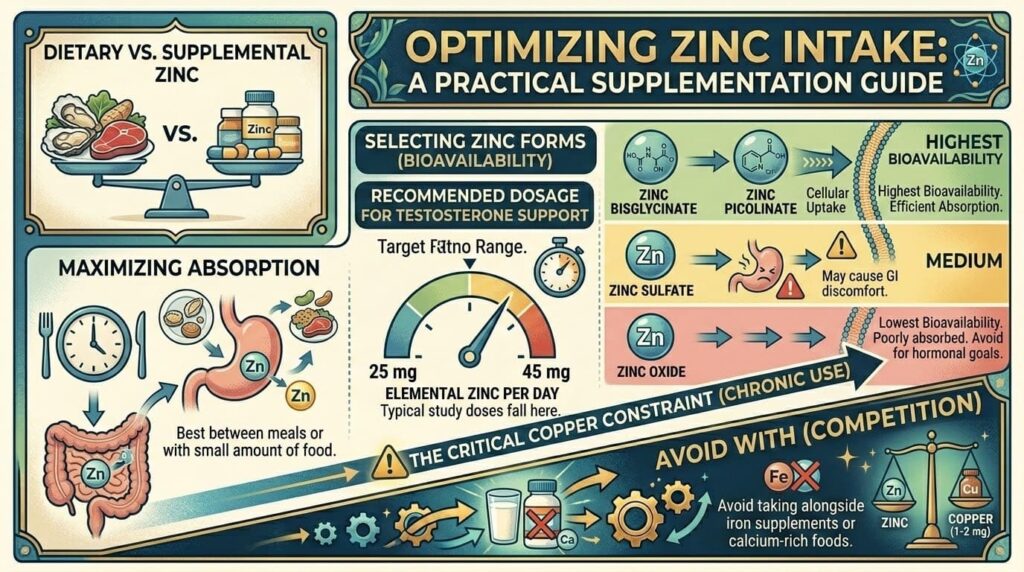
Zinc bisglycinate and zinc picolinate are among the most bioavailable forms. A higher percentage of the elemental zinc in these actually gets absorbed. Found in cheaper supplements and multivitamins, zinc oxide is poorly absorbed. Avoid it when hormonal support is the goal. The sulfate form sits in the middle of the bioavailability range. It can cause gastrointestinal discomfort in some people, particularly on an empty stomach.
Doses studied in relation to testosterone support typically fall between 25 and 45 mg of elemental zinc per day. One critical constraint: chronic zinc intake above 40 to 50 mg per day consistently depletes copper, another essential mineral with its own important roles in metabolism and neurological function. Long-term zinc supplementation without attention to copper balance can create a secondary deficiency that brings its own set of problems. Taking a separate copper supplement at 1 to 2 mg daily, or choosing a zinc-copper combined formula, addresses this.
Zinc is best absorbed between meals or with a small amount of food. Avoid taking it alongside iron supplements or calcium-rich foods, which compete for absorption at the intestinal level.
Where zinc fits in a broader hormonal strategy
Zinc does not operate in isolation, and no single nutrient does. Its role in the testosterone pathway connects it to other nutritional and lifestyle factors in ways that make a comprehensive approach more effective than any targeted intervention alone.
Vitamin D, for instance, also influences Leydig cell function and testosterone synthesis through its own receptor-mediated pathway. The two are not redundant. They address different parts of the same system, and deficiency in either one creates a separate constraint. Sleep quality, meanwhile, governs the hormonal environment that both nutrients operate within. A man who is zinc-replete but chronically sleep-deprived is still suppressing the nocturnal testosterone secretion that constitutes the majority of his daily hormonal output.
Understanding how sleep directly governs testosterone production adds a dimension to this picture that no supplement, however well-chosen, can fully replace. The nutrients enable the system. The lifestyle factors determine whether that system is allowed to run.
Zinc is not the whole answer. But for a meaningful number of men, it is the missing piece that makes the rest of the strategy actually work.
The question worth sitting with: if deficiency in a single common mineral can reduce testosterone by 75%, how many men are currently trying to optimize their hormonal health without ever checking whether that baseline is covered?