




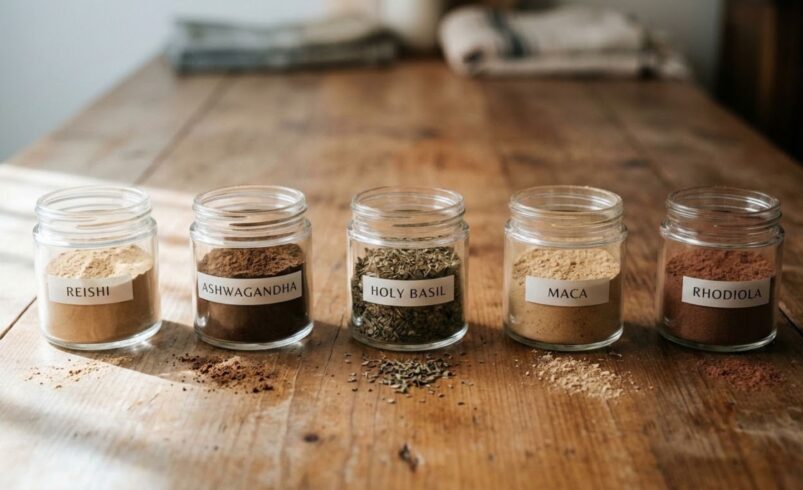

More is better. That instinct has wrecked more supplement routines than any single bad ingredient ever could. You find one adaptogen that works, you feel a little sharper or calmer, and the logic writes itself: if one helped, five will transform me. I have watched people build elaborate morning rituals of six powders in a single smoothie and then wonder why they feel worse, not better. Stacking adaptogens is real strategy. It is also where enthusiasm quietly turns self-defeating.
Let me show you how to do it right, because when it works, it genuinely works. And when it does not, it is almost always for reasons you could have avoided.
Why Stacking Even Makes Sense
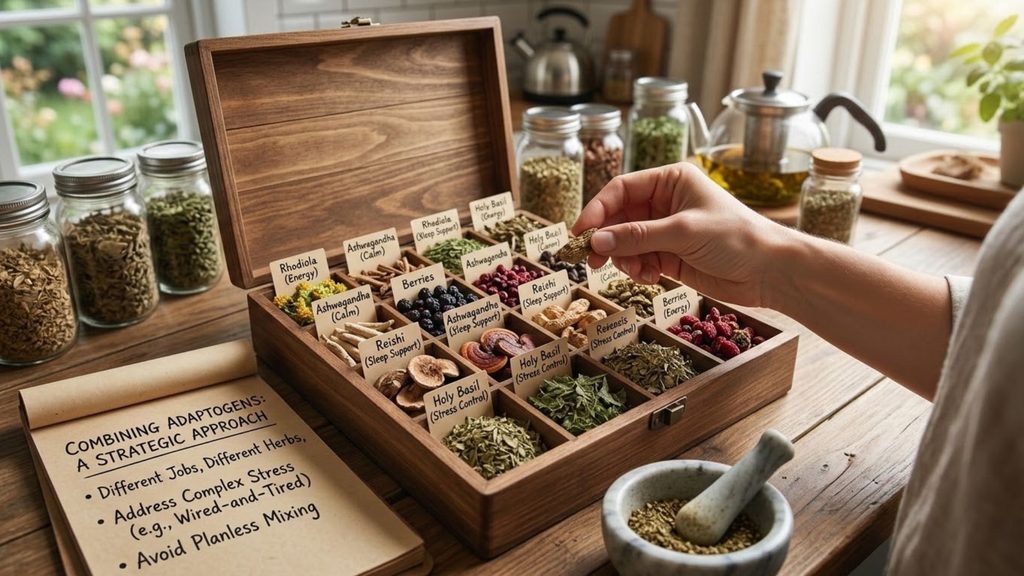
Start with the legitimate case, because there is one. Different adaptogens do different jobs. Some energize, some calm, some target sleep, some blunt cortisol. Stress is rarely one-dimensional, so it stands to reason that a thoughtful combination could cover more ground than a single herb.
That is true. A well-built stack can address the wired-and-tired paradox better than any solo act. The problems start when people stack without a plan, mixing herbs that pull in opposite directions or overloading the same pathway. If you are new to any of this, the wider logic behind natural support for chronic stress is the foundation this whole approach rests on. Stacking is the advanced move, not the starting point.
The One Rule That Saves You
If you remember nothing else, remember this. Add one adaptogen at a time.
I know it is slower. I know it is less exciting than assembling your dream stack in one heroic trip to the store. But it is the only way to actually learn what each herb does in your particular body. Introduce three at once and something helps, you will have no idea which one. Introduce three at once and something goes sideways, same problem in reverse.
The disciplined path looks boring on paper. Start one herb. Give it two to four weeks. Notice how you feel. Only then consider adding a second. This is the difference between running an experiment and just throwing ingredients at a wall.
Match the Herbs to the Time of Day
Here is where most stacks fall apart. Timing. Adaptogens are not interchangeable pills you swallow whenever. Some belong to the morning. Some belong to the night. Mix them up and you fight yourself.
The general principle is simple. Energizing adaptogens go early. Calming ones go late. Put a stimulating herb in your evening routine and you will be staring at the ceiling at midnight. Put a sedating one in your morning and you will be foggy by ten.
| Time of day | Goal | Fits well |
| Morning | Energy, resilience, focus | Rhodiola, KSM-66 ashwagandha |
| Midday | Steady, even keel | Holy basil |
| Evening | Wind down, sleep support | Reishi, Sensoril ashwagandha |
Notice ashwagandha appears twice, in two different forms. That is not a typo. The energizing and calming extracts belong at opposite ends of the day, which is exactly why knowing the difference between KSM-66 and Sensoril matters so much before you build any stack around ashwagandha. Get that wrong and your carefully planned routine works against itself.
The Combinations Worth Trying
Once you understand the day-and-night logic, a few reliable pairings emerge. These are the ones I have seen work most consistently, though your mileage will vary.
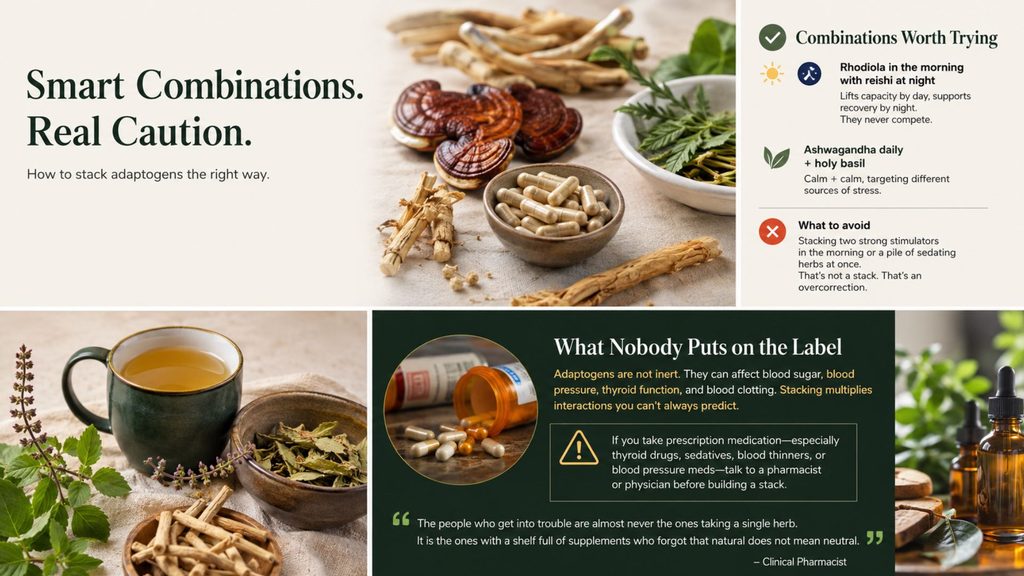
Rhodiola in the morning with reishi at night is a classic for the burned-out person who is both exhausted during the day and restless at bedtime. One lifts capacity, the other supports recovery. They never compete because they never share a time slot.
Ashwagandha as a daily base, in whichever extract suits your goal, layered with holy basil for the cortisol-heavy afternoons, is another dependable structure. Calm plus calm, but hitting slightly different targets.
What you generally do not want is two strong stimulating adaptogens stacked on the same morning, or a pile of sedating herbs all landing at once. That is not a stack. That is an overcorrection.
What Nobody Puts on the Label
Now the serious part, and I am not going to soften it. Adaptogens are not inert. They interact with medications and with real physiology, and stacking multiplies those interactions.
Several adaptogens can affect blood sugar, blood pressure, thyroid function, and blood clotting. Stack three of them and you are compounding effects you cannot easily predict. If you take any prescription medication, particularly thyroid drugs, sedatives, blood thinners, or anything for blood pressure, a conversation with a pharmacist or physician is not optional before building a stack. For a sober, no-hype reference on herb-drug interactions, the NIH National Center for Complementary and Integrative Health is the source I trust most.
As one clinical pharmacist told me last year, “The people who get into trouble are almost never the ones taking a single herb. It is the ones with a shelf full of supplements who forgot that natural does not mean neutral.” That line belongs on a sticky note above every supplement cabinet in America.
The Case for Cycling and Restraint
One more layer. Many practitioners suggest cycling adaptogens, taking periodic breaks rather than using them endlessly. The reasoning is partly to prevent your body from adapting to the point of diminishing returns, and partly just good sense. If you cannot occasionally stop a supplement without feeling like you fall apart, that dependence is worth examining.
Restraint, in other words, is part of the strategy. The most sophisticated stack is not the biggest one. It is the smallest one that gets the job done.
The truth about stacking adaptogens is that it rewards patience and punishes greed, which makes it a decent mirror for the stress it is meant to address. You cannot brute-force calm. You cannot rush resilience. The people who build stacks that actually work are the ones who move slowly, listen to their bodies, and resist the pull to keep adding. So before you assemble that ambitious six-herb morning ritual, ask yourself the honest question: are you building a stack because your body needs it, or because adding more just feels like doing something?