





Your body cannot tell the difference between a saber-toothed tiger and a Monday. That is the whole problem in one sentence. The stress response that kept our ancestors alive was built for short, sharp emergencies followed by long stretches of calm. What it was never designed for is the modern default: a low, constant hum of pressure that never fully switches off. Deadlines that bleed into evenings. Notifications that follow you to bed. A nervous system stuck in a state of mild alarm for years at a time.
By 2026, most of us have stopped pretending this is temporary. Chronic stress is not a personal failing or a phase you push through. It is the water we swim in, and our bodies are quietly paying the tab. That is why a category of herbs once tucked away in Ayurvedic texts and traditional Chinese medicine has moved to the center of the wellness conversation. Adaptogens. The plants that supposedly help your body cope with the very thing it was never built to handle.
I have spent years watching people reach for these herbs, some with genuine results, plenty with disappointment. The disappointment is almost never the herb’s fault. It is a matter of using the wrong one, at the wrong time, for the wrong kind of stress. So before you spend another dollar on a bottle promising calm, it is worth understanding what these plants actually do, who they help, and where the hype outruns the evidence.
What Adaptogens Actually Are, and Why 2026 Made Them Mainstream
Let me clear the air first, because the word gets thrown around so loosely it has almost lost meaning. An adaptogen is not a sedative. It is not a stimulant. It is not a magic calm pill you swallow to erase a bad day. The term describes a specific class of plants that appear to help your body adapt to stress by supporting the systems that manage it, rather than forcing your physiology in one direction.

The concept is not new, though the branding is. The word itself was coined by a Soviet scientist in the mid-twentieth century, studying plants that might help soldiers and workers withstand physical and mental strain. Long before that, though, traditional systems in India and China were using these same herbs for exactly this purpose. What changed recently is not the science so much as the demand. A burned-out, overstimulated culture went looking for answers, and an ancient category met a very modern ache.
Here is the mechanism in plain terms. When you face a stressor, your body activates a chain of responses often called the stress axis, releasing hormones like cortisol to help you meet the threat. In short bursts, that system is brilliant. The trouble comes when it never stands down. Adaptogens seem to help modulate that response, nudging an overactive system toward balance and supporting a depleted one toward recovery. They work with your biology, not against it.
A functional medicine physician I interviewed last spring put it better than I could. “People want adaptogens to be a switch,” she said. “They are closer to a thermostat. They do not force a temperature. They help the room find the right one.” That framing has stuck with me ever since, because it explains almost every failed experiment I have seen. People expect a jolt or a knockout. What they get is subtler, slower, and honestly more valuable once expectations are set correctly.
The other reason 2026 belongs to adaptogens is trust. After years of flashy nootropics and energy products that overpromised and crashed, a lot of people are tired of being sold acceleration. There is a growing appetite for support that does not come with a payback. That is the lane these herbs occupy, and it is a genuinely different pitch from the stimulant economy that dominated the last decade.
Why Not All Adaptogens Are Interchangeable
This is where most people go wrong, so pay attention. Adaptogens are not one thing. Lumping them together is like saying “medicine” as if aspirin and antibiotics were the same. Each herb has a personality, a direction it pulls, and a kind of stress it suits best.
Some are energizing. They lift you out of the flat, depleted exhaustion that chronic stress leaves behind. Others are calming, easing the wired, tense, cannot-switch-off feeling that keeps you staring at the ceiling. A few sit in the middle, gently regulating rather than pushing either way. Match the herb to your actual state and the results can be quietly impressive. Mismatch them and you will conclude, wrongly, that adaptogens do not work for you.
I learned this the expensive way. Years ago, stressed and exhausted, I grabbed a well-reviewed adaptogen without checking what it actually did, took it at night, and spent the next week more wired than ever. The herb was fine. My choice was terrible. It was energizing, and I was feeding it to an already-overactive nervous system right before bed.
A quick map helps more than any lecture.
| If your stress feels like… | You likely want… | General direction |
| Flat, foggy, running on empty | An energizing adaptogen | Restores capacity |
| Wired, tense, restless | A calming adaptogen | Settles the system |
| Cortisol-driven, physical tension | A regulating adaptogen | Rebalances the response |
| Poor sleep dragging down your days | A grounding, sleep-supporting adaptogen | Improves recovery |
Keep that table in mind as we go, because the rest of this comes down to matching. The person chasing energy needs a completely different herb from the person chasing calm, even though both are dealing with the same underlying enemy: stress that will not let up.
And that is the real starting point for using adaptogens well. Not “which one is best,” a question with no honest answer, but “which one is right for the specific way stress shows up in my body.” Get that question right and everything downstream gets easier.
Ashwagandha: The Most Popular Adaptogen, and the Most Misunderstood
If adaptogens have a headliner, it is ashwagandha. Walk into any store in 2026 and it dominates the shelf, stacked in more forms than you can count. It has the deepest well of human research behind it for stress, and for once the popularity is mostly earned. But here is the twist almost nobody explains at the point of sale. The single most popular adaptogen is also the one people most reliably buy wrong.
Ashwagandha comes from Withania somnifera, a plant used in Ayurvedic practice for thousands of years. Its reputation rests on a genuinely useful effect. Multiple randomized trials have linked it to meaningful reductions in perceived stress and cortisol, usually over an eight to twelve week window. That is a stronger evidence base than most herbs in this category can claim. When someone asks me where to start with adaptogens for stress, ashwagandha is often my first suggestion, precisely because the science is relatively solid.
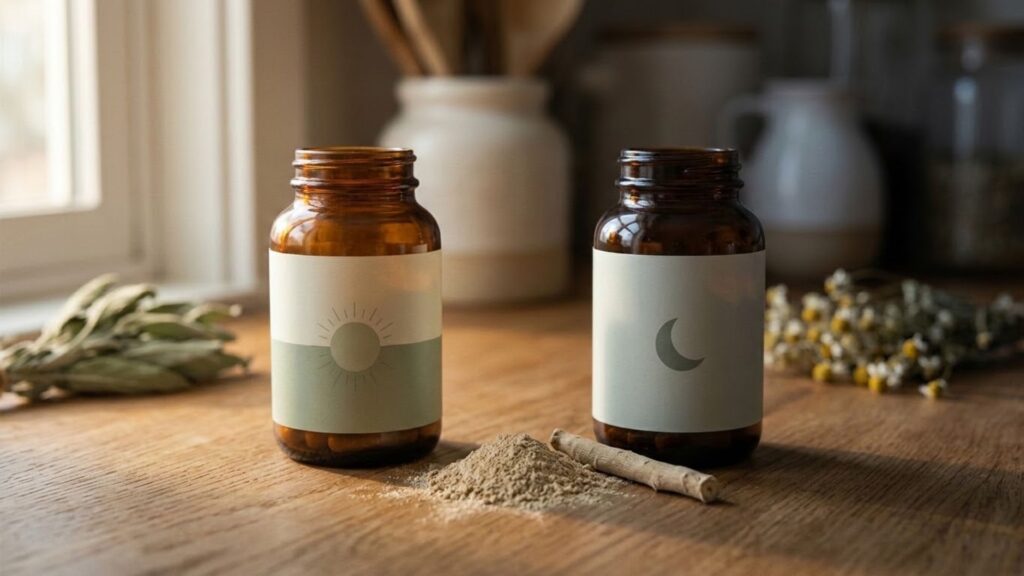
The problem is not whether ashwagandha works. It does. The problem is that there are two dominant extracts on the market, and they pull in opposite directions. KSM-66 uses only the root and leans energizing and grounding, while Sensoril concentrates a higher level of withanolides and leans calming, sometimes to the point of drowsiness. Buy the energizing extract when you wanted calm, take it at night, and you will swear it does not work. It works fine. You picked the version pulling in the wrong direction. Sorting out the difference between these two ashwagandha extracts before you buy is five minutes of reading that saves weeks of frustration.
A quick word on the label trap. Sensoril often lists around 10 percent withanolides, KSM-66 closer to 5 percent, and shoppers assume higher must mean better. It does not. A higher withanolide count is not a quality score, it is a personality trait, meaning a stronger pull toward sedation. Ignore the percentage and answer one question instead: do you want to feel calmer, or steadier?
Whichever extract you choose, respect the timeline. Ashwagandha is not a same-day fix. Give it eight to twelve weeks of consistent daily use before you judge it. This overlaps heavily with the burnout picture, so if your exhaustion runs deep, the energizing route pairs naturally with rhodiola for the burnout state as a daytime combination. Two cautions I will not skip: ashwagandha is not recommended in pregnancy, and it can interact with thyroid medication and sedatives. For a level-headed overview of the evidence and safety, the National Center for Complementary and Integrative Health is the reference I point people to constantly.
When Stress Wears Two Faces: Burnout and the Cortisol Trap

Chronic stress does not feel the same for everyone, and that single fact explains most failed adaptogen experiments. Some people are wired. Some are fried. Two very different states, two very different herbs. The moment you get specific about how stress actually shows up in your body, two plants step forward with real credentials. One for the depleted. One for the tense.
Start with burnout, because it fools people. Some tiredness responds to sleep. Burnout does not. It is the deep, structural exhaustion that lingers after months of relentless pressure, the kind where you sleep eight hours and still wake up depleted. Rhodiola rosea speaks directly to that state. Unlike a stimulant, which borrows energy from tomorrow and charges you a crash as interest, rhodiola appears to help your body use its own resources more efficiently under strain. People do not report feeling amped on it. They report feeling capable again.
The research holds up better than I expected. Trials on shift workers, students during exams, and exhausted professionals have shown reductions in fatigue and improvements in concentration. Timing matters though. Because rhodiola is mildly energizing, take it late in the day and you will be wired at bedtime. Morning is the sweet spot. And a firm caveat: rhodiola suits the flat, foggy version of stress, not the racing kind. That is exactly why understanding the full picture of rhodiola for burnout matters before you reach for it. For a sober summary of the evidence, the Mount Sinai health library keeps a clear, non-hyped overview.
Now the other face of stress. Your body treats a work deadline like a charging predator, flooding you with cortisol, the same alarm chemical that once helped your ancestors sprint from danger. The trouble is the predator used to leave. Your inbox never does. Let me correct the biggest myth of 2026 while I am here. Cortisol is not the villain. You need it to wake up, focus, and handle real pressure. The problem is cortisol that never comes back down, and it rarely announces itself as stress. It disguises itself as the wired-but-tired feeling at bedtime, the stubborn belly weight, the 3 p.m. sugar crash, the brain fog, the 3 a.m. wake-ups with a racing heart.
Holy basil, known as tulsi across South Asia and revered there for thousands of years, is the gentle answer to this specific pattern. It does not force cortisol down like a hammer. It nudges, supporting the body’s ability to return that hormone toward its normal daily rhythm. Research, though still building, has linked it to reductions in stress symptoms, better mood, and improved sleep in stressed adults. The person whose stress lives in the body, the tension and the cravings, is exactly who benefits most from holy basil for taming the stress hormone. As one Ayurvedic practitioner told me, “Tulsi is not a sledgehammer. It is a hand on your shoulder telling your body it is safe to stand down.”
The mistake I see over and over is people treating stress as one problem with one solution. It is not. The depleted person and the wired person are fighting different battles. Choose the herb that meets you where you actually are, not where a trending video told you to be.
Reishi and the Art of Combining Adaptogens Without Wrecking Them

Everyone chases focus with more stimulation. More caffeine, more inputs, more pushing. Then they wonder why they feel frazzled by noon. There is an older, stranger answer, and it grows on dead logs in the forest. Reishi, the mushroom that does not hand you energy so much as it hands back your composure. In a culture addicted to acceleration, that makes it quietly radical.
Reishi does not work like a nootropic. Where stimulants whip your nervous system into alertness, reishi settles it, and the focus arrives as a side effect of that calm. Known as lingzhi in China, it has been revered for over two thousand years, once reserved for emperors who called it the mushroom of immortality. The mechanism is more about regulation than stimulation, and the hidden lever is sleep. Poor sleep is the single biggest saboteur of concentration, so by supporting rest and helping the nervous system downshift, reishi improves focus through the back door. If your problem is overstimulation, the fuller case for reishi and calm focus explains where it shines and where it does not. For a measured overview, the Memorial Sloan Kettering integrative medicine database is one of the least breathless sources you will find.
Reishi is also the perfect herb to close on, because it teaches the lesson that governs this entire category. Adaptogens reward restraint, not greed. And nowhere does that matter more than when you start combining them. You find one herb that works, feel a little better, and the logic writes itself: if one helped, five will transform me. I have watched people build elaborate morning smoothies of six powders and then wonder why they feel worse, not better.
The single rule that prevents most of this: add one adaptogen at a time. Introduce three at once and something helps, you will have no idea which. Start one herb, give it two to four weeks, notice how you feel, then consider a second. Timing matters just as much. Energizing adaptogens belong to the morning, calming ones to the night. Mix them up and you fight yourself.
| Time of day | Goal | Fits well |
| Morning | Energy, resilience | Rhodiola, KSM-66 ashwagandha |
| Midday | Steady, even keel | Holy basil |
| Evening | Wind down, sleep | Reishi, Sensoril ashwagandha |
Notice ashwagandha appears twice, in two forms, at opposite ends of the day. That is not an error. A reliable pairing for the burned-out is rhodiola in the morning with reishi at night. One lifts capacity, the other supports recovery, and they never compete because they never share a time slot. What you want to avoid is stacking two strong stimulating herbs on the same morning. That is not a stack. It is an overcorrection. Doing this properly, with attention to timing and interactions, is the entire point of learning to combine adaptogens safely rather than hopefully.
One serious note I will not soften. Adaptogens are not inert. Several can affect blood sugar, blood pressure, thyroid function, and blood clotting, and combining them multiplies those interactions. As a clinical pharmacist told me last year, “The people who get into trouble are almost never the ones taking a single herb. It is the ones with a shelf full of supplements who forgot that natural does not mean neutral.” If you take any prescription medication, a conversation with a pharmacist before building a stack is not optional.
The Quiet Truth About Adaptogens and Stress
Somewhere along the way we started believing that fixing our stress had to be complicated. That it lived in a subscription box, a stack of ten powders, a routine so elaborate it became its own source of pressure. Adaptogens quietly call that bluff. Used well, they are not a lifestyle or a personality. They are a modest, legitimate tool for a nervous system that forgot how to stand down.
But everything hinges on that phrase, used well. These herbs are neither the miracle the influencers promise nor the scam the skeptics dismiss. They occupy the unglamorous middle, where real things usually live. They work best for the person willing to name their own particular flavor of stress, match the right herb to it, give it genuine time, and keep expectations grounded. The depleted person needs rhodiola, not reishi. The wired person needs calm, not more energy. The whole game is matching, and matching requires you to actually understand your own stress before you spend a dime.
If I have learned anything watching people succeed and fail with these plants, it is that patience is the real active ingredient. The ones who quit want a switch. The ones who benefit treat adaptogens like a slow investment, something that compounds quietly over weeks rather than announcing itself in twenty minutes. There is also a limit worth stating plainly. No herb can outrun a life that keeps the alarm ringing. Adaptogens can help your body recover between stressors, but if the stressors never let up, you are bailing water out of a boat with a hole in it.
So if you are ready to move from reading about this to actually trying it, start small and start smart. Pick the single herb that matches your dominant symptom, learn how to use it properly, and resist the urge to build a cathedral out of supplements on day one. For most people new to this, the most practical first step is understanding how to combine and sequence these herbs without undoing their benefits, which is where stacking adaptogens safely earns its place as the foundation everything else builds on.
The stress is not going anywhere. Not in 2026, probably not for a long while. But your relationship with it can change, and it does not require a perfect routine or a shelf full of jars. It requires knowing what your body is actually asking for. So before you add another bottle to your cart this week, the honest question is the one worth sitting with: have you taken the time to understand your own stress well enough to choose the right herb, or have you been treating calm as if it only comes in one shape?