




Most men who start taking ashwagandha are thinking about testosterone. What they are actually fixing is something else entirely.
That gap between expectation and mechanism is not a problem. It is, in fact, the most interesting thing about this herb. Ashwagandha does not pour testosterone into your system the way a hormone injection does. It removes something that was quietly draining it. And for a surprisingly large portion of American men in 2026, that distinction is not academic. It is the difference between an intervention that works for them and one that does not.
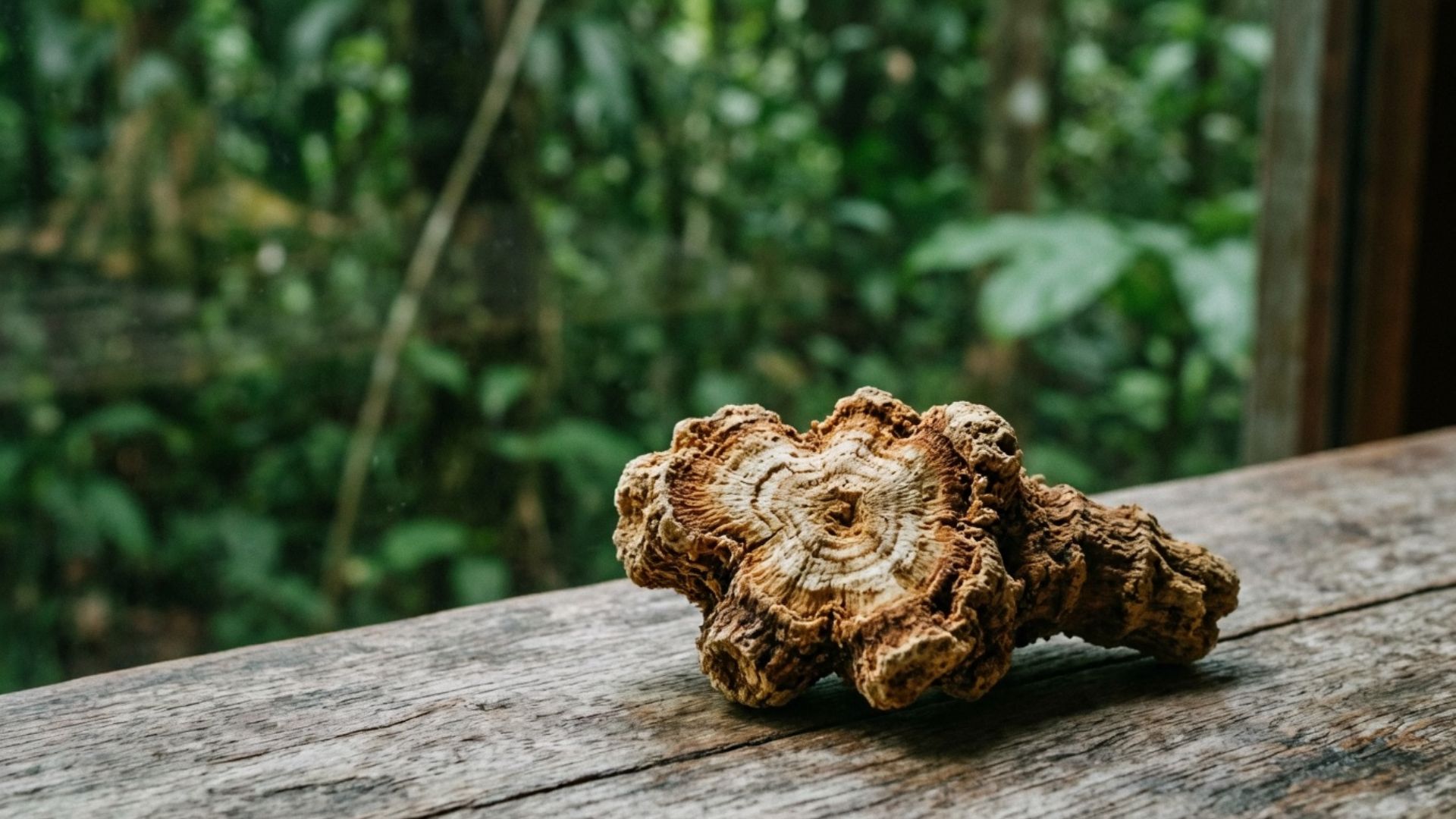
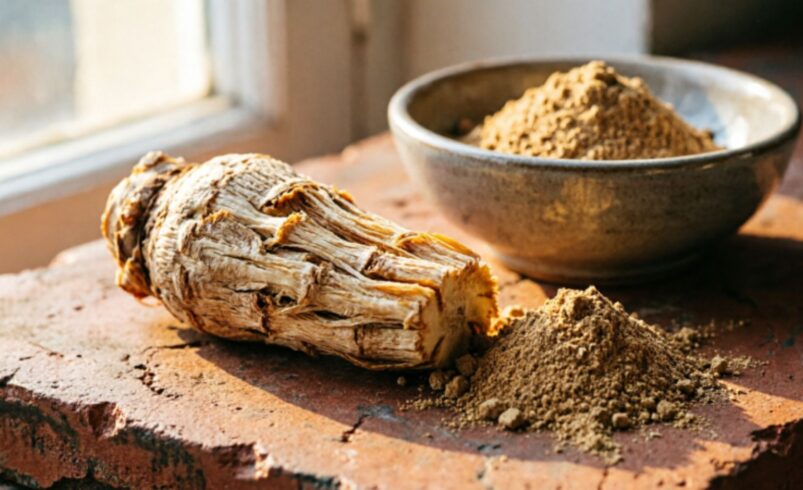
The root itself has been used in Ayurvedic medicine for over three thousand years. In Sanskrit, ashwagandha translates loosely to “smell of horse,” referencing both its earthy aroma and the vitality it was traditionally believed to confer. Modern researchers have spent the last two decades trying to verify that traditional reputation with randomized controlled trials. What they have found is genuinely compelling, provided you understand what you are actually measuring.
Before getting into the specifics, it helps to have a clear map of how testosterone production gets disrupted in the first place. The full framework of natural testosterone support covers that landscape broadly, and ashwagandha’s role makes considerably more sense in that context.
What it is
A root from a small shrub that grows in India and North Africa. Used in traditional Ayurvedic medicine for over 3,000 years.
What it does
It belongs to a group called adaptogens: plants that help the body manage stress more efficiently, without stimulating or sedating.
Why it matters
Modern trials have tested it for cortisol reduction, sleep quality, and testosterone support in men, with consistent results at 600 mg per day.
In plain language: ashwagandha is not a drug, a stimulant, or a quick fix. It is a well-studied plant extract that helps your body handle stress more efficiently, which in turn supports hormonal balance and sleep quality.
The cortisol problem nobody talks about at the gym
Cortisol is not the enemy. That framing is too simple and does a disservice to a hormone that is genuinely essential for survival. Cortisol helps you respond to acute stress, mobilizes energy, regulates inflammation, and supports healthy blood pressure. In short bursts, it is exactly what you want.
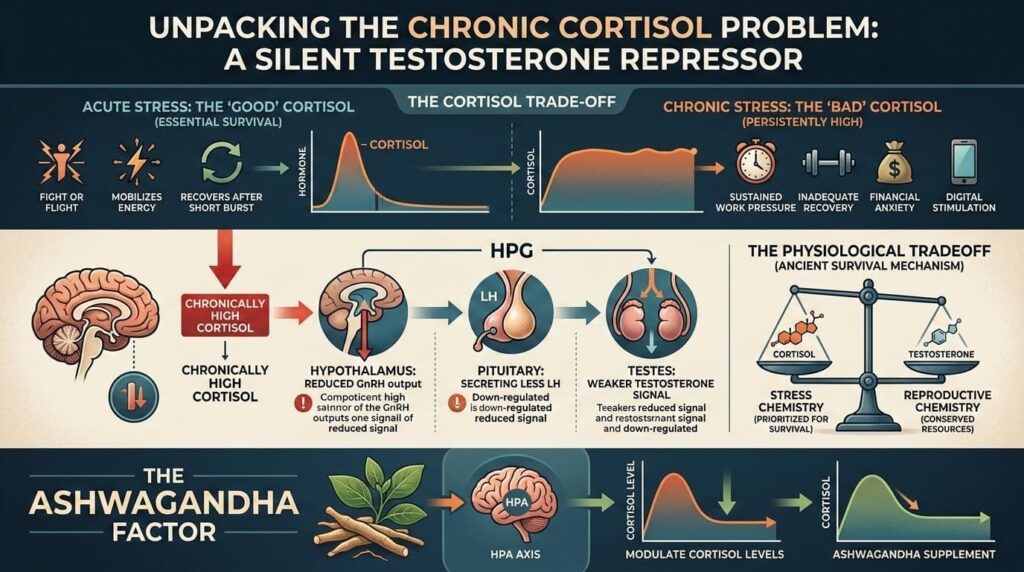
The problem is chronic elevation. And chronic cortisol elevation is one of the defining physiological features of modern male life in a way that was not true for previous generations to the same degree. Sustained work pressure, poor sleep, financial anxiety, high-stimulation digital environments, inadequate recovery between training sessions: all of these keep cortisol elevated beyond the short window where it is useful.
When cortisol stays high, the hormonal consequences are specific and measurable. The hypothalamus reduces its output of gonadotropin-releasing hormone. The pituitary responds by secreting less luteinizing hormone. The testes receive a weaker signal to produce testosterone. The entire hypothalamic-pituitary-gonadal axis, the system that governs male hormone production, gets dialed down as a direct consequence of the body prioritizing stress chemistry over reproductive chemistry.
This is not a malfunction. It is an ancient survival trade-off. When resources are scarce and threats are persistent, the body conserves energy by reducing functions that are not immediately necessary. Testosterone production is one of those functions.
The relevance for men doing everything else right, training consistently, sleeping reasonably well, eating adequately, but still feeling hormonally flat, is that chronic cortisol may be the missing variable. Not a deficiency of testosterone-stimulating herbs, but an excess of a suppressive hormone that no testosterone booster directly addresses.
Ashwagandha addresses it.
What the clinical trials actually found
The most rigorous human data on ashwagandha and testosterone comes from trials using KSM-66, a root-only standardized extract produced by Ixoreal Biomed that has been the subject of more published clinical research than any other ashwagandha preparation.
A double-blind, placebo-controlled study published in the American Journal of Men’s Health in 2019 examined 57 young men who received either 600 mg of KSM-66 daily or a placebo for eight weeks. The ashwagandha group showed an 18% increase in serum testosterone compared to a 1% change in the placebo group. Cortisol levels fell by 14% in the treatment group. The researchers also observed significant improvements in muscle recovery, exercise performance, and self-reported vitality.
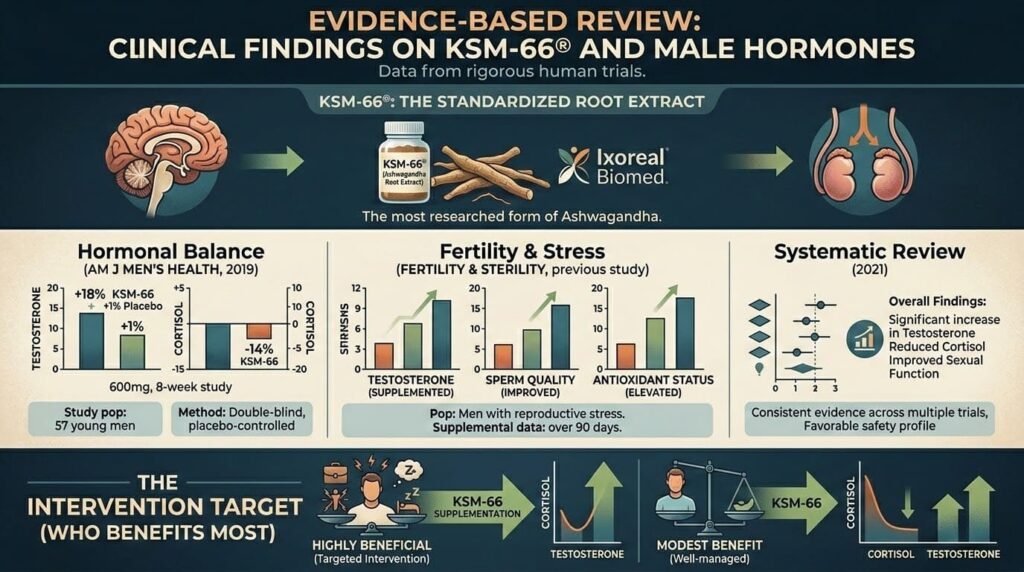
An earlier trial focused on male fertility found that ashwagandha supplementation over 90 days improved testosterone levels, sperm quality, and antioxidant status in men with reproductive stress. That study, published in Fertility and Sterility, is notable because it used a population under a specific and measurable physiological stress, which is precisely the condition where ashwagandha’s cortisol-lowering mechanism would be most relevant.
A 2021 systematic review compiled data from multiple human trials and concluded that ashwagandha supplementation was consistently associated with statistically significant increases in testosterone levels, improved sexual function, and reductions in cortisol, with a favorable safety profile across all included studies.
The pattern across this body of research is consistent. The effect is most pronounced in men who are stressed, sleep-deprived, or under physiological strain. It is more modest in men whose cortisol is already well-managed. That is not a weakness of the evidence. It is information about who the intervention is actually for.
KSM-66 vs Sensoril: the extract question
If you have spent any time researching ashwagandha supplements, you have encountered two dominant proprietary extracts: KSM-66 and Sensoril. They are not interchangeable, and understanding the difference saves both money and confusion.
| Feature | KSM-66 | Sensoril |
| Plant part used | Root only | Root and leaf |
| Withanolide content | Min. 5% | Min. 10% |
| Primary research focus | Testosterone, performance, energy | Stress, sleep, cognitive function |
| Typical clinical dose | 600 mg/day | 125 to 250 mg/day |
| Best suited for | Active men, hormonal support | Stress reduction, sleep quality |
KSM-66 is the extract used in most testosterone-relevant clinical trials. It is derived exclusively from the root, which aligns with traditional Ayurvedic use and avoids the leaf’s higher alkaloid content. The 5% withanolide standardization gives it a consistent bioactive profile across batches.
Sensoril uses a whole-plant extraction method that concentrates withanolides more densely by percentage but at a lower total dose. The research on Sensoril skews toward stress, anxiety, and sleep quality rather than testosterone specifically. Both have legitimate applications. For the purposes of male hormonal support, KSM-66 is where the evidence points.
Generic ashwagandha powders and non-standardized extracts are harder to evaluate. Withanolide content can vary dramatically between batches and suppliers, making clinical dose comparisons unreliable. In a category where the mechanism depends on consistent delivery of specific bioactive compounds, this variability matters.
The stress profile of the man who benefits most
Understanding the cortisol mechanism clarifies something that supplementation marketing tends to obscure: ashwagandha is not equally useful for every man.
A man in his thirties with a demanding career, irregular sleep, high training volume, and ongoing life stressors is a strong candidate. His cortisol is likely chronically elevated. His HPG axis is probably being suppressed to some degree as a result. Reducing that cortisol load gives the hormonal system room to recover, and testosterone levels tend to follow.
A man with genuinely low cortisol, perhaps someone who is already well-recovered, meditates regularly, works moderate hours, and sleeps eight hours consistently, may find the testosterone effect of ashwagandha modest at best. Not because the herb is ineffective. Because the specific problem it solves may not be his primary constraint.
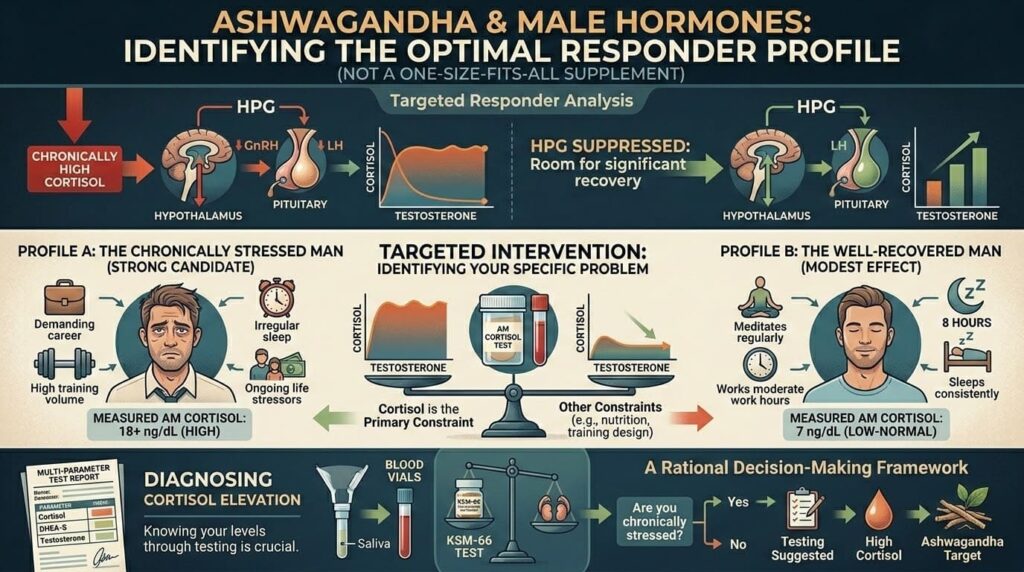
This is one of the more honest conversations in the supplement space, and it rarely happens because it is not good for sales. Targeted interventions produce targeted results. Knowing whether cortisol is your specific problem, ideally through morning cortisol testing via a saliva or blood panel, makes the decision considerably more rational.
Timing, dosing, and practical use
At 600 mg of KSM-66 per day, most clinical trials ran for eight to twelve weeks. Some men report noticeable changes in energy, stress response, and sleep quality within two to three weeks. Hormonal changes, when they occur, tend to emerge more gradually over six to eight weeks of consistent use.
Timing is genuinely flexible. Ashwagandha is not a stimulant and does not interfere with sleep for most people. Some prefer taking it in the morning with breakfast for convenience. Others take it in the evening, citing its mild relaxing effect as a useful wind-down signal. A small subset report mild drowsiness if taken mid-day, so morning or evening dosing tends to be the most practical.
Food slightly improves absorption and reduces the chance of gastrointestinal discomfort, which affects a small percentage of users with sensitive stomachs. Starting at 300 mg for the first week before moving to the full dose is a reasonable approach for anyone with a history of gut sensitivity.
Ashwagandha is generally well-tolerated. Rare adverse effects reported in trials include loose stools, nausea, and drowsiness. Individuals with autoimmune conditions should consult a physician before use, as adaptogens that modulate immune function may not be appropriate in that context. The same applies to men taking thyroid medication, as ashwagandha has demonstrated mild thyroid-stimulating effects in some studies.
How Ashwagandha fits into a complete protocol
No adaptogen is a standalone solution, and ashwagandha works best when it is addressing a real problem rather than filling a slot in a supplement stack.
If cortisol is the central issue, ashwagandha is the right primary tool. But cortisol elevation does not happen in a vacuum. It is almost always accompanied by, or caused by, inadequate sleep. And the relationship between sleep and testosterone is direct enough that no adaptogen fully compensates for it. Prioritizing deep, consistent sleep as a testosterone strategy is not a secondary recommendation to ashwagandha. In many cases it is the primary one, with ashwagandha serving as a support mechanism that helps the nervous system actually get there.
Zinc deficiency is another variable worth ruling out before adding adaptogens to the picture. A constrained testosterone production pathway that is missing an essential mineral cofactor does not become unconstrained simply because cortisol is lower. The foundations need to be solid for the herbal layer to express its full effect.
The most effective approach is sequential and logical: verify nutritional adequacy, optimize sleep, address cortisol through both lifestyle and targeted supplementation, and then evaluate herbal support from that stable platform. Ashwagandha earns its place in that sequence because the human evidence supports it and the mechanism is coherent.
The underlying question is a useful one to keep asking: are you supplementing to fix a real, identifiable problem, or filling space where better habits should be?