






Three bottles sit in my cart right now, and each one swears it is the magnesium that will finally fix my nights.
One says glycinate and promises calm. One says threonate and talks about the brain like it is selling a smartphone. One says citrate and leans on absorption. I have been writing about supplements long enough to know that when three products make three different promises about the same mineral, the real story is usually somewhere none of the labels mention.
Magnesium is one of the most self-prescribed sleep supplements in America in 2026. It went from a quiet multivitamin ingredient to a TikTok staple when the “sleepy girl mocktail” (tart cherry juice, magnesium powder, sparkling water) took over feeds a couple of years ago. The marketing has moved fast. The science has moved slowly.
So let’s look at what the trials actually measured, why the form on the front of the bottle matters less than you think, and the one number on the back that matters more. For the bigger picture, see how natural sleep supplements compare.
What the research supports, and what it doesn’t
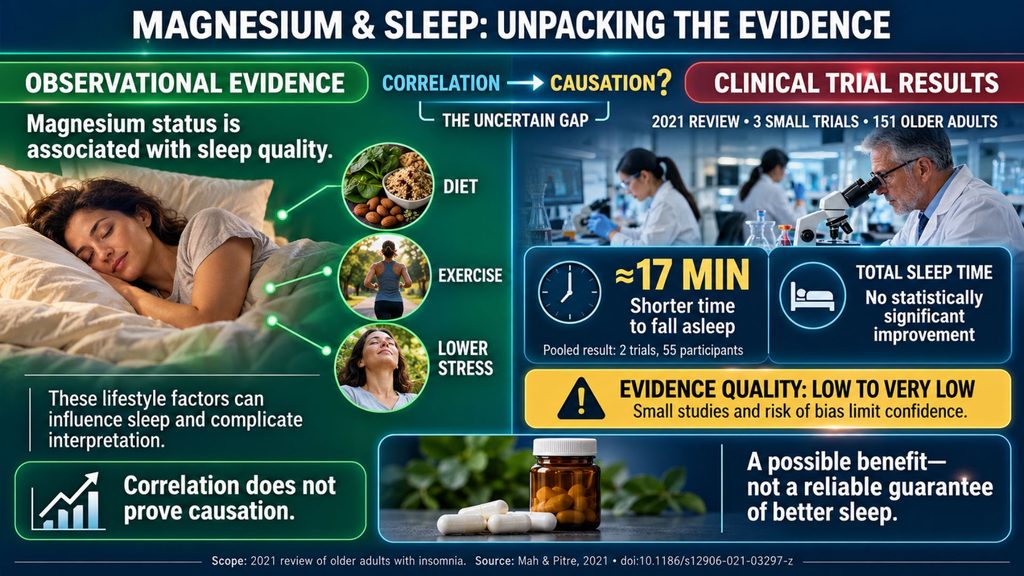
Here is the uncomfortable starting point. A 2023 systematic review found that observational studies link magnesium status with sleep quality, while randomized trials showed an uncertain connection between supplementation and sleep disorders.
That gap matters. People who eat more magnesium tend to sleep better, but they also tend to eat more vegetables, nuts, and whole grains, and probably live differently in a dozen other ways. Correlation is a door, not a destination.
The older trial data is thin too. A 2021 meta-analysis pooled three small trials in 151 older adults and found people fell asleep about 17 minutes faster on magnesium, while the gain in total sleep time was not statistically significant. The authors’ verdict was blunt: the literature was “substandard for physicians to make well-informed recommendations”.
Seventeen minutes is not nothing if you spend your nights staring at the ceiling. But it is a long way from the “deep, restorative sleep” printed on most labels.
What I take from this: magnesium is a reasonable thing to consider, not a reliable thing to count on. Those are different purchases.
Glycinate vs threonate vs citrate at a glance
The name on the bottle tells you what the magnesium is bound to. It does not tell you how much magnesium you are getting, and it does not prove a sleep benefit.
| Form | What it is | Rough elemental magnesium | Direct sleep evidence |
|---|---|---|---|
| Magnesium glycinate (bisglycinate) | Magnesium bound to glycine | Roughly 14% by weight | One solid 2025 trial, modest effect |
| Magnesium L-threonate | Magnesium bound to threonic acid | Roughly 7 to 8% by weight | Two trials of one branded ingredient, mixed results |
| Magnesium citrate | Magnesium bound to citric acid | Roughly 16% by weight | No strong sleep-specific trials; well absorbed |
That middle column is where a lot of shoppers get lost. A capsule containing 1,000 mg of a magnesium compound does not contain 1,000 mg of magnesium. With threonate, you get a fraction of that.
Magnesium glycinate: the best data, with modest expectations
If you want the strongest single trial in this space, it belongs to glycinate.
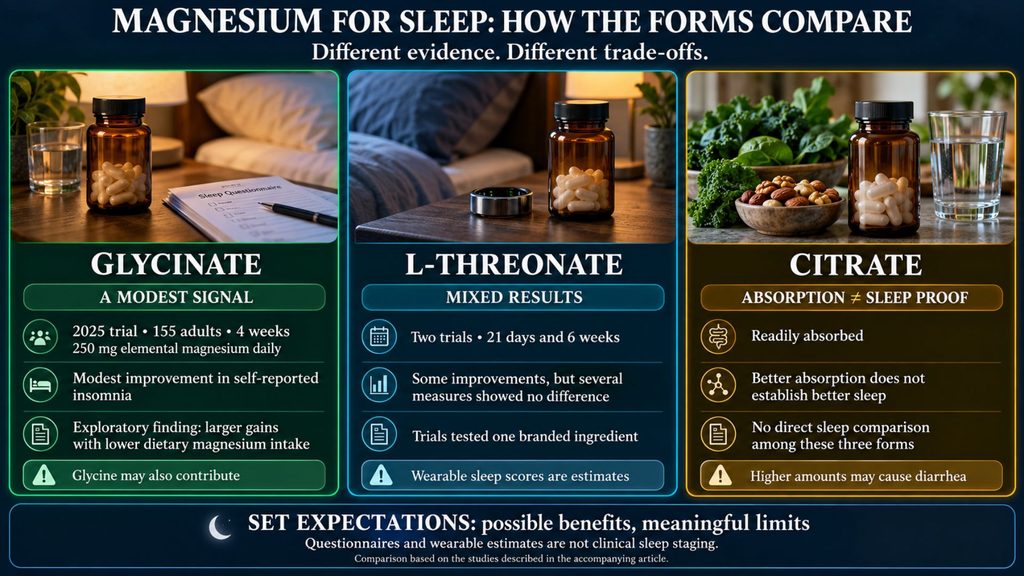
In a randomized, double-blind, placebo-controlled trial published in August 2025, 155 adults aged 18 to 65 with self-reported poor sleep took either magnesium bisglycinate providing 250 mg of elemental magnesium daily or a placebo. The study ran four weeks across Germany, using home-based assessments. The conclusion: insomnia severity improved modestly.
Modestly is the honest word. It was a real effect, not a dramatic one, and it was measured by questionnaire rather than in a sleep lab.
The more interesting detail is buried in the exploratory analysis. Participants who reported lower baseline magnesium intake from food showed notably larger improvements, which hints at a subgroup of strong responders.
That is the part I wish every supplement brand would print on the bottle. Magnesium may work best as a correction, not an upgrade. If your diet is already rich in leafy greens, beans, nuts, and seeds, the ceiling may be low. If your meals look more like a drive-through receipt, the story could be different. (If you suspect you are short on more than one nutrient, our breakdown of vitamin and mineral deficiency symptoms is a good place to start.)
One more wrinkle. Bisglycinate also delivers glycine, roughly 1.54 g for every 250 mg of elemental magnesium. Glycine has its own sleep research. So nobody can say for sure whether the magnesium, the glycine, or the pairing deserves the credit.
Magnesium L-threonate: read the marketing slowly
Threonate is the premium kid on the shelf. It is often priced higher, and it is sold on a brain-bioavailability story that sounds sophisticated.
The trials are worth reading closely, because they point in slightly different directions.
A 2024 trial gave 80 adults aged 35 to 55 with self-assessed sleep problems either 1 g per day of magnesium L-threonate or placebo for 21 days, tracking sleep with questionnaires and an Oura ring. The researchers reported that the threonate group held steady on sleep quality while the placebo group declined, along with better wearable scores for deep and REM sleep.
Then a 2025 trial raised the bar. One hundred adults aged 18 to 45 who were dissatisfied with their sleep took 2 g daily of the same branded ingredient or placebo for six weeks. Self-reported sleep-related impairment improved more in the threonate group, but there were no group differences on several other measures.
Two things deserve a raised eyebrow. First, both studies tested Magtein, a single branded ingredient, so the findings don’t automatically transfer to every threonate on the shelf. Second, wearable “deep sleep scores” are algorithmic estimates, not clinical sleep staging. My own ring has told me I had a great night after evenings I would personally rate a C minus.
Threonate may well have something to offer. But “improves your deep sleep” is a bigger claim than the evidence has earned, and a higher price needs a better reason than a scientific-sounding name.
Magnesium citrate: absorption is a separate question
Citrate is the budget workhorse. NIH lists it among the forms the body absorbs more readily, which matters if your goal is simply getting magnesium in.
But absorption and sleep are two separate questions. A form that reaches your bloodstream efficiently has not demonstrated that it helps you fall asleep faster than glycinate or threonate. No head-to-head trial has tested that.
There is also a practical catch. Citrate is the same compound used in some laxatives, and at higher amounts your gut will remind you. If you are someone with a sensitive stomach, that alone may decide the matter.
The number on the back of the bottle
Every time someone asks me which magnesium to buy, I give the same answer: turn the bottle around.
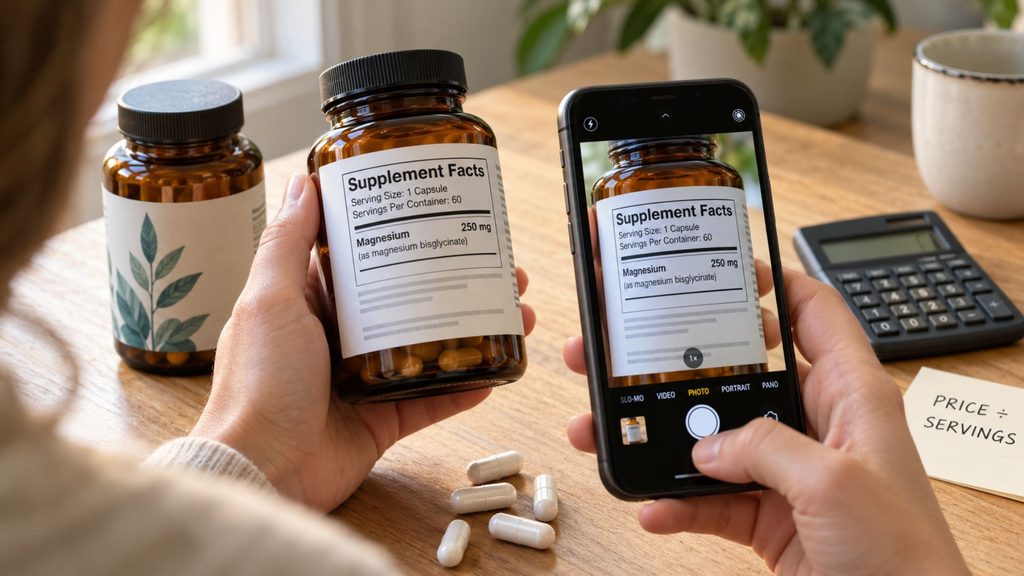
On a US Supplement Facts panel, the magnesium figure represents elemental magnesium, not the weight of the whole compound. That is the only number you can fairly compare across products.
A quick example. Bottle A has 60 capsules and costs $22. Bottle B has 90 capsules and costs $24. Bottle B looks like the deal until you read the serving size: three capsules per serving versus one. Suddenly Bottle A gives you 60 servings and Bottle B gives you 30.
The math that actually matters is simple:
Cost per serving = bottle price ÷ number of labeled servings
Then check what else is inside. If a “sleep magnesium” also contains melatonin, ashwagandha, or a proprietary herb blend, you are no longer comparing magnesium forms. You are comparing formulas. (And if you are tempted to stack it with adaptogens, read our guide on stacking adaptogens safely first.)
A habit that has saved me real money: photograph the full Supplement Facts panel before buying. Front labels are designed to be remembered. Back panels are designed to be skipped.
Safety: the limit, the interactions, the kidneys
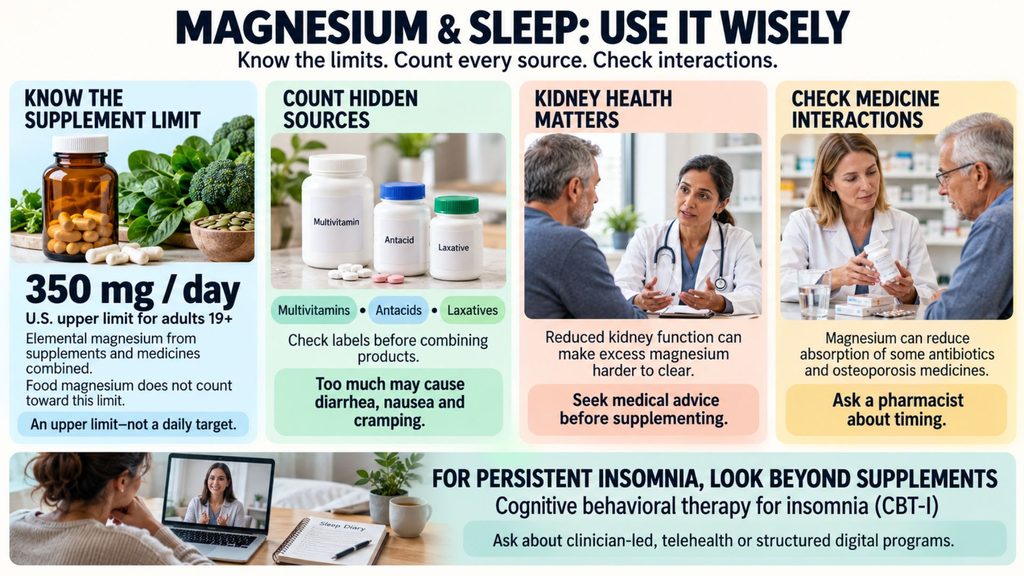
For adults 19 and over, the US upper limit is 350 mg per day of magnesium from supplements and medications combined, unless a clinician advises otherwise. Magnesium from food does not count toward it. That is a ceiling, not a target, and certainly not a “sleep dose.”
Count everything. Multivitamins, antacids, and some laxatives all carry magnesium, and people routinely double up without noticing. Too much supplemental magnesium tends to announce itself through diarrhea, nausea, and cramping.
Two groups need to slow down:
- People with reduced kidney function. The kidneys clear excess magnesium, and when they can’t, toxicity becomes a real risk. Do not self-prescribe.
- People on certain medications. Magnesium can interfere with the absorption of some antibiotics and osteoporosis drugs. Spacing matters, and a pharmacist can tell you how much.
And if your sleep trouble has dragged on for months, magnesium is not the main event. Cognitive behavioral therapy for insomnia (CBT-I) remains the most strongly recommended treatment for chronic insomnia, and it is far more accessible in 2026 through telehealth and app-based programs than it was even five years ago.
So which one should you buy?
Here is my honest take after reading the trials more times than I’d like to admit.
If you want the form with the best direct evidence, glycinate has it, with the caveat that the effect was modest and may be strongest in people who eat little magnesium. If you want the cheapest reliable way to get magnesium in, citrate does the job, as long as your stomach agrees. If you are drawn to threonate, make sure you are paying for evidence and not for vocabulary.
Before ordering anything, write down the specific problem. Trouble falling asleep? Waking at night? Waking up wrecked? “Better sleep” is too vague to judge any purchase against.
And change one thing at a time. If you start magnesium the same week you cut afternoon coffee and banish your phone from the bedroom, you will feel better and have no idea why. Your gut matters here too, by the way; the link between your microbiome and sleep quality is stronger than most people expect.
Magnesium sits in an odd place in 2026. It is cheap, widely tolerated, and backed by just enough research to keep the hope alive without ever quite closing the case. Maybe that is the right place for it: a reasonable experiment, not a promise. If melatonin is the next bottle you are eyeing, our guide to melatonin dosage and timing explains why it works on a completely different problem.
Have you ever switched magnesium forms and actually noticed a difference, or did the change turn out to be the routine around it?