








Nobody sat me down at 25 and explained that my hormones would spend the next three decades shifting in ways that would require completely different nutritional support at different times. Nobody mentioned that what helped with PMS at 22 would not be what I needed at 38 for fertility, or at 47 when sleep started feeling like a negotiation rather than a given.
Most women piece this together slowly. Through conversations, through trial and error, and through a cabinet full of supplements that turned out to be the right products for the wrong life stage.
The interest in supplements for hormonal balance in women has become one of the most significant health conversations of the past several years. In 2026, the science is specific enough to act on meaningfully. The evidence maps quite clearly onto the different hormonal environments women navigate across their reproductive and post-reproductive lives. The gap between what that research actually shows and what most women know about it remains frustratingly wide.
This guide addresses that gap directly. It covers the most impactful supplements across three major hormonal chapters: the menstrual cycle years, the preconception and fertility window, and the perimenopause-to-menopause transition. The approach is practical and the evidence is real. The goal is a supplement strategy that fits where you are right now, not a generic protocol designed for a woman at an unspecified average age.
One framing note before anything else, because it changes how to read everything that follows.
Hormonal balance is not a fixed state. Estrogen, progesterone, cortisol, insulin, and thyroid hormones all fluctuate in response to your cycle, your age, your stress levels, and your nutritional environment. Balance means each hormone is at the right level for the right phase, not that all hormones are equal at all times. The supplements that support that shifting balance are different at 28, at 38, and at 52. Life stage is the starting point for every decision here.
The Cycle Years: Managing PMS and Monthly Hormonal Shifts

For most women, the hormonal conversation begins with the menstrual cycle. Specifically, it begins with the two weeks before menstruation when everything becomes harder.
The luteal phase, roughly days 15 through 28 of a typical cycle, brings a predictable set of challenges for a significant number of women. Irritability arrives without warning. Sleep becomes lighter. Bloating sets in. A low-grade anxiety shows up that does not correspond to anything actually happening in daily life. These are not character flaws or simple stress responses. They are the direct neurochemical consequences of declining serotonin, weakened GABA signaling, and a progesterone-to-estrogen ratio that shifts in ways affecting brain chemistry month after month.
Understanding that mechanism changes the supplement approach entirely.
Magnesium: Where the Evidence Is Clearest
Magnesium is the most evidence-supported supplement for premenstrual symptoms. It is also one of the most commonly taken in a form that barely absorbs. Magnesium oxide, which dominates the pharmacy shelf, absorbs at roughly 4 percent. Magnesium glycinate absorbs considerably more efficiently and causes none of the digestive disruption that pushes women away from magnesium altogether.
At 300 to 400 mg taken in the evening, magnesium glycinate directly supports GABA receptor activity, the brain’s primary calming mechanism. It also reduces the inflammatory prostaglandins responsible for cramping. Multiple randomized controlled trials confirm its effectiveness for PMS symptom severity compared to placebo. Most women notice a measurable shift within two to three cycles of consistent use.
Vitamin B6 and Serotonin
B6 is a required cofactor in the synthesis of both serotonin and dopamine. Without adequate B6, those neurotransmitters simply cannot be produced at sufficient levels, regardless of everything else in the protocol. Research consistently shows women with pronounced premenstrual mood symptoms often test low in B6, and that supplementation at 50 to 100 mg daily improves emotional symptoms measurably. B6 also supports the liver’s clearance of estrogen, which matters particularly for women whose dominant symptoms point to estrogen accumulation: breast tenderness, water retention, and heightened emotional reactivity.

Vitex and the Progesterone Picture
Chasteberry acts on the pituitary gland in a way that reduces prolactin and allows progesterone to rise more appropriately during the luteal phase. It is not a fast-acting supplement. Most clinical protocols run it for three to six months before evaluating results. Women with confirmed short luteal phases, mid-cycle spotting, or consistently low progesterone respond most noticeably. It belongs in the longer-game portion of a PMS protocol rather than the immediate intervention layer.
For the full clinical breakdown and dosing across each of these, including which symptom profiles respond best to each supplement, the article on natural supplements for PMS and what the research actually shows covers that evidence in detail.
Syncing Supplement Timing With the Full Cycle
Beyond the luteal phase, there is a broader and increasingly well-supported approach: adjusting nutritional inputs across all four cycle phases rather than only addressing symptoms in the final two weeks.
The follicular phase, when estrogen is rising after menstruation, favors B vitamins and probiotic support for gut estrogen metabolism. The ovulatory window benefits from zinc and antioxidants that protect the maturing follicle. The luteal phase calls for magnesium, B6, and zinc to support progesterone production and clearance.
In practice this is far less complicated than it initially sounds. It largely means front-loading nutrients in the first half of the cycle so the second half has more to draw from. Women who treat cycle syncing as a nutritional foundation rather than a rigid daily protocol typically find their luteal phase becomes measurably easier within two to three months.
The phase-by-phase cycle syncing supplement protocol maps this approach across the entire month with specific forms, doses, and the testing framework that makes the protocol precise rather than approximate.
The Fertility Window: Preconception Nutrition and the 90-Day Timeline

Most preconception advice starts too late.
The standard recommendation to begin a prenatal vitamin when you decide to try to conceive is not wrong exactly. It is just poorly timed relative to the biology that actually determines fertility outcomes. The egg your body releases at ovulation this month began developing approximately 90 days ago. The nutritional environment it grew within during that entire window shapes its chromosomal integrity and mitochondrial function in ways that a few weeks of reactive supplementation cannot meaningfully reverse.
That 90-day timeline is the most important single piece of information most women never receive before trying to conceive. Starting the protocol three to four months before you plan to begin is not overcautious. It is the timeline the biology actually requires.
The Folate Distinction That Changes Outcomes
Folate is non-negotiable in preconception nutrition. Its role in preventing neural tube defects, which form in the earliest weeks of fetal development before many women know they are pregnant, is one of the most robustly established findings in reproductive health research.
The distinction worth understanding in 2026 is between synthetic folic acid and methylfolate, its biologically active form. Folic acid requires enzymatic conversion by a protein coded by the MTHFR gene before it becomes usable at the cellular level. Research suggests that between 40 and 60 percent of the population carries gene variants that reduce this conversion efficiency. Methylfolate, also labeled 5-MTHF on supplement packaging, bypasses the conversion requirement entirely.
The standard preconception dose is 400 to 800 mcg of methylfolate daily. Women with a prior pregnancy affected by a neural tube defect, or confirmed MTHFR compound heterozygous or homozygous status on genetic testing, should discuss higher doses with their clinician before adjusting independently.
CoQ10 and the Mitochondrial Case for Egg Quality
Egg quality is the variable that determines whether a fertilized egg has the chromosomal integrity to implant and develop into a viable pregnancy. Mitochondrial function sits at the center of that equation. Oocytes require more mitochondrial energy to complete chromosomal division correctly than almost any other cell in the body. That energy production depends on coenzyme Q10 as a critical cofactor, and CoQ10 levels decline measurably with age.
A randomized controlled trial published in Fertility and Sterility found that CoQ10 supplementation prior to IVF cycles improved both ovarian response and embryo quality in older women. The form matters significantly here. Ubiquinol, the reduced active form of CoQ10, is substantially more bioavailable than ubiquinone, particularly for women over 35. Doses of 400 to 600 mg of ubiquinol daily represent the range most studied in fertility protocols.

Inositol for PCOS and Ovulation Regularity
For women with polycystic ovary syndrome, inositol sits among the most consistently evidence-supported interventions available and one of the most underutilized in mainstream preconception conversations.
PCOS drives ovulation disruption through a hormonal cascade rooted in insulin resistance. High circulating insulin stimulates androgen production in the ovaries, which interferes with follicle maturation and ovulation timing. Inositol addresses that cascade at its origin rather than managing symptoms downstream.
The combination showing the most consistent clinical results is myo-inositol and D-chiro-inositol in a 40:1 ratio. At a standard dose of 4 grams of myo-inositol combined with 100 mg of D-chiro-inositol daily, research consistently shows improvements in ovulation rates, menstrual regularity, and egg quality markers.
Vitamin D and the Fertility Variable Most Women Have Not Tested
Vitamin D functions more like a steroid hormone than a traditional micronutrient. Its receptors appear in the ovaries, the uterine lining, and the placenta. Adequate vitamin D status is independently associated with higher implantation rates and live birth outcomes in IVF research. A 2019 meta-analysis of over 2,700 women found that women with sufficient vitamin D levels had significantly higher live birth rates even after controlling for other clinical variables.
The only reliable way to assess status is to measure it. A 25-hydroxyvitamin D blood test gives a specific number to calibrate dosing against rather than estimating. Most women in the preconception window benefit from 2,000 to 4,000 IU of vitamin D3 daily alongside vitamin K2 in the MK-7 form, with the specific dose determined by baseline testing.
Omega-3s: The Cell Membrane Argument
EPA and DHA support fertility through mechanisms that rarely appear in mainstream preconception conversations. They provide structural support to oocyte cell membranes, which must remain fluid and functionally responsive for successful fertilization to occur. They reduce inflammatory prostaglandins that affect the uterine environment. They support uterine blood flow during the implantation window.
A daily dose of 1,000 to 2,000 mg of combined EPA and DHA from a third-party tested fish oil or algae-based equivalent addresses all of these simultaneously.
The full preconception protocol, including a complete breakdown of the 90-day supplement timeline and how to structure testing before you begin, is covered in depth in the fertility supplements for women guide. For women who are also using cycle-phase nutrition to optimize their preconception window, the ovulatory phase supplementation detail in the cycle syncing protocol maps directly onto the fertility preparation framework and adds a useful additional layer of timing precision.
The Hormonal Transition Years: Perimenopause, Menopause, and the Long Game

Perimenopause is the most underserved chapter in women’s hormonal health conversations.
It does not fit cleanly into reproductive health discussions, because it is not technically about reproduction. It does not fit neatly into menopause conversations either, because menstruation has not yet stopped. It lives in the gap between those two categories, which is precisely where most clinical guidance falls short and where women are most likely to spend years managing symptoms without a coherent nutritional framework to anchor them.
The biology of this transition is genuinely counterintuitive. Most women expect perimenopause to mean declining estrogen. What actually happens, particularly in the early years, is wildly fluctuating estrogen. Some cycles it spikes higher than it did in the 30s. Others it drops sharply. Progesterone, which depends on ovulation occurring, becomes increasingly insufficient because anovulatory cycles produce none at all. The result is not simple estrogen deficiency. It is an unstable estrogen-to-progesterone ratio combined with a hypothalamic thermostat that has become hypersensitive to those fluctuations.
Managing the Vasomotor Symptoms That Define Early Perimenopause
Hot flashes are the most recognizable perimenopausal symptom and among the most studied. The mechanism begins in the hypothalamus, the brain region that regulates body temperature. As estrogen fluctuates, the thermoregulatory zone narrows. Small temperature changes that would previously go unnoticed now trigger disproportionate heat dissipation responses.
Black cohosh has the most substantial botanical evidence base for addressing this specific mechanism. Decades of clinical use and a formal approval from the German Commission E for menopausal complaints give it a track record that most herbal supplements do not have. The mechanism, which was long misunderstood as phytoestrogenic, now points more convincingly to serotonin receptor activity in the hypothalamus. A standardized extract at 20 mg taken twice daily is the most consistently studied protocol. Women with existing liver conditions should consult a physician before use.
Sleep, Cortisol, and the HPA Axis
Sleep disruption during perimenopause is not simply a side effect of night sweats. It reflects something deeper in the neurochemical architecture of sleep itself.
Cortisol, which follows a 24-hour rhythm with its lowest levels in the evening and its peak in the early morning, becomes dysregulated during perimenopause. Elevated nighttime cortisol delays sleep onset, increases waking, and reduces the restorative slow-wave sleep that hormonal repair depends on.
Magnesium glycinate at 300 to 400 mg taken 30 to 60 minutes before bed is the most impactful low-risk intervention for this pattern. It supports GABA receptor function, which directly counteracts cortisol-driven nighttime arousal. Most women who commit to consistent use report meaningful improvement within two to three weeks.
Ashwagandha addresses the root problem rather than the nighttime symptom alone. As an adaptogen with strong evidence for reducing cortisol and modulating the stress response, it works on the HPA axis dysregulation that amplifies every perimenopausal symptom. A 2019 double-blind trial published in Medicine found that 240 mg of standardized ashwagandha root extract daily reduced serum cortisol by approximately 23 percent over 60 days.

Bone Health: The Silent Urgency of the Perimenopausal Window
This is the conversation most women have five years too late.
Bone density peaks in the late 20s and declines gradually through the 30s. Perimenopause accelerates that decline sharply as estrogenic suppression of bone-resorbing osteoclasts weakens. The supplementation window that most powerfully influences fracture risk decades from now is the one being navigated right now, not after a DEXA scan delivers a difficult result.
The foundation is the calcium-D3-K2 triad. Calcium citrate is the preferred form for women in this life stage. It absorbs without requiring stomach acid, which becomes relevant as digestive function changes across the 40s and 50s. Total daily calcium from food and supplements combined should land around 1,000 to 1,200 mg. Vitamin D3 drives intestinal calcium absorption from a baseline rate of roughly 10 to 15 percent up to 30 to 40 percent. Vitamin K2 in the MK-7 form activates the proteins that direct absorbed calcium into bone matrix rather than arterial walls.
Magnesium supports bone matrix integrity and activates vitamin D, making it a necessary companion to the rest of this triad. Boron at 3 mg daily has shown meaningful effects on calcium and magnesium retention in tissue and appears to extend some of estrogen’s bone-protective mechanisms in postmenopausal women. Silica supports the collagen cross-linking that gives bone its structural resilience beyond raw mineral density.
The Menopause Threshold and What Changes After
Once menstruation has been absent for 12 consecutive months, the hormonal environment shifts from volatile to low and stable. The longer-term biological consequences move to the foreground.
Cardiovascular disease risk increases meaningfully in the years following menopause. Omega-3 fatty acids, specifically EPA and DHA at doses of 2,000 to 4,000 mg daily from a third-party tested source, step into that gap more effectively than almost any other post-menopausal supplement. At meaningful doses, EPA and DHA lower triglycerides, reduce systemic inflammation, and support arterial flexibility in ways that become progressively more relevant the longer estrogenic cardiovascular protection has been absent.
Phytoestrogens occupy a genuinely complicated position in the post-menopausal conversation. Soy isoflavones and red clover bind weakly to estrogen receptors and can reduce hot flash frequency for some women, while producing almost no effect in others. The difference comes down to individual gut bacteria and the capacity to convert isoflavones into equol, the metabolite responsible for most of the clinical benefit.
Cognitive support becomes an increasingly relevant supplement category in the post-menopausal years. Lion’s mane mushroom, through its support of nerve growth factor production, offers one of the more evidence-informed options for long-term cognitive maintenance. The research base is still building, but the safety profile is favorable and the mechanism is biologically plausible in a way that distinguishes it from most brain health supplements on the market.
Life Stage Supplement Overview
| Life Stage | Priority Supplements | Primary Goals |
|---|---|---|
| Menstrual years | Magnesium glycinate, B6, vitex | PMS relief, luteal support, cycle regulation |
| Preconception | Methylfolate, CoQ10 ubiquinol, inositol, vitamin D | Egg quality, ovulation, implantation readiness |
| Perimenopause | Black cohosh, ashwagandha, magnesium, calcium-D3-K2 | Vasomotor relief, sleep, cortisol, bone protection |
| Post-menopause | Omega-3s, phytoestrogens, lion’s mane, magnesium | Cardiovascular, cognitive longevity, bone maintenance |
The supplements for perimenopause symptoms guide covers the full transitional protocol in detail, including how to sequence these interventions as symptoms shift across the perimenopausal years. For women who have already crossed the menopause threshold, the natural supplements for menopause article addresses the post-estrogenic supplement strategy with specific attention to cardiovascular protection and cognitive longevity, the two domains where the evidence is strongest and the long-term stakes are highest.
Building a Protocol That Actually Fits Your Life
The most common mistake women make with hormonal supplementation is not taking the wrong supplements. It is taking the right supplements for the wrong life stage.
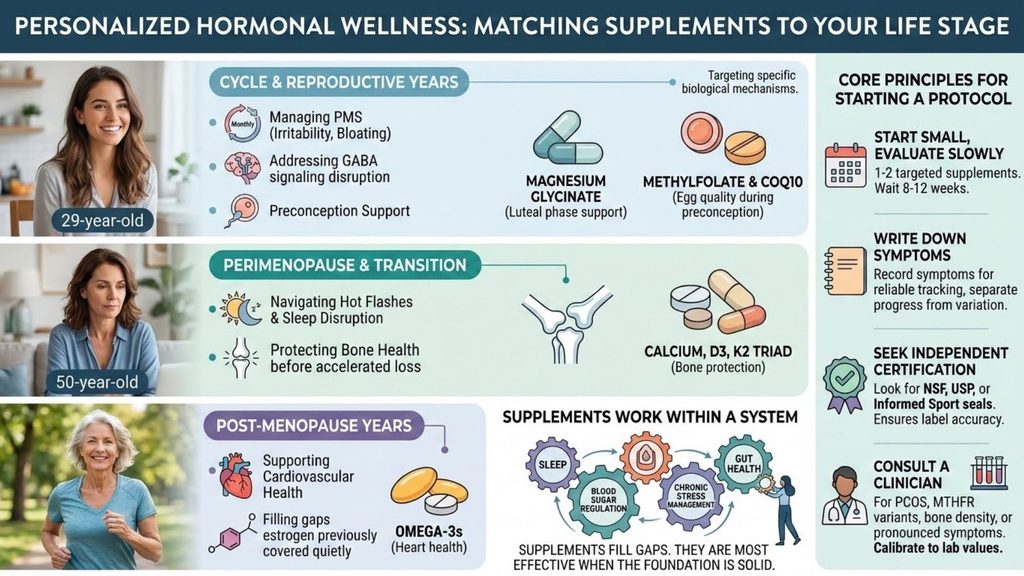
A 29-year-old managing PMS and a 50-year-old navigating hot flashes and sleep disruption are both pursuing hormonal health. They need almost entirely different protocols. The biology governing each situation is distinct, the nutritional gaps are different, and the mechanisms requiring support are not the same. Life stage is not a detail to factor in after choosing supplements. It is the starting point for every decision.
What the research across all three chapters covered here consistently shows is that targeted, stage-appropriate supplementation produces meaningful results when the right nutrients are matched to the right biological context. Magnesium glycinate in the luteal phase addresses the GABA signaling that PMS disrupts. Methylfolate and ubiquinol CoQ10 during the preconception window shape the egg quality that reproductive outcomes depend on. The calcium-D3-K2 triad during perimenopause protects bone before the most aggressive loss window begins. Omega-3s in the post-menopausal years fill the cardiovascular gap that estrogen previously occupied quietly and without credit.
None of these interventions are complicated once the mechanism is understood. The complexity in the supplement market is largely manufactured. The actual biology is logical.
A Few Principles Worth Carrying Forward
Start with one to two targeted supplements rather than rebuilding your entire protocol simultaneously. Give each addition eight to twelve weeks before evaluating its effect. Hormonal symptoms fluctuate naturally month to month, and a written symptom record is the only reliable way to separate genuine progress from normal variation.
Choose supplements certified by third-party testing organizations such as NSF International, USP, or Informed Sport. These certifications confirm that what appears on the label matches what is inside the capsule and that no harmful contaminants are present. In a category with limited pre-market regulation, that independent verification matters considerably.
Work with a clinician where your situation warrants it. Women with PCOS, confirmed MTHFR variants, early bone density loss, or pronounced perimenopausal symptoms benefit from protocols calibrated to actual lab values rather than population averages.
Supplements Work Within a System, Not in Spite of One
The most consistently overlooked variable in hormonal health is the one that predates supplementation entirely.
Sleep, blood sugar regulation, chronic stress, and gut microbiome health all exert more influence on the hormonal environment than any supplement can independently compensate for. A magnesium protocol running alongside chronic sleep deprivation and a blood sugar rollercoaster is working against significant headwinds. The same protocol running alongside consistent sleep and stabilized glucose will produce noticeably different results.
Supplements fill gaps. They are most effective when the foundation beneath them is reasonably solid. This is not a reason to delay starting until everything is perfect. It is a reason to treat supplementation as one element of a larger hormonal support system rather than the whole of it.
In 2026, women have access to better nutritional science than any previous generation navigating these same biological transitions. The research is specific enough to act on with confidence. The gap that remains is largely informational, the distance between what the evidence supports and what most women have actually been told.
Closing that gap, life stage by life stage and mechanism by mechanism, is exactly what this resource is designed to do. Women who are currently in the cycle years and want to go deeper on the symptom-specific evidence will find the natural supplements for PMS guide the most immediately actionable next step, with full clinical dosing and the trial data behind each recommendation.
Your hormonal health is not a fixed condition. It is a dynamic system that responds to the right inputs at the right times. Which life stage are you in right now, and which symptom, if you addressed it with a precise, evidence-based protocol, would change the most about how you feel day to day?