








The first hot flash arrived at 44, in the middle of a work presentation, and I had absolutely no framework for what was happening.
It was not the temperature spike that was most disorienting. It was the complete absence of any warning. One moment I was fine. The next I was visibly flushed, sweating through my shirt collar, and trying to finish a sentence while my internal thermostat appeared to be running a completely separate agenda. It took three more months of increasingly disruptive sleep and a new kind of pre-period anxiety I had never experienced before to understand that perimenopause had started, quietly and without introduction, years before I expected it.
This is how perimenopause works for most women. It does not arrive with a clear announcement. It infiltrates a life that is otherwise functioning normally and begins shifting the hormonal ground beneath it. Subtle at first, then increasingly difficult to ignore.
What makes perimenopause genuinely different from other hormonal transitions is that estrogen does not simply decline. It fluctuates wildly. Some cycles it spikes higher than it did in your 30s. Others it drops sharply. That unpredictability is what drives the vasomotor chaos, the mood instability, and the sleep disruption that characterize this phase. Managing it requires a different approach than either PMS support or post-menopausal care.
For women building out a broader hormonal health strategy, the complete guide to supplements for women’s hormonal balance provides the full life-stage context. This article zooms in on perimenopause specifically, covering the supplements with the most clinical traction and the clearest mechanisms, alongside the honest limitations of each.
Understanding the hormonal volatility behind the symptoms
Before reaching for supplements, it helps to understand what the perimenopausal hormonal environment actually looks like on paper, because it is genuinely counterintuitive.
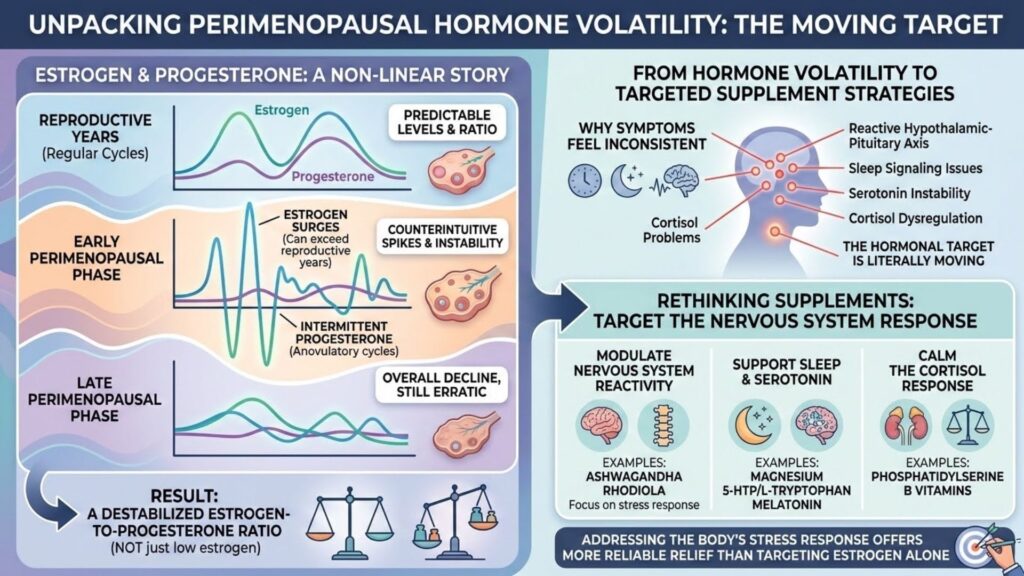
Estrogen in perimenopause is not consistently low. The ovaries are producing increasingly erratic amounts as the follicular pool diminishes and ovulation becomes less predictable. Some cycles, particularly in early perimenopause, feature estrogen surges that exceed anything the reproductive years produced. Others feature sharp drops. Progesterone, which depends on ovulation occurring, becomes increasingly insufficient because cycles without ovulation, known as anovulatory cycles, produce no progesterone at all.
The result is not estrogen deficiency in the traditional sense. It is a destabilized estrogen-to-progesterone ratio combined with an increasingly reactive hypothalamic-pituitary axis trying to compensate. This is why symptoms feel so inconsistent from month to month. The hormonal target is literally moving.
Supplement strategies that address the nervous system response to this volatility, the cortisol dysregulation, the impaired sleep signaling, the serotonin instability, tend to produce more reliable relief than those targeting estrogen directly.
Hot flashes: the vasomotor mechanism and what addresses it
Hot flashes are among the most studied perimenopausal symptoms and among the most poorly understood by the women experiencing them.
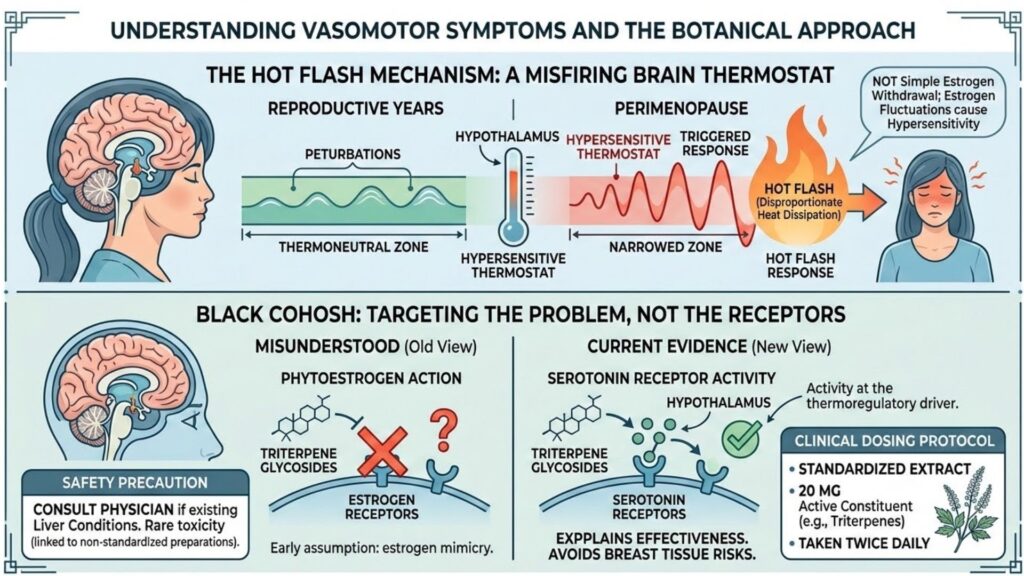
The mechanism begins in the hypothalamus, the brain region responsible for thermoregulation. As estrogen fluctuates, the hypothalamic thermostat becomes hypersensitive, narrowing the thermoneutral zone in which the body feels comfortable. Small temperature perturbations that would ordinarily go unnoticed trigger disproportionate heat dissipation responses. That is the flash. It is a misfiring thermostat, not a simple estrogen withdrawal effect.
Black cohosh is the most thoroughly studied botanical for vasomotor symptom relief. The German Commission E, Europe’s equivalent of a herbal medicine regulatory body, formally approved it for menopausal complaints in the 1980s, and the evidence base has continued to grow since. The National Center for Complementary and Integrative Health’s black cohosh overview summarizes the current evidence fairly, including its limitations.
What was originally misunderstood about black cohosh is instructive. Early research assumed it acted as a phytoestrogen, mimicking estrogen at receptor sites. Current evidence points to a different mechanism entirely, activity at serotonin receptors in the hypothalamus, which is precisely the region driving the thermoregulatory dysfunction. This explains both its effectiveness and why it does not appear to carry the breast tissue risks associated with estrogen supplementation.
A standardized extract providing 20 mg of the primary active constituent, taken twice daily, is the most clinically studied dosing protocol. Women with existing liver conditions should consult a physician before use.
Sleep: the symptom that unravels everything else
Poor sleep during perimenopause is not simply a consequence of night sweats. It reflects a deeper disruption in the neurochemical architecture of sleep itself.
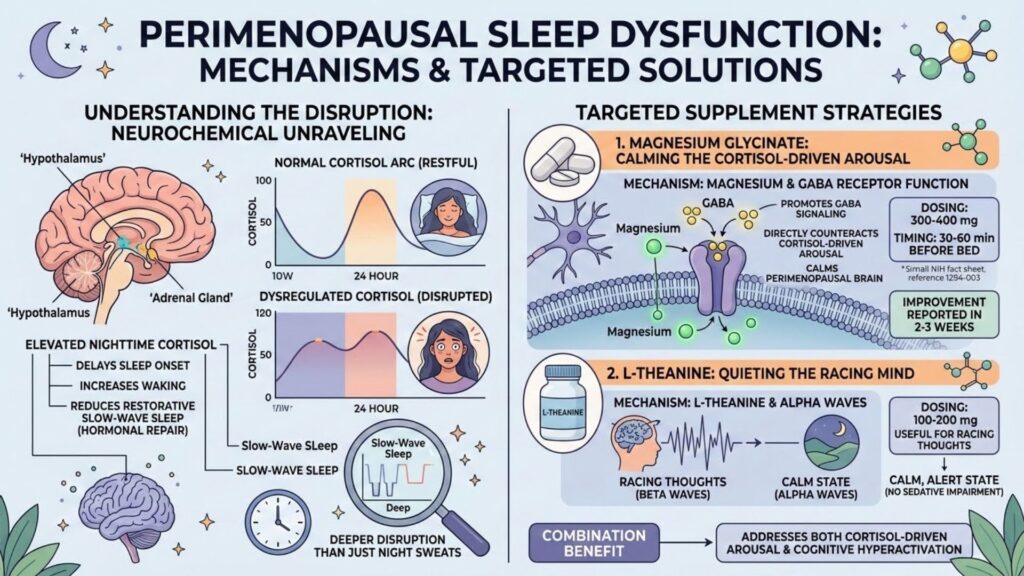
Cortisol, which should follow a predictable 24-hour arc with its lowest levels in the evening and peak levels in the early morning, becomes dysregulated during perimenopause. Elevated nighttime cortisol is one of the most consistent findings in perimenopausal women with sleep complaints. It delays sleep onset, increases nighttime waking, and reduces the restorative slow-wave sleep that the body depends on for hormonal repair.
Magnesium glycinate at 300 to 400 mg taken 30 to 60 minutes before bed is the single most impactful low-risk intervention for this specific pattern. Magnesium supports GABA receptor function, which directly counteracts the cortisol-driven arousal that keeps the perimenopausal brain from transitioning into sleep. The NIH magnesium fact sheet covers the GABA interaction in detail for anyone who wants the mechanistic depth.
Most women who commit to consistent magnesium glycinate use report meaningful sleep improvement within two to three weeks. This is one of the faster-responding interventions in the perimenopausal toolkit.
L-theanine at 100 to 200 mg is a useful complement for women whose primary nighttime complaint is racing thoughts rather than physical restlessness. It promotes alpha wave activity in the brain, which produces a calm, alert state conducive to sleep onset without the sedative effect that impairs morning function. Taken alongside magnesium, the combination addresses both the cortisol-driven arousal and the cognitive hyperactivation that characterizes disrupted perimenopausal sleep.
Ashwagandha and the HPA axis: getting to the root of perimenopausal anxiety
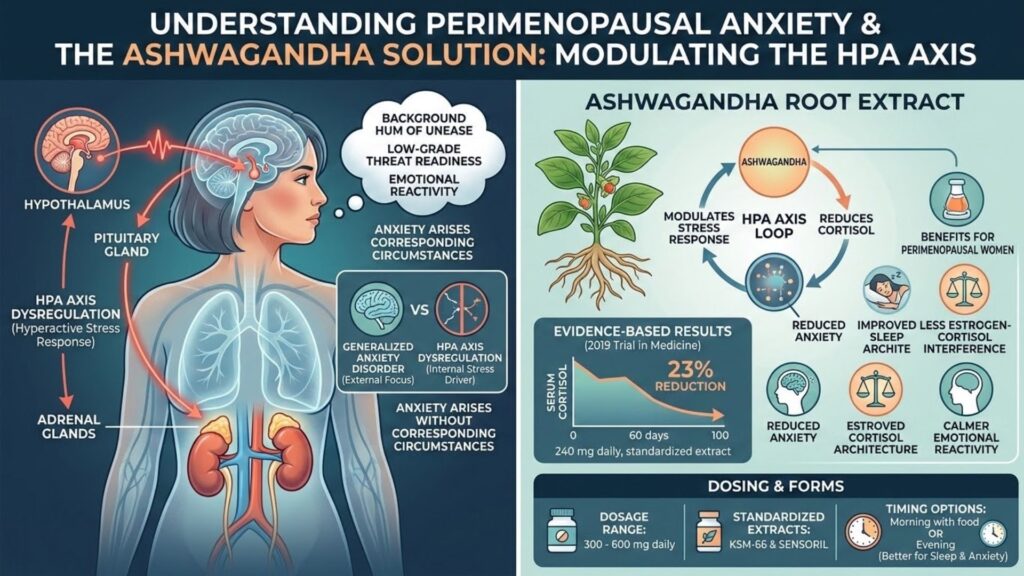
The anxiety that arrives during perimenopause often confuses women who have never experienced it before. It is frequently described as a background hum of unease, a low-grade readiness for threat that does not correspond to actual circumstances. This is HPA axis dysregulation, not generalized anxiety disorder, though the lived experience can feel indistinguishable.
Ashwagandha, specifically the root extract, is among the most evidence-supported adaptogens for reducing cortisol and modulating the stress response. A well-designed double-blind trial published in Medicine in 2019 found that 240 mg of standardized ashwagandha root extract daily reduced serum cortisol by approximately 23 percent over 60 days. That is a clinically meaningful reduction.
For perimenopausal women, the impact extends beyond anxiety. Lower cortisol improves sleep architecture, reduces the cortisol-estrogen interference that worsens hormonal volatility, and often produces a noticeable improvement in the emotional reactivity that makes the perimenopausal transition feel unmanageable on hard days.
The KSM-66 and Sensoril extracts are the most studied standardized forms. Dosing ranges from 300 to 600 mg daily. Some women do better taking it in the morning with food; others prefer the evening. Given its cortisol-lowering and sleep-promoting properties, the evening dose is a reasonable starting point for women whose primary complaints are anxiety and sleep disruption.
Brain fog: the perimenopausal symptom nobody warns you about
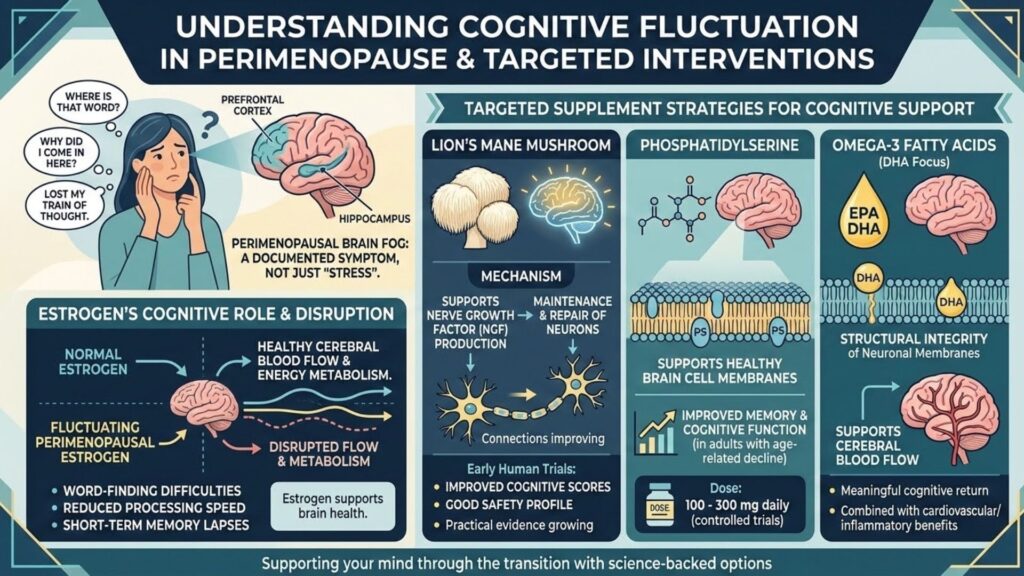
It was not until I mentioned misplacing words mid-sentence to my clinician that I realized cognitive fog was a documented perimenopausal symptom with biological causes and not just stress.
Estrogen plays a significant role in cerebral blood flow and in the brain’s energy metabolism. The fluctuating estrogen environment of perimenopause disrupts both, contributing to the word-finding difficulties, reduced processing speed, and short-term memory lapses that women in this transition frequently report.
Lion’s mane mushroom is gaining genuine traction in the cognitive health literature. It supports the production of nerve growth factor, which promotes the maintenance and repair of neurons. Early human trials show improvements in mild cognitive impairment scores. The research base is still smaller than the botanical deserves, but the mechanism is plausible, the safety profile is good, and the practical evidence from clinical use is accumulating.
Phosphatidylserine is a less widely known but well-studied option. It is a phospholipid found in high concentrations in brain cell membranes, and supplemental PS has shown improvements in memory and cognitive function in adults experiencing age-related cognitive decline. Doses of 100 to 300 mg daily are the range most commonly studied in controlled trials.
Omega-3 fatty acids, specifically DHA, maintain the structural integrity of neuronal membranes and support cerebral blood flow. For perimenopausal women already taking omega-3s for cardiovascular or inflammatory reasons, the cognitive benefits represent a meaningful additional return on the same supplemental investment.
A practical overview of the core perimenopausal supplement stack
| Supplement | Primary target | Form to choose | Dose range | Time to effect |
|---|---|---|---|---|
| Black Cohosh | Hot flashes, vasomotor symptoms | Standardized extract | 20 mg twice daily | 4-8 weeks |
| Magnesium Glycinate | Sleep, GABA, cortisol | Glycinate form only | 300-400 mg at night | 2-3 weeks |
| Ashwagandha | Cortisol, anxiety, HPA axis | KSM-66 or Sensoril | 300-600 mg daily | 4-8 weeks |
| L-Theanine | Sleep onset, cognitive calm | Free-form L-theanine | 100-200 mg at night | 1-2 weeks |
| Lion’s Mane | Cognitive clarity, NGF support | Dual-extract | 500-1,000 mg daily | 8-12 weeks |
| Omega-3 (EPA + DHA) | Inflammation, mood, cognition | Fish oil or algae | 1,000-2,000 mg daily | 6-8 weeks |
Building a protocol that fits where you actually are
Perimenopause spans a window that can last anywhere from two to ten years. The symptoms and their intensity shift considerably across that span. Early perimenopause, when cycles are still occurring but increasingly irregular, responds differently to interventions than late perimenopause, when cycles have become rare and estrogen is trending lower overall.
Start with the symptom that is most disruptive to your daily function. For most women, that is either sleep or mood. Magnesium glycinate and ashwagandha address both simultaneously and carry the most consistent evidence base for the perimenopausal window. Add black cohosh if vasomotor symptoms are significant. Layer in cognitive support supplements once the sleep and anxiety foundation is stable, since cognitive performance improves substantially when those two variables are addressed first.
Track symptoms across cycles rather than across weeks. Perimenopausal symptoms are cyclical even when they feel constant, and a written record reveals patterns that daily perception misses entirely.
Women who are approaching the later stages of perimenopause, particularly those whose cycles are becoming increasingly spaced apart, will find the transition to post-menopausal supplementation is smoother when planned deliberately. The natural supplements for menopause article covers how the supplement priorities shift once menstruation has ceased, particularly around cardiovascular protection and long-term cognitive longevity, two areas where the strategy changes meaningfully from the perimenopausal approach.
Bone health is the other area that deserves deliberate attention during perimenopause rather than waiting until after. Estrogen fluctuation accelerates bone resorption in ways that often go unmeasured until a first fracture or unexpected DEXA result. The bone density supplements for women over 40 article outlines exactly why starting the calcium-D3-K2 protocol now produces better outcomes than waiting for a clinical trigger.
Perimenopause is the most underserved chapter in women’s health conversations, largely because it does not fit neatly into either the reproductive health category or the menopause category. It lives in the gap between them, which is precisely where the most impactful interventions can be made.
What would change about how you approach the next 12 months if you treated perimenopause not as a countdown to something ending, but as an active phase that responds meaningfully to the right nutritional decisions made now?