







Nobody prepares you for the silence.
Not the silence of the symptoms quieting down, but the silence of the medical conversation that should have been happening for years and simply was not. Menopause remains one of the most underserved chapters in women’s healthcare, a universal biological transition experienced by every woman who lives long enough to reach it, and yet one that still receives a fraction of the research investment, clinical attention, and nutritional guidance directed at earlier reproductive stages.
In 2026, that is slowly beginning to change. The science on non-pharmaceutical menopause support has matured considerably over the past decade. The evidence base is specific enough now to separate what genuinely works from what is primarily marketing, and the distinction matters because the supplement aisle marketed to menopausal women contains both in roughly equal measure.
This article is not about managing menopause with a tolerant shrug. It is about understanding which interventions have real clinical traction, which ones come with important caveats, and how to build a long-view supplement strategy for a life stage that could span 30 or more years. Women who want the full hormonal picture across every life stage will find the complete guide to supplements for women’s hormonal balance provides the essential framework. This article goes deep on the post-menopausal chapter specifically.
What menopause actually changes in your biology
Menopause is defined clinically as 12 consecutive months without menstruation. It is not a moment. It is a threshold, and crossing it marks a permanent shift in the hormonal environment that shapes virtually every system in the body.
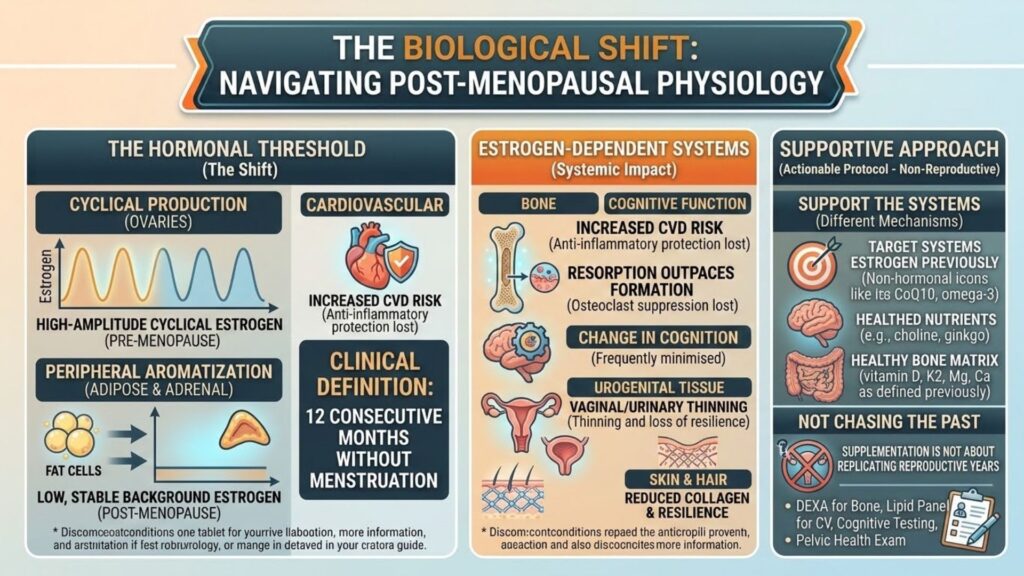
Estrogen does not disappear entirely after menopause. The ovaries cease to be the primary production site, but adipose tissue and the adrenal glands continue to produce small amounts through a process called peripheral aromatization. What disappears is the cyclical, high-amplitude estrogen that governed the reproductive years. What remains is a low, relatively stable background level that is insufficient to maintain the tissues and systems that depended on higher concentrations.
The consequences extend well beyond hot flashes. Cardiovascular disease risk increases meaningfully in the years following menopause, partly because estrogen previously exerted a protective anti-inflammatory effect on arterial tissue. Bone resorption continues to outpace formation without estrogenic suppression of osteoclast activity. Cognitive function changes in ways that women frequently describe but clinicians have historically minimized.
Supplementation at this stage is not about chasing the hormonal environment of the reproductive years. It is about supporting the systems that estrogen previously maintained through different, available mechanisms.
Soy isoflavones: why this works for some women and not others?
Soy isoflavones are the most studied phytoestrogens in the menopause literature. They bind weakly to estrogen receptors, particularly the beta subtype, and can produce modest estrogenic effects in tissues that have lost their primary estrogen input.
The clinical results, however, are famously inconsistent. Some trials show significant reductions in hot flash frequency and severity. Others show almost no effect. The real explanation turns out to be considerably more interesting than variability in study design.
The active compound responsible for most of the clinical benefit is not actually the isoflavone itself. It is equol, a metabolite produced when gut bacteria convert daidzein, a primary soy isoflavone. The problem is that only approximately 30 to 40 percent of Western women carry the gut bacteria capable of making this conversion. Women who can produce equol respond to soy isoflavone supplementation. Women who cannot largely do not.
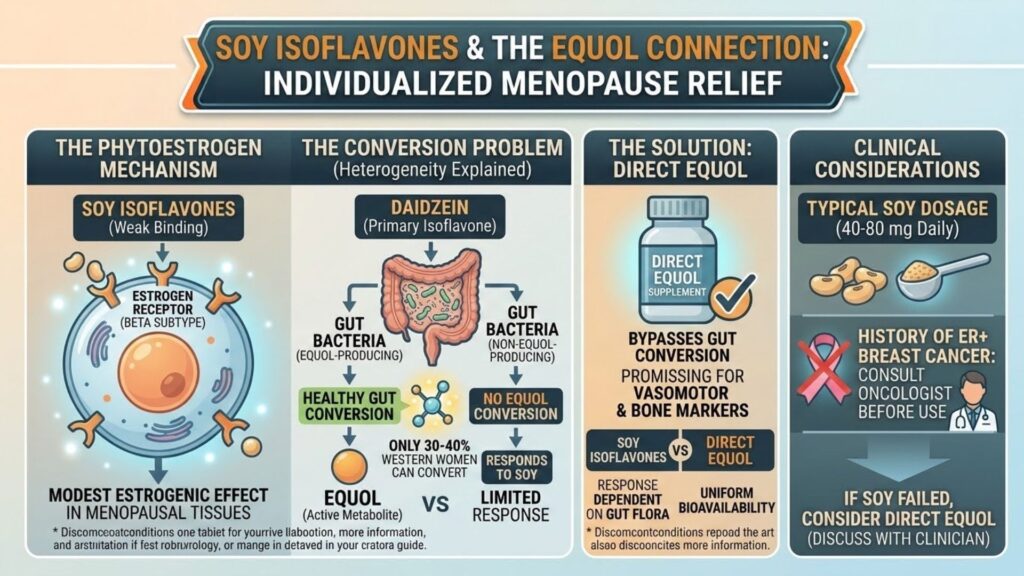
This explains the trial heterogeneity almost entirely.
Some supplement manufacturers have begun selling equol directly, bypassing the gut conversion requirement. Early trials on equol supplementation show promising results for vasomotor symptoms and bone markers. For women who have tried soy isoflavones without notable effect, direct equol supplementation is a logical next step worth discussing with a clinician.
Standard soy isoflavone doses in clinical trials range from 40 to 80 mg daily. Women with estrogen-receptor-positive breast cancer history should consult an oncologist before using any phytoestrogen supplement, as the estrogenic activity, though weak, adds a layer of complexity that requires individual clinical judgment.
Red clover: a broader phytoestrogen profile
Red clover contains four isoflavones rather than soy’s primary two, including formononetin and biochanin A alongside daidzein and genistein. This broader profile means it delivers precursors to equol through multiple pathways, which may explain why some women who respond poorly to soy isoflavones do better with red clover.
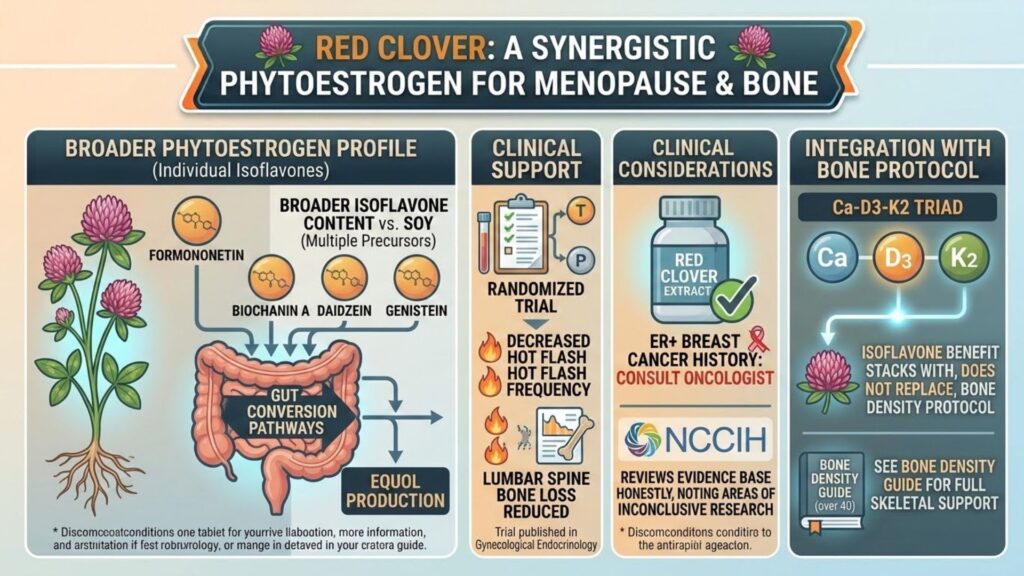
The clinical evidence supports red clover particularly for hot flash frequency reduction and for bone density markers. A randomized trial published in Gynecological Endocrinology found that red clover isoflavone supplementation significantly reduced both hot flash frequency and lumbar spine bone loss in postmenopausal women compared to placebo.
The National Center for Complementary and Integrative Health’s red clover page summarizes the current evidence base honestly, including areas where the research remains inconclusive. The same considerations regarding estrogen-receptor-positive cancer history apply here as with soy isoflavones.
For women who are already managing their bone health protocol, the isoflavone benefit here stacks with the calcium-D3-K2 triad rather than replacing it. The bone density supplements for women over 40 guide covers the full skeletal support protocol in detail, including why the post-menopausal years require particular attention to both supplemental form and total daily intake.
Omega-3s: the cardiovascular priority nobody expected
Here is the shift that catches most women off guard when they read the actual research.
Before menopause, cardiovascular disease rates in women are significantly lower than in men of the same age. After menopause, that gap closes rapidly. Women’s cardiovascular risk trajectory steepens in the post-menopausal years in a way that makes the earlier decades look almost protected by comparison. The protection that was quietly operating in the background was largely estrogenic, anti-inflammatory, and vasodilatory in nature.
EPA and DHA step into this gap more effectively than almost any other supplement on the post-menopausal list.
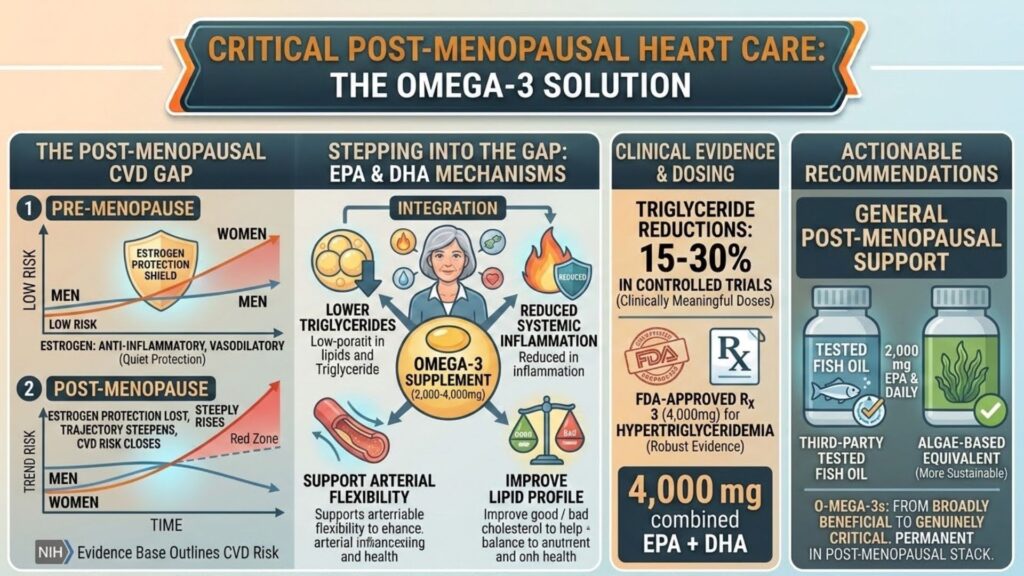
The NIH Office of Dietary Supplements omega-3 fatty acids resource outlines the cardiovascular evidence in considerable detail. The short version: EPA and DHA lower triglycerides at clinically meaningful doses, reduce systemic inflammation, support arterial flexibility, and improve the lipid profile in ways that matter significantly once estrogenic cardiovascular protection is gone.
At doses of 2,000 to 4,000 mg of combined EPA and DHA daily, omega-3 supplementation has demonstrated triglyceride reductions of 15 to 30 percent in controlled trials. For general post-menopausal cardiovascular support, 2,000 mg of combined EPA and DHA from a third-party tested fish oil or algae-based equivalent is a practical and well-supported starting point.
This is the life stage at which omega-3 supplementation shifts from broadly beneficial to genuinely critical. It deserves a permanent place in the post-menopausal supplement stack.
Lion’s mane: making the case for cognitive longevity
The cognitive changes of menopause, word-finding difficulties, reduced processing speed, memory lapses that feel sudden and unfamiliar, tend to improve for most women within a few years of the menopausal transition as the brain adapts to its new hormonal environment. But the long-term trajectory of cognitive aging becomes more relevant in this life stage, and the research on proactive cognitive support is more developed than it was even five years ago.
Lion’s mane mushroom occupies a genuinely interesting position in the cognitive supplement space. It is not a stimulant. What it does is support the production of nerve growth factor, a protein that promotes the survival, maintenance, and repair of neurons.
A landmark double-blind, placebo-controlled trial published in Phytotherapy Research found that older adults taking lion’s mane scored significantly higher on cognitive function assessments than those taking placebo, with those benefits declining when supplementation was discontinued. The research base is still smaller than the supplement deserves, but the mechanism is biologically plausible, the safety profile across multiple studies is favorable, and the practical clinical evidence is accumulating alongside the formal trials.
Dual-extract preparations, meaning extracts that capture both the water-soluble beta-glucans and the alcohol-soluble hericenones, represent the most complete form. A daily dose of 500 to 1,000 mg of a standardized dual extract is the range most commonly used in trials showing cognitive benefit. Expect a minimum of eight to twelve weeks before assessing effect, since the mechanism involves gradual neurotrophin support rather than acute neurotransmitter shifts.
Magnesium: the supplement that earns its place at every stage
Magnesium’s relevance does not diminish after menopause. It changes character.
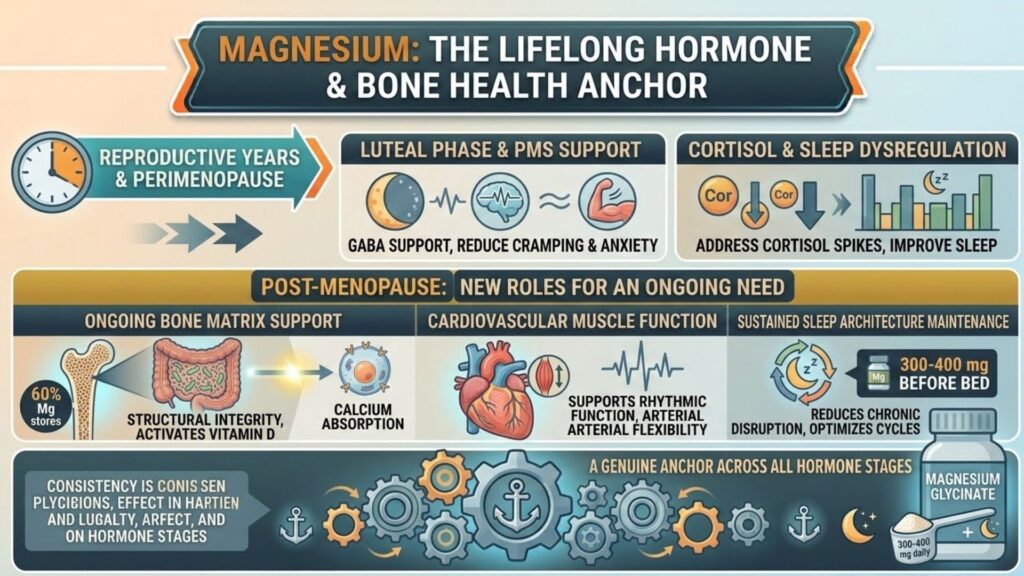
During the reproductive years, magnesium is primarily relevant for GABA support during the luteal phase and for reducing PMS-related cramping and anxiety. The transition into perimenopause shifts its role toward cortisol dysregulation and sleep disruption. By post-menopause, it takes on a third function: ongoing bone matrix support, combined with cardiovascular muscle function and sustained sleep architecture maintenance.
Approximately 60 percent of the body’s magnesium stores reside in bone tissue, where it contributes directly to structural integrity and activates vitamin D, which is central to the calcium absorption protocol. Sleep disruption, which remains common in post-menopausal women even after the most acute perimenopausal symptoms settle, continues to respond well to magnesium glycinate at 300 to 400 mg before bed.
The consistency of magnesium’s relevance across every hormonal life stage makes it one of the few supplements that functions as a genuine anchor across the full protocol.
A practical post-menopausal supplement stack
| Supplement | Primary role | Form to choose | Daily dose | Time to effect |
|---|---|---|---|---|
| Soy Isoflavones or Equol | Vasomotor symptom relief, bone support | Standardized extract or direct equol | 40-80 mg isoflavones or 10-20 mg equol | 8-12 weeks |
| Red Clover Isoflavones | Hot flash reduction, bone markers | Standardized isoflavone extract | 40-160 mg | 8-12 weeks |
| Omega-3 EPA + DHA | Cardiovascular protection, inflammation | Fish oil or algae (third-party tested) | 2,000-4,000 mg | 6-12 weeks |
| Lion’s Mane | Cognitive longevity, NGF support | Dual-extract standardized | 500-1,000 mg | 8-12 weeks |
| Magnesium Glycinate | Bone matrix, sleep, cardiovascular | Glycinate form | 300-400 mg at night | 2-3 weeks |
| Vitamin D3 with K2 | Calcium direction, bone maintenance | D3 with MK-7 | 2,000-4,000 IU + 100-200 mcg | Ongoing |
The long-game thinking that changes everything
Post-menopause is the longest hormonal chapter most women will navigate. If menopause arrives at 51, which is close to the median age in the United States, and life expectancy extends into the mid-to-late 80s, that represents more than three decades of post-estrogenic physiology. The supplement decisions made in the first five years of that period shape the trajectory of bone density, cardiovascular health, and cognitive function for everything that follows.
This is not an argument for anxiety. It is an argument for strategic, early investment in the systems that matter most at this stage. Cardiovascular protection through omega-3s and lifestyle. Skeletal maintenance through the calcium-D3-K2-magnesium protocol. Cognitive longevity through lion’s mane and DHA. Vasomotor relief through isoflavones calibrated to your individual gut microbiome.
Women who are still navigating perimenopause or approaching its final stages will find that starting many of these supplements before the formal menopause threshold produces measurably better outcomes. Building the protocol during the transitional years, as covered in the complete perimenopause supplement guide, means arriving at post-menopause with nutritional support already in place rather than building it reactively.
The science is clear enough to act on. The dosing is specific enough to do intelligently. The window that matters most is the one you are in right now.
Given everything you now know about what the post-menopausal years actually demand nutritionally, which of these interventions have you been underestimating, and what is the one change you would make this week if you were treating this chapter of your health with the same seriousness as everything that came before it?