








Nobody told me that the meaningful supplementation window for fertility opens three months before you actually try to conceive. That piece of information would have been useful earlier than I received it.
The 90-day timeline is not a marketing construct. It reflects a genuine biological reality: the egg your body releases at ovulation this month began its developmental journey roughly 90 days ago. The nutritional environment it grew within during that period, the mitochondrial energy available, the antioxidant protection, the folate status, shapes its quality in ways that a week of reactive supplementation simply cannot reverse.
Most preconception conversations start too late. Women begin taking a prenatal vitamin when they see a positive test, or a few weeks before they start trying. The biology places the most impactful nutritional window considerably further upstream than that.
If you have been reading through the complete guide to supplements for women’s hormonal balance, you already have a framework for how nutritional needs shift across the reproductive lifespan. Preconception is one of the most demanding and time-sensitive windows within that arc. This article works through the specific supplements with the strongest evidence, addresses what the prenatal vitamin aisle consistently gets wrong, and offers a practical framework for the protocol that actually moves the needle.
The 90-day biology that changes everything
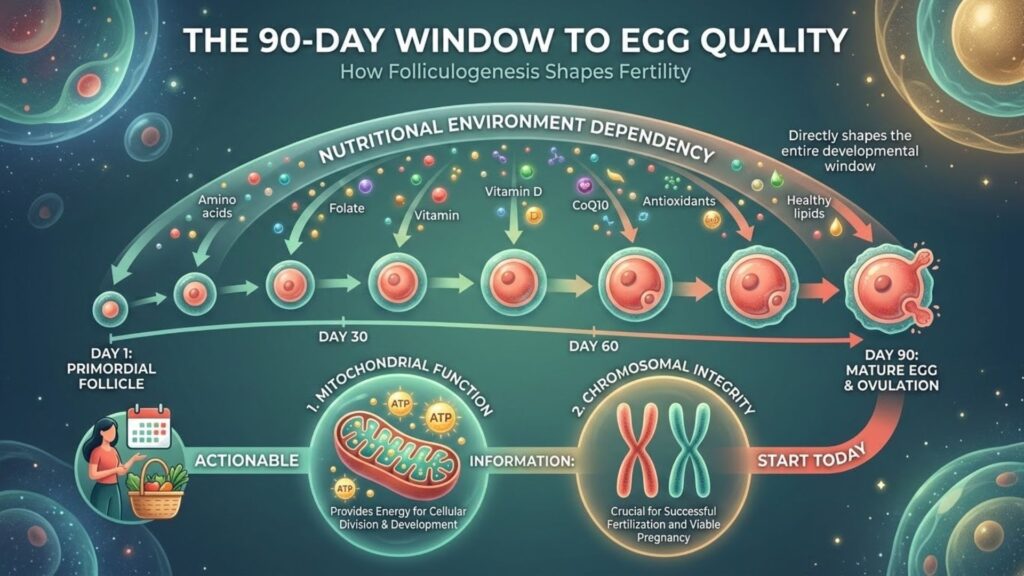
Folliculogenesis, the process by which a mature egg develops from a primordial follicle, takes approximately 90 days. During that entire window, the developing oocyte depends on the nutritional environment surrounding it for almost everything it needs to mature correctly.
Egg quality in clinical fertility language refers primarily to two things: chromosomal integrity and mitochondrial function. These two factors determine whether a fertilized egg can implant successfully and develop into a viable pregnancy. Both are directly influenced by nutritional status throughout the 90-day development window, not just in the days surrounding ovulation.
This is actionable information, not discouraging information. The protocol you start building today is shaping the egg quality your body will be working with three months from now. Starting earlier is always better. Starting now is still meaningful.
Folate vs. folic acid: a distinction with real consequences
The standard recommendation to take folic acid before and during pregnancy has been part of public health guidance for decades. The science underlying it is solid. Folate prevents neural tube defects, specifically the failure of the neural tube to close in the earliest weeks of fetal development, often before a woman even knows she is pregnant.
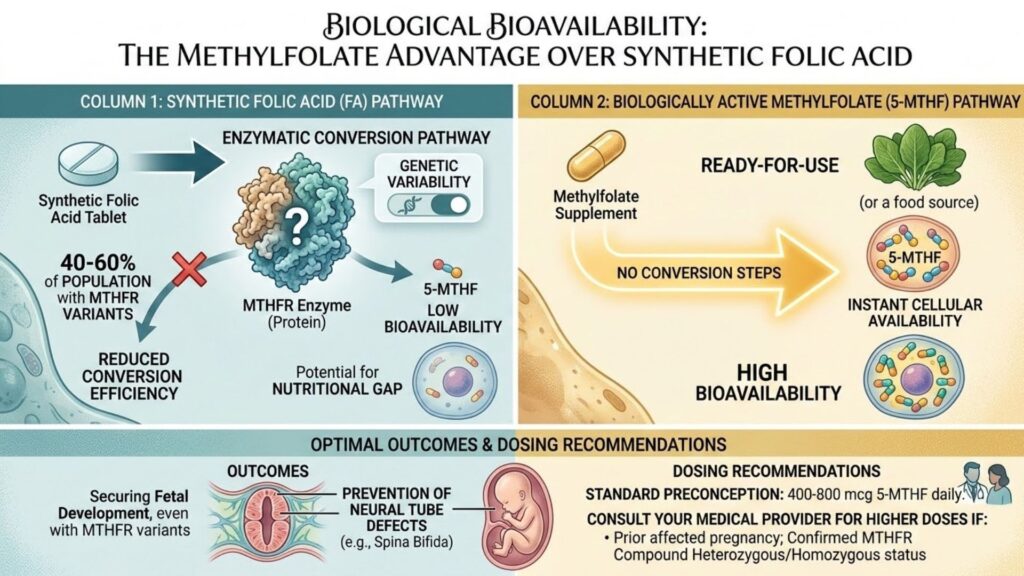
What that long-standing recommendation missed is the distinction between synthetic folic acid and its biologically active form, methylfolate, also known as 5-MTHF.
Folic acid is not the form your cells use. It requires enzymatic conversion by a protein called MTHFR before it becomes bioavailable. Research suggests that between 40 and 60 percent of the population carries variants in the MTHFR gene that reduce this conversion efficiency. Women with reduced MTHFR enzyme function cannot convert synthetic folic acid at adequate rates. Standard supplementation may leave a meaningful gap even when taken at the recommended dose.
Methylfolate bypasses this entirely. It arrives in the form cells can use immediately, without requiring the conversion step. The NIH Office of Dietary Supplements folate fact sheet outlines the biological distinctions clearly for anyone who wants to go deeper on the mechanisms.
The standard preconception dose is 400 to 800 mcg of methylfolate daily. Women with a prior pregnancy affected by a neural tube defect, or confirmed MTHFR compound heterozygous or homozygous status, should discuss higher doses with their OB, midwife, or reproductive endocrinologist before self-adjusting.
CoQ10: the mitochondrial case for egg quality
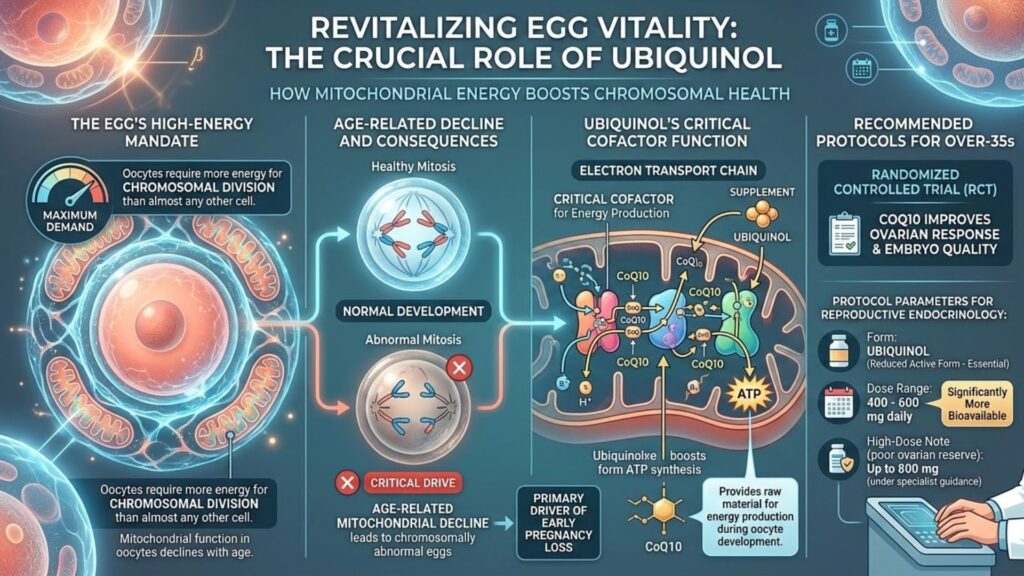
CoQ10 sits at an interesting moment in the fertility literature. In 2026, the evidence base has grown solid enough that many reproductive endocrinologists now recommend it as a standard component of preconception protocols for women over 35, not an optional add-on.
The biology is specific. Oocytes, egg cells, require more mitochondrial energy to complete chromosomal division than almost any other cell in the human body. That energy-intensive process determines whether a fertilized egg has the right chromosome count to develop into a viable pregnancy. Mitochondrial function in oocytes declines with age. The result is a higher proportion of chromosomally abnormal eggs, which is the primary driver of age-related fertility decline and early pregnancy loss.
CoQ10 functions as a critical cofactor in the mitochondrial electron transport chain. Providing it in supplemental form gives the developing oocyte raw material for energy production during its most demanding developmental period. A randomized controlled trial published in Fertility and Sterility found that CoQ10 supplementation prior to an IVF cycle improved both ovarian response and embryo quality in older women. These are not minor findings.
The form is not negotiable. Ubiquinol, the reduced active form, is significantly more bioavailable than ubiquinone, particularly in women over 35 whose cells have reduced capacity to convert between forms. Doses of 400 to 600 mg of ubiquinol daily represent the range most commonly studied in fertility protocols. Some reproductive endocrinologists work with doses as high as 800 mg in women with confirmed poor ovarian reserve.
Inositol: the PCOS intervention that changes the outcome
For women with polycystic ovary syndrome, inositol is among the most evidence-supported preconception interventions available. It is also one of the most consistently underutilized.
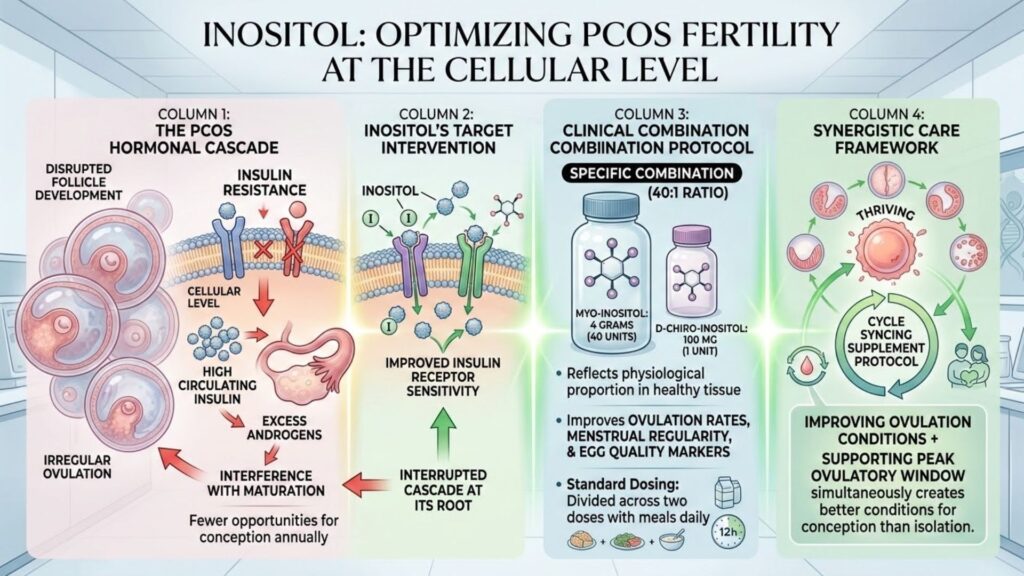
PCOS drives fertility challenges through a specific hormonal cascade. Insulin resistance at the cellular level disrupts the signaling that regulates follicle development and ovulation timing. High circulating insulin stimulates the ovaries to produce excess androgens. Those androgens interfere with follicle maturation. The result is irregular or absent ovulation, which means far fewer opportunities for conception in any given year.
Inositol improves insulin receptor sensitivity, which interrupts this cascade at its root rather than managing symptoms downstream.
The combination that performs most consistently in clinical trials is myo-inositol and D-chiro-inositol in a 40:1 ratio. This ratio reflects the physiological proportion found in healthy human tissue. Research consistently shows that this specific combination improves ovulation rates, menstrual regularity, and egg quality markers in women with PCOS. Standard dosing is 4 grams of myo-inositol combined with 100 mg of D-chiro-inositol daily, divided across two doses taken with meals.
Women who are also working with phase-specific supplementation will find that the cycle syncing supplement protocol provides a useful complementary framework. Improving the biological conditions for ovulation and supporting the peak ovulatory window simultaneously creates better overall conditions for conception than addressing either in isolation.
Vitamin D: the fertility nutrient most women are still deficient in
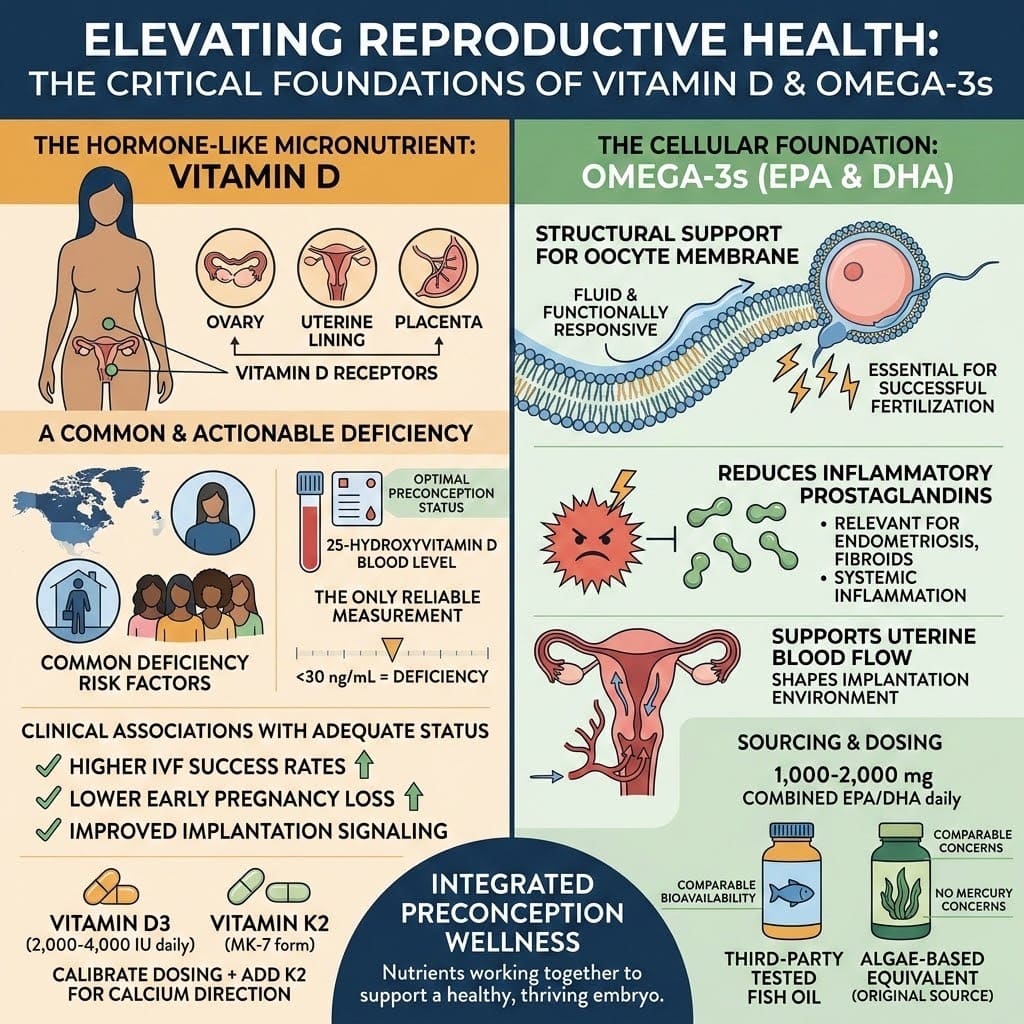
Vitamin D occupies an unusual position in reproductive health. It functions more like a hormone than a traditional micronutrient. Its receptors are expressed in the ovaries, the uterine lining, and the placenta. It participates directly in implantation signaling.
Vitamin D deficiency is consistently associated with lower IVF success rates, higher rates of early pregnancy loss, and impaired implantation. A 2019 meta-analysis of over 2,700 women undergoing IVF found that adequate vitamin D status was independently associated with significantly higher live birth rates, even after controlling for other variables.
The problem is that deficiency is genuinely common, particularly among women living in northern latitudes, spending limited time outdoors, or with darker skin tones that reduce cutaneous vitamin D synthesis. The only reliable way to assess your status is to measure it. A 25-hydroxyvitamin D blood level below 30 ng/mL indicates deficiency. The NIH Office of Dietary Supplements vitamin D resource is a useful reference point for understanding the clinical thresholds.
Most women benefit from 2,000 to 4,000 IU of vitamin D3 daily during the preconception period, calibrated based on baseline testing. Take it alongside vitamin K2 in the MK-7 form to direct calcium appropriately and prevent soft tissue accumulation.
Omega-3s: the foundation that does not get enough credit
EPA and DHA support fertility through several mechanisms that rarely appear in mainstream preconception conversations.
They provide structural support to cell membranes, including the oocyte membrane, which must remain fluid and functionally responsive for successful fertilization to occur. They reduce inflammatory prostaglandins, which is directly relevant for women with endometriosis, fibroids, or systemic inflammation affecting the uterine environment. And they support uterine blood flow, which shapes the implantation environment in meaningful ways.
A daily dose of 1,000 to 2,000 mg of combined EPA and DHA from a third-party tested fish oil, or an algae-based equivalent, covers most preconception needs. Algae-based omega-3s are worth knowing about if you avoid fish products. They are the original source from which fish accumulate EPA and DHA in the first place, and they deliver comparable bioavailability without the mercury concerns associated with larger predatory fish species.
What your prenatal vitamin probably gets wrong
Most prenatal vitamins sold on the pharmacy shelf contain synthetic folic acid rather than methylfolate. Many use iron forms that cause constipation. Most contain either no CoQ10 or a dose too low to be clinically meaningful, and provide vitamin D at levels insufficient to correct existing deficiency.
A quality prenatal can serve as a useful foundation. It is rarely sufficient as a standalone preconception protocol.
When selecting a prenatal, look for methylfolate over folic acid, iron bisglycinate over ferrous sulfate, vitamin D3 at a minimum of 1,000 IU, and vitamin K2 included in the formulation. Build CoQ10, omega-3s, and inositol as separate supplements adjusted to your specific situation, age, and diagnosed conditions. Think of the prenatal as the base layer, not the complete stack.
The 90-day protocol at a glance
| Supplement | Form to Choose | Daily Dose | Primary Fertility Role |
|---|---|---|---|
| Methylfolate | 5-MTHF | 400-800 mcg | Neural tube protection, DNA methylation |
| CoQ10 | Ubiquinol | 400-600 mg | Oocyte mitochondrial energy production |
| Myo-Inositol + D-Chiro (40:1) | Combined capsule or powder | 4g + 100 mg | Ovulation, insulin sensitivity, PCOS |
| Vitamin D3 | Cholecalciferol with K2 | 2,000-4,000 IU | Implantation signaling, IVF outcomes |
| Omega-3 (EPA + DHA) | Fish oil or algae-based | 1,000-2,000 mg | Cell membrane integrity, uterine blood flow |
| Iron Bisglycinate | Bisglycinate form only | Per ferritin result | Oocyte health, energy, cycle support |
Building the protocol: where to start
The 90-day window is a biological guideline, not a hard deadline. Starting three months before you plan to try is the evidence-supported recommendation, but starting earlier carries only upside. Starting later is still meaningfully better than not starting at all.
Introduce supplements incrementally rather than beginning the full stack simultaneously. Assess your baseline vitamin D through a simple blood test before committing to a dose. If you have a history of irregular cycles, confirmed PCOS, or known MTHFR variants, those specific findings should shape the protocol more than any generic preconception advice.
Work with a clinician who is familiar with functional nutrition where possible. A reproductive endocrinologist, functional medicine practitioner, or fertility-trained nutritionist can help interpret lab work and calibrate the stack to your actual biology rather than a population average.
Women in their mid-to-late 30s navigating fertility decisions may also find that the hormonal picture is more complex than preconception nutrition alone addresses. Early perimenopausal shifts and fertility planning can overlap in ways that catch women off guard. The article on supplements for perimenopause symptoms adds relevant context for women who are noticing those changes alongside their preconception preparations.
The 90 days before conception may be the most nutritionally consequential window in a woman’s reproductive life. If you knew with certainty that the decisions you make in the next three months would directly shape that outcome, what would you do differently starting today?