








The DEXA scan result arrived in my inbox on a Tuesday afternoon, and I sat with it for a long time before I knew what to do with it.
Osteopenia. Not osteoporosis, not yet, but a measurable reduction in bone mineral density at 46 that my clinician described as not unusual for your age in a tone that somehow made it feel both normal and alarming at the same time. I had exercised consistently for years. I ate reasonably well. I had not thought about my bones since the last time someone mentioned calcium in passing.
That is the nature of bone loss. It is completely silent, and by the time most women receive a clinical signal, the process has been running for years.
The biology here is genuinely sobering. Bone density peaks somewhere between the late 20s and early 30s. A gradual decline begins through the 30s that most women never notice. Then perimenopause arrives, and the rate of bone resorption accelerates sharply as estrogen levels become erratic. In the first five years following menopause, some women lose between 10 and 20 percent of their bone mineral density. The window that most powerfully determines your fracture risk decades from now is the one you are navigating right now.
For women building a complete hormonal health strategy, the complete guide to supplements for women’s hormonal balance maps the full life-stage picture, including why bone health connects so directly to the hormonal transitions of the 40s and 50s. This article focuses on the specific supplementation protocol that moves the needle on bone density.
Why bone loss accelerates in perimenopause?
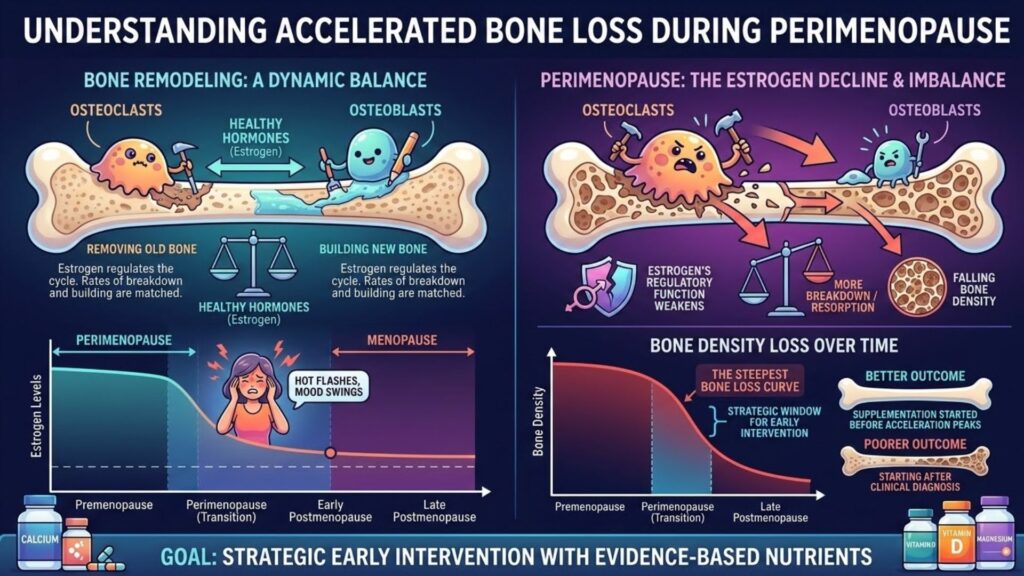
Bone is not static tissue. It is constantly being broken down and rebuilt in a process called remodeling. Two cell types manage this process: osteoclasts, which break down old bone, and osteoblasts, which build new bone. Under healthy hormonal conditions, these two activities stay roughly in balance.
Estrogen plays a direct regulatory role in this balance. It suppresses osteoclast activity, keeping bone breakdown in check. When estrogen fluctuates unpredictably during perimenopause and then declines permanently after menopause, that suppressive effect weakens. Osteoclasts become significantly more active. Bone resorption outpaces formation. Density falls.
This is not a slow, gradual process once it begins in earnest. The years immediately surrounding menopause represent the steepest bone loss curve in a woman’s life. Supplementation started before the acceleration peaks produces meaningfully better outcomes than supplementation started in response to a clinical diagnosis.
Calcium: the form you choose changes everything
Calcium is the most abundant mineral in bone. It also generates more confusion in the supplement aisle than almost any other nutrient.
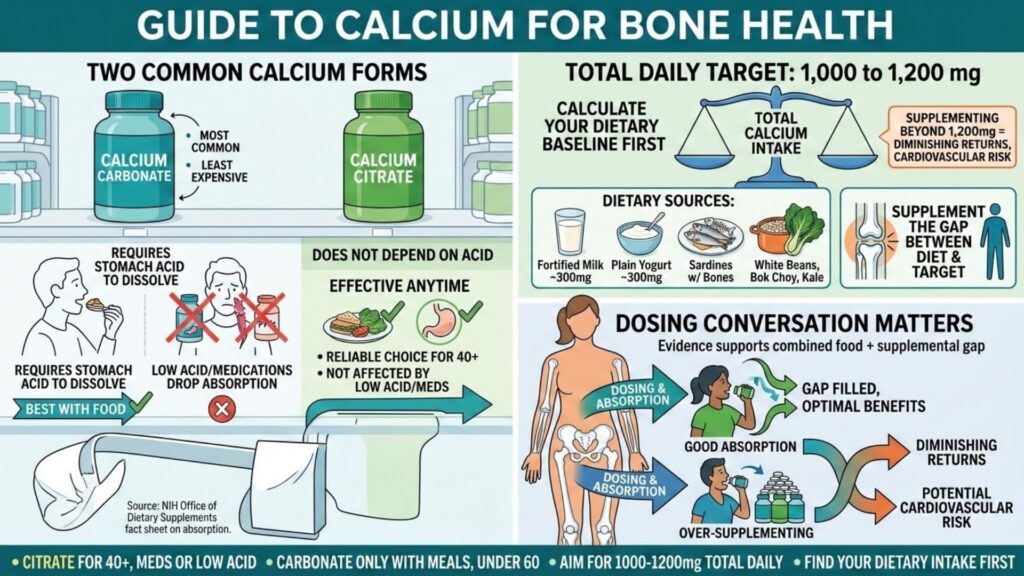
Two forms dominate the market. Calcium carbonate is the most common and the least expensive. It requires adequate stomach acid to dissolve, which means it absorbs best when taken with food. For women under 60 with healthy digestive function, it is a reasonable option when taken correctly. For women on proton pump inhibitors, antacids, or with any history of low stomach acid, its absorbability drops considerably.
Calcium citrate does not depend on stomach acid. It absorbs effectively regardless of whether food is present or stomach acid production is adequate. It is the more reliable choice for women in their 40s and beyond, particularly those who notice digestive changes or take acid-suppressing medications.
The dosing conversation matters as much as the form. Current evidence supports a total daily calcium intake, from food and supplements combined, of approximately 1,000 to 1,200 mg. Supplementing the gap between what your diet provides and that target is the approach the evidence supports. The NIH Office of Dietary Supplements calcium fact sheet lays out the absorption evidence and upper intake limits in useful detail.
Food sources cover more than most women realize. A cup of plain yogurt delivers roughly 300 mg. A cup of fortified milk provides a similar amount. Sardines with bones, white beans, and leafy greens like bok choy and kale are all meaningful contributors. Calculate your dietary baseline before deciding how much supplemental calcium you actually need.
Vitamin D3: the absorption gatekeeper nobody tests until it is too late
Vitamin D is not simply a bone health nutrient. It functions as a steroid hormone with receptors expressed across virtually every tissue type in the body. Its relevance to bone health is specific and well-established: without adequate vitamin D, calcium absorption from the intestine falls to approximately 10 to 15 percent of dietary intake. With sufficient vitamin D, that absorption rate rises to 30 to 40 percent. The difference is not marginal.
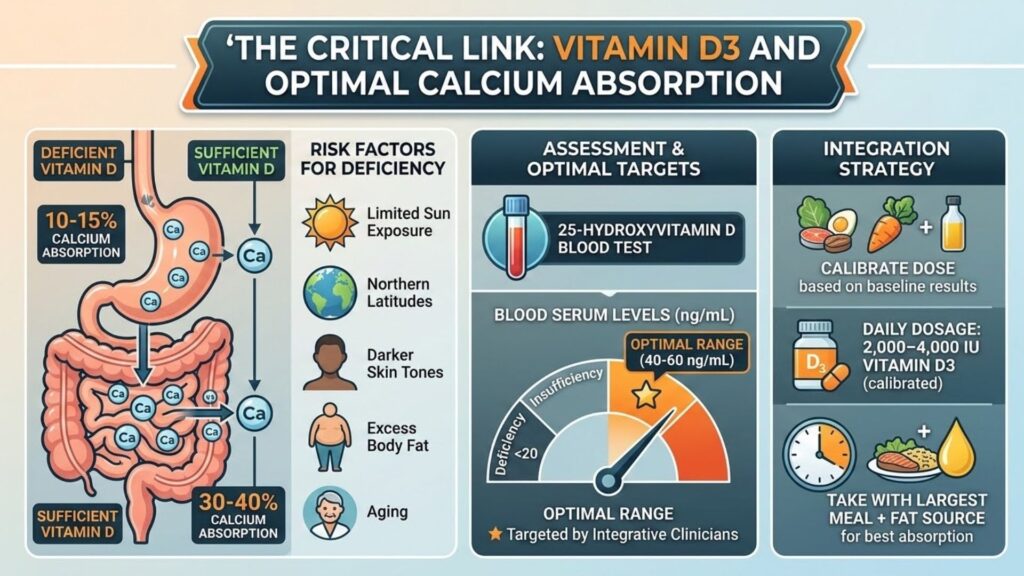
The more difficult reality is that deficiency is common across all demographic groups. Women who spend limited time outdoors, live above the 37th parallel during winter months, have darker skin tones, or carry excess body fat are at particularly elevated risk.
The NIH Office of Dietary Supplements vitamin D resource provides clear guidance on what constitutes deficiency versus sufficiency, and why the testing threshold matters for interpreting results accurately.
A 25-hydroxyvitamin D blood test is the only reliable way to establish your baseline. Most integrative clinicians target a serum level of 40 to 60 ng/mL for optimal bone protection, rather than simply avoiding the clinical deficiency threshold of 20 ng/mL. Most women need between 2,000 and 4,000 IU of vitamin D3 daily to maintain levels in that optimal range, with the specific dose calibrated to the baseline result rather than guessed at.
Take vitamin D3 with your largest meal of the day, alongside a dietary fat source. It is fat-soluble and absorbs significantly better in the presence of dietary fat.
Vitamin K2: the piece that makes the other two work correctly
Here is the part of the bone density conversation that most mainstream advice leaves out.
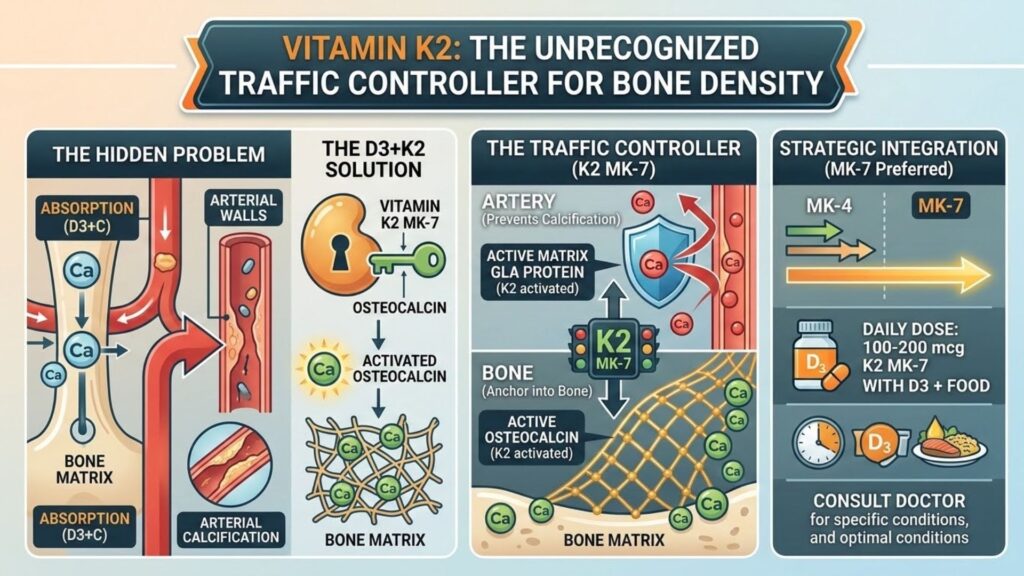
When vitamin D3 increases calcium absorption from the intestine, that calcium needs to be directed correctly. Without adequate vitamin K2, absorbed calcium can accumulate in soft tissue, including arterial walls, rather than being incorporated into bone matrix. This is not a theoretical concern. Several observational studies have linked high supplemental calcium intake without K2 to increased arterial calcification.
Vitamin K2, specifically the MK-7 form, activates a protein called osteocalcin, which binds calcium and anchors it into bone matrix. It simultaneously activates matrix Gla protein, which prevents calcium from depositing in arterial tissue. In practical terms, K2 is the traffic controller that sends absorbed calcium where it needs to go.
The MK-7 form is the preferred option for supplementation. It has a longer half-life than MK-4, which means it remains active in the bloodstream for significantly longer and requires only one daily dose rather than multiple. A dose of 100 to 200 mcg of K2 MK-7 taken alongside vitamin D3 completes the absorption and utilization triad.
Women on warfarin or other vitamin K-dependent blood thinners should consult their physician before adding K2, as it influences coagulation pathways.
Magnesium: the bone mineral that gets forgotten
Approximately 60 percent of the body’s magnesium is stored in bone tissue. It contributes directly to the structural integrity of the bone mineral matrix and also activates vitamin D, which matters considerably given how central vitamin D is to the entire protocol.
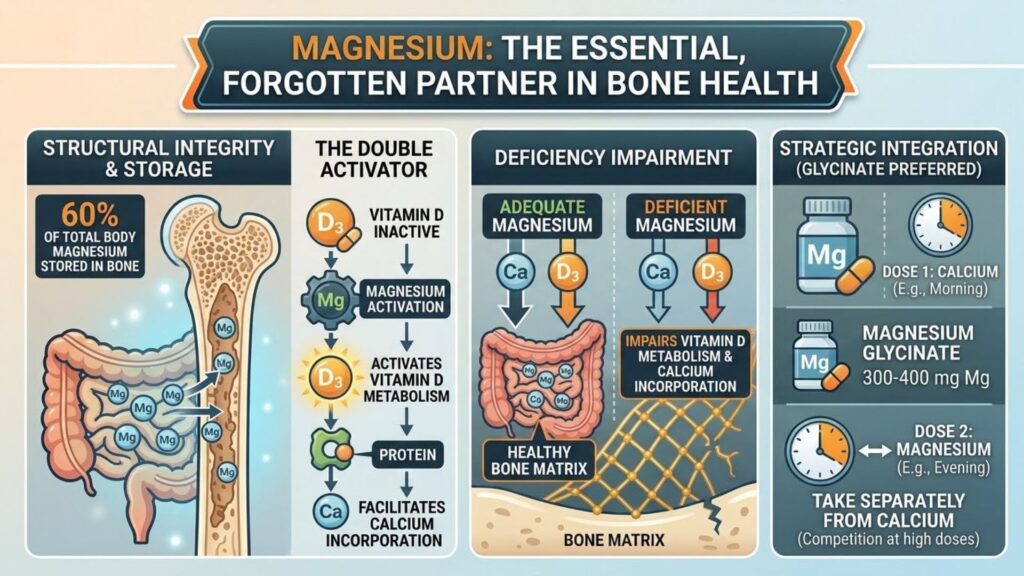
Magnesium deficiency impairs both vitamin D metabolism and calcium incorporation into bone. Women who supplement calcium and vitamin D without adequate magnesium are running the protocol at reduced efficiency.
The glycinate form offers the best absorption with the least digestive disruption. A dose of 300 to 400 mg daily, taken separately from calcium since the two compete for absorption at high doses, covers most women’s needs.
Boron and Silica: the underrated pair
These two minerals appear on almost no mainstream bone health supplement labels. The research supporting both is modest but consistent enough to take seriously.
Boron influences bone metabolism through several pathways. It extends the half-life of estrogen in postmenopausal women, helping to maintain some residual estrogenic bone protection. It also appears to activate vitamin D and improve calcium and magnesium retention in tissue. A controlled study published in the FASEB Journal found that boron supplementation at 3 mg per day significantly reduced urinary calcium and magnesium losses in postmenopausal women, which is directly relevant to bone retention.
Silica, found in food sources like oats, leeks, and green beans, supports the collagen cross-linking that gives bone its structural flexibility. Bone mineral density is one measure of skeletal health. Bone quality, meaning the strength and resilience of the collagen matrix within which mineral sits, is another. Silica addresses the second dimension that calcium supplementation alone cannot touch. A supplemental dose of 10 to 30 mg of orthosilicic acid daily is the form with the most bioavailability data.
The complete bone health stack at a glance
| Supplement | Form to choose | Daily dose | Primary role |
|---|---|---|---|
| Calcium | Citrate (preferred) or Carbonate with food | 500-600 mg (gap from diet) | Bone mineral structure |
| Vitamin D3 | Cholecalciferol | 2,000-4,000 IU (test first) | Calcium absorption |
| Vitamin K2 | MK-7 | 100-200 mcg | Directs calcium to bone, not arteries |
| Magnesium | Glycinate | 300-400 mg | Bone matrix, D3 activation |
| Boron | Ionic or amino acid chelate | 3 mg | Calcium retention, estrogen extension |
| Silica | Orthosilicic acid | 10-30 mg | Collagen matrix quality |
The testing framework that makes this actionable
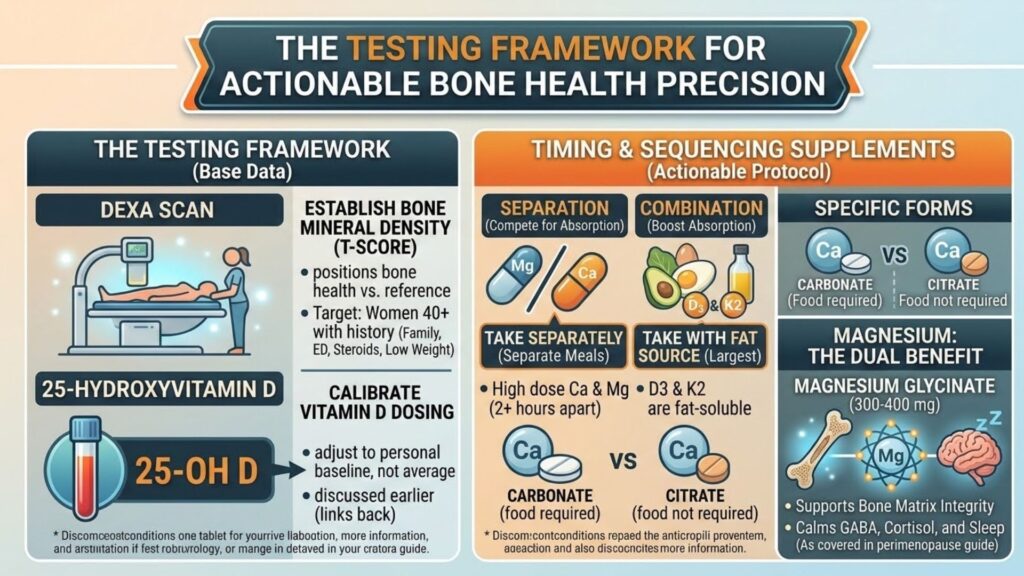
Supplementing for bone health without any baseline data is, frankly, a suboptimal approach. Two tests make the protocol significantly more precise.
A DEXA scan establishes your current bone mineral density and gives you a T-score that positions your bone health against the population reference. Women 40 and over who have never had a baseline DEXA should consider requesting one, particularly those with a family history of osteoporosis, a history of disordered eating, long-term corticosteroid use, or low body weight.
A 25-hydroxyvitamin D blood test, discussed earlier, calibrates your vitamin D dosing to your actual starting point rather than a population average.
Timing and sequencing your supplement intake
Bone health supplements are particularly sensitive to how and when you take them, more so than almost any other nutritional protocol.
Calcium and magnesium compete for absorption at high doses. Take them at separate meals if you supplement both at meaningful doses. Calcium carbonate requires food; calcium citrate does not. Vitamin D3 and K2 absorb best with dietary fat, so a meal containing avocado, olive oil, nuts, or eggs is the ideal pairing. Iron and calcium compete at the absorption level as well. If you take iron, separate it from calcium by at least two hours.
Women in perimenopause who are also navigating sleep disruption, hot flashes, and mood instability will find that the magnesium serving double duty here is one of the more efficient aspects of this protocol. The same 300 to 400 mg of magnesium glycinate that supports bone matrix integrity also supports GABA signaling, cortisol regulation, and sleep architecture, as covered in detail in the supplements for perimenopause symptoms guide.
What changes after menopause
The bone loss acceleration that characterizes perimenopause does not stop immediately after menopause. It continues at a meaningful rate for several years before slowing. Women who have already passed the 12-month amenorrhea threshold that defines menopause will find that the calcium-D3-K2 protocol remains entirely relevant, with some additional considerations around cardiovascular protection and long-term supplementation strategy.
Women in post-menopause should pay particular attention to the cumulative total of supplemental calcium and to testing vitamin D levels annually rather than periodically, as maintenance dosing needs can drift over time. The natural supplements for menopause article addresses how the broader supplemental stack evolves in the post-menopausal years, particularly around cardiovascular and cognitive longevity supplements that work alongside bone health support.
Bone density is not a fixed asset you either have or do not have. It is a living tissue that responds to nutritional inputs over time. The research on targeted supplementation is clear enough to act on with confidence.
If you knew that the decisions you make about bone health in the next 12 months would determine your fracture risk and physical independence 20 years from now, what would you be willing to change about how you approach this particular chapter of your health?