


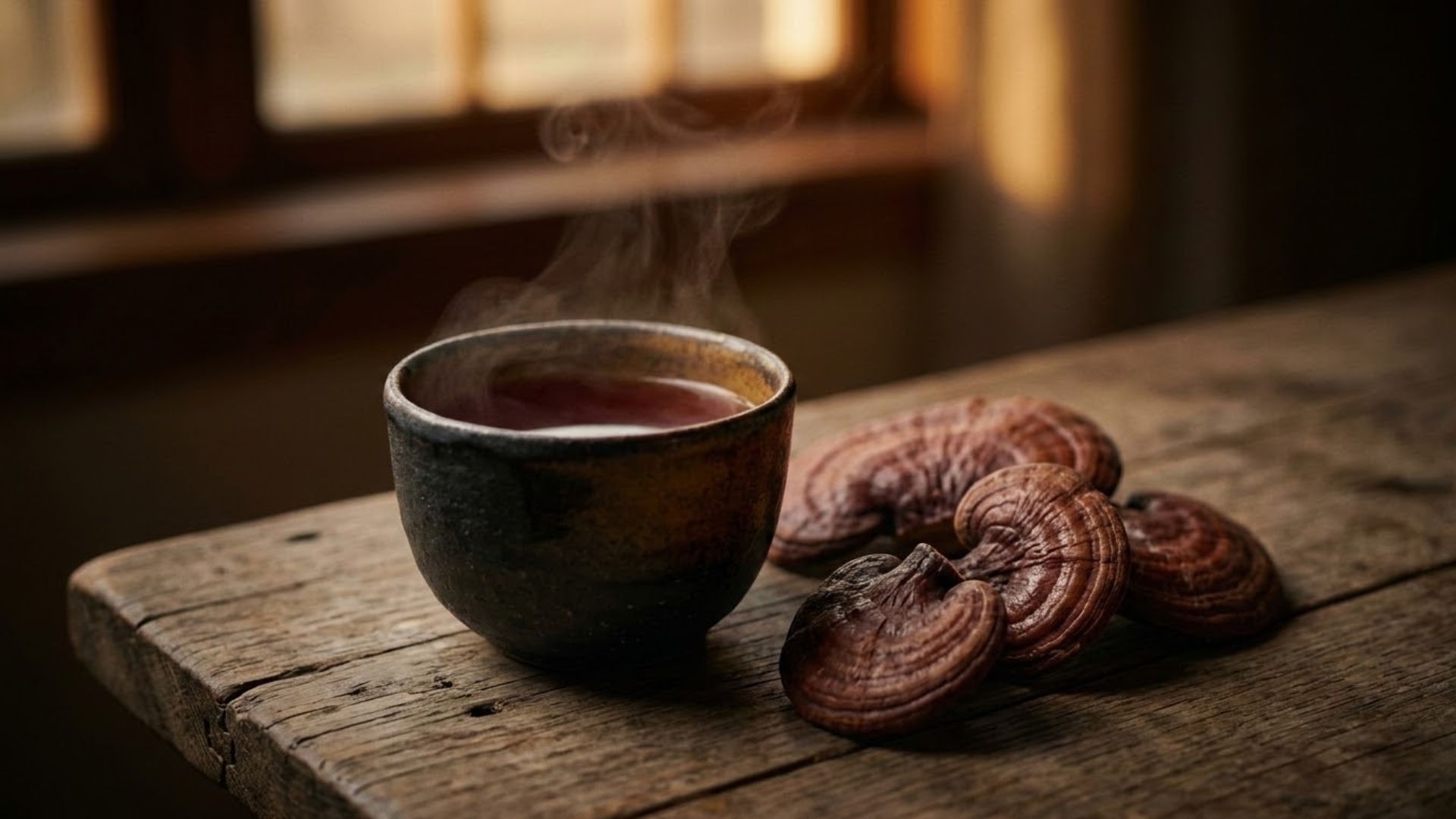



I once watched a friend drink four espressos before noon and still describe herself as “tired but vibrating.” That paradox, exhausted and wired at the same time, is the signature failure of how most of us chase focus in 2026. We keep pressing the gas pedal on a car that is already overheating. There is an older, stranger, far more patient answer, and it grows on dead logs in the forest.
Reishi. The mushroom that does not give you energy so much as it gives you back your composure. And in a culture addicted to stimulation, that makes it quietly radical.
The Focus Nobody Sells You
Here is the reframe worth sitting with. Almost every focus product on the market works by revving your nervous system. Caffeine, nootropics, the endless “clean energy” drinks. They push. Reishi pulls in the opposite direction, and understanding why means understanding the difference between two kinds of focus.
There is the sharp, buzzy focus of stimulation, the kind that feels productive until it tips into anxiety. And there is the settled, grounded focus that comes when your body finally stops sounding the alarm. Reishi aims squarely at the second. It does not whip your attention into place. It removes the static so attention can land on its own. That distinction sits at the heart of how these herbs support the body rather than override it, which the natural support for chronic stress framework unpacks in full.

A 2,000-Year Head Start
Reishi is not a wellness fad, whatever the sleek modern packaging suggests. Known as lingzhi in China, it has been revered in traditional medicine for over two millennia, once so prized it was reserved for emperors. They called it the “mushroom of immortality,” which is charmingly overstated, but the reverence tells you something. This is not a plant humans discovered last Tuesday.
What is new is the science catching up. Modern research has taken interest in reishi’s compounds, particularly triterpenes and beta-glucans, for their effects on stress, immune balance, and sleep. For a measured overview of where the evidence actually stands, the Memorial Sloan Kettering integrative medicine database is one of the most honest sources I know, neither dismissive nor breathless.
How Reishi Creates Calm Focus
The mechanism is less about stimulation and more about regulation. Reishi appears to support the body’s stress response and, importantly, sleep quality. And that is the hidden lever most focus discussions ignore entirely.
Think about it. Poor sleep is the single biggest saboteur of concentration. You cannot think clearly on a wrecked night, no matter how much caffeine you throw at the problem. By helping the nervous system downshift and improving rest over time, reishi supports focus through the back door. Better sleep tonight becomes clearer thinking tomorrow. It is not a same-hour effect. It is a compounding one.
That patience is exactly why reishi frustrates people looking for a switch. It rewards the long game.
Where Reishi Fits, and Where It Does Not
Matching the herb to the person is everything, so let me be specific about who reishi actually serves.
| You are someone who… | Is reishi a good fit? |
| Feels wired, anxious, overstimulated | Yes, strongly |
| Sleeps poorly and thinks foggily | Yes |
| Wants a calm, grounded mind | Yes |
| Needs an immediate energy jolt | No, look elsewhere |
| Is flat, depleted, burned out | Only as a supporting player |
If your problem is depletion rather than overstimulation, reishi alone will underwhelm you. That flat, running-on-empty state is better addressed by the energizing profile of rhodiola for burnout, with reishi playing a supporting role for sleep. Reishi is the calmer, not the charger. Do not ask it to be something it is not.
How to Actually Use It
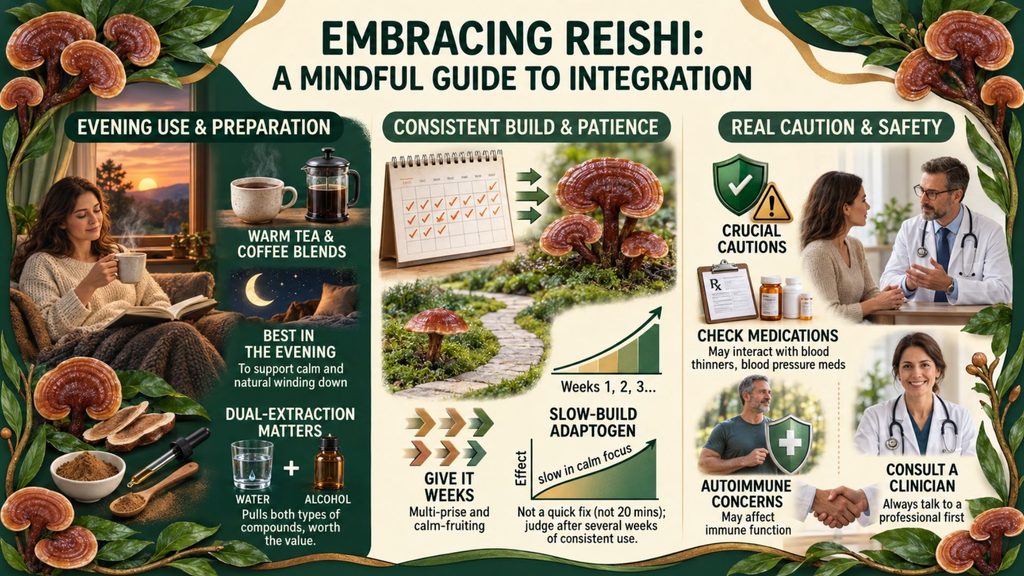
The most traditional route is a warm reishi tea or a mushroom coffee blend, taken in the evening when calm is the goal. Powders and extracts are widely available in 2026, and dual-extracted products, which pull out both the water-soluble and alcohol-soluble compounds, tend to be worth the slightly higher price.
Evening is generally the smart window, since the aim is to support winding down and better sleep rather than daytime alertness. Like most adaptogens, reishi is a slow build. Give it several weeks of consistent use before you judge it. This is not a substance you feel in twenty minutes, and anyone promising that is selling you something else.
A quick but real caution. Reishi can interact with blood thinners and blood pressure medication, and it may affect the immune system in ways that matter if you have an autoimmune condition or are on immune-modulating drugs. Check with a clinician before starting if any of that applies. Genuinely.
The Radical Act of Slowing Down
Here is the deeper point, the one that goes beyond a single mushroom. Our entire approach to focus is built on acceleration. More stimulation, more inputs, more pushing. Reishi represents the opposite philosophy, the almost countercultural idea that clarity comes from calm, not from cranking harder.
That philosophy only works if you honor it. Reishi will not fix focus for someone who sleeps four hours and lives on adrenaline. It supports a system you are also willing to protect. And if you want to build a broader routine around it, pairing reishi with other adaptogens can be genuinely effective, but only with intention. Stacking calming and stimulating herbs carelessly tends to cancel the benefits, which is why a deliberate approach to combining adaptogens safely is worth reading before you start mixing.
I keep a jar of reishi extract on my desk now, next to the coffee I have not managed to give up. The two are not enemies. One pushes, one steadies, and most days I need a little of both. But it was reishi that taught me the thing no energy drink ever could, that sometimes the fastest way to think clearly is to stop trying so hard to. So here is the question I will leave you with: what if the focus you have been chasing with more stimulation was actually waiting on the other side of finally calming down?