





Anyone who has stood frozen in a supplement aisle, phone in hand, comparing two bottles of the same herb knows a particular kind of frustration. You did your homework. You decided ashwagandha was worth trying. And then you discovered there are two versions everyone swears by, and they seem to promise opposite things. Welcome to the single most confusing decision in the entire adaptogen category.
Let me settle it for you, because I have watched this exact standoff play out with clients more times than I can count, and the answer is simpler than the marketing makes it look.
KSM-66
A full-spectrum extract made only from ashwagandha root, standardized to 5% withanolides. Most studied for stress, cortisol, and strength support.
Maker: Ixoreal Biomed
Sensoril
A water-based extract combining root and leaf, with a higher concentration of withanolide glycosides. Most studied for sleep and relaxation.
Maker: Natreon
Same Plant, Two Very Different Personalities
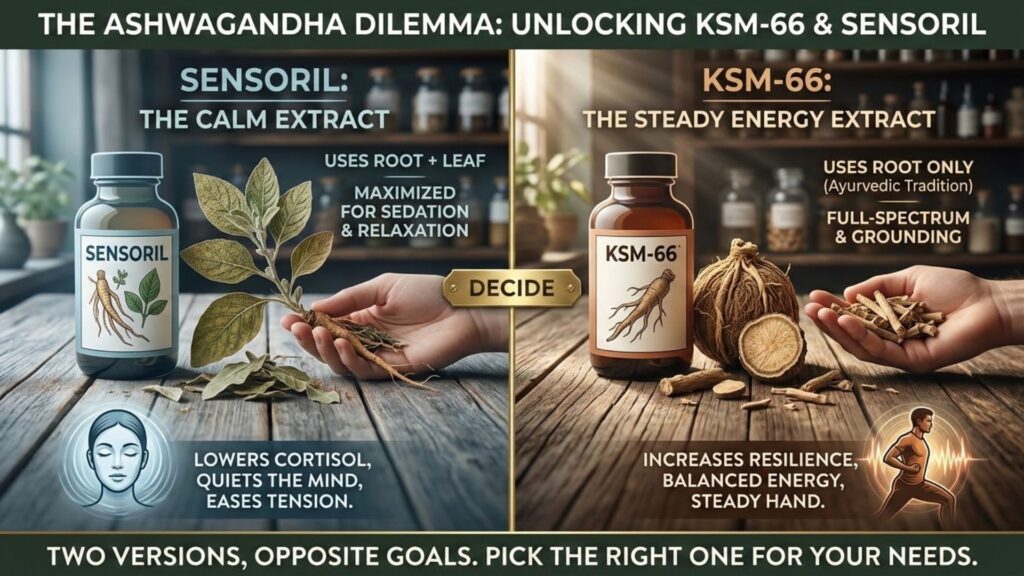
Here is the part nobody explains clearly. KSM-66 and Sensoril both come from Withania somnifera, the ashwagandha plant. That is where the similarity ends. The difference lives in how each one is extracted and which part of the plant it uses, and that single manufacturing choice changes everything about how the supplement feels in your body.
KSM-66 uses only the root, the traditional part of the plant used in Ayurvedic practice for centuries. It is a full-spectrum extract, meaning it aims to preserve the natural balance of the root’s compounds rather than concentrating one in particular. The result leans energizing and grounding at the same time. People describe it as feeling steadier, more resilient, better able to handle a hard day without crashing.
Sensoril takes a different road. It uses both the root and the leaf, and it is standardized to a much higher concentration of withanolides, the compounds most associated with the sedative, cortisol-lowering side of the plant. Sensoril is the calm-down extract. It is the one that quiets a racing mind and eases physical tension, and it can make some people feel noticeably relaxed, occasionally to the point of drowsiness.
That last detail is the whole ballgame. Buy the wrong one for your goal, and you will swear ashwagandha “does not work.” It works. You just picked the version pulling in the opposite direction.
The Withanolide Number That Trips Everyone Up
Walk down the aisle and you will see percentages on the label. This is where shoppers get fooled. Sensoril is standardized to a higher withanolide content, often around 10 percent, while KSM-66 sits closer to 5 percent. A reasonable person sees those numbers and assumes higher must mean better, more potent, more bang for the buck.
Not so fast. A higher withanolide concentration is not a quality score. It is a personality trait. More withanolides means a stronger pull toward the calming, sedating end of the spectrum. If your goal is daytime energy and stress resilience, that higher number is not an upgrade. It is a mismatch.
This is one of those wellness-industry quirks where the flashier spec actively misleads the person it is supposed to help. I have learned to tell clients to ignore the percentage entirely and focus on one question instead: do you want to feel calmer, or do you want to feel steadier?
A Side-by-Side That Actually Helps
| KSM-66 | Sensoril | |
| Plant part | Root only | Root and leaf |
| Withanolides | ~5 percent | ~10 percent |
| Best for | Energy, focus, stress resilience | Calm, tension relief, sleep |
| Typical feel | Steady and grounded | Relaxed, sometimes sedating |
| Take it when | Morning or midday | Evening, or all-day if anxious |
| Best fit | The wired-but-functional | The tense and overstimulated |
Print that, screenshot it, whatever it takes. It is the cheat sheet I wish someone had handed me years ago when I was quietly wasting money on the wrong bottle.
So Which One Should You Actually Buy?
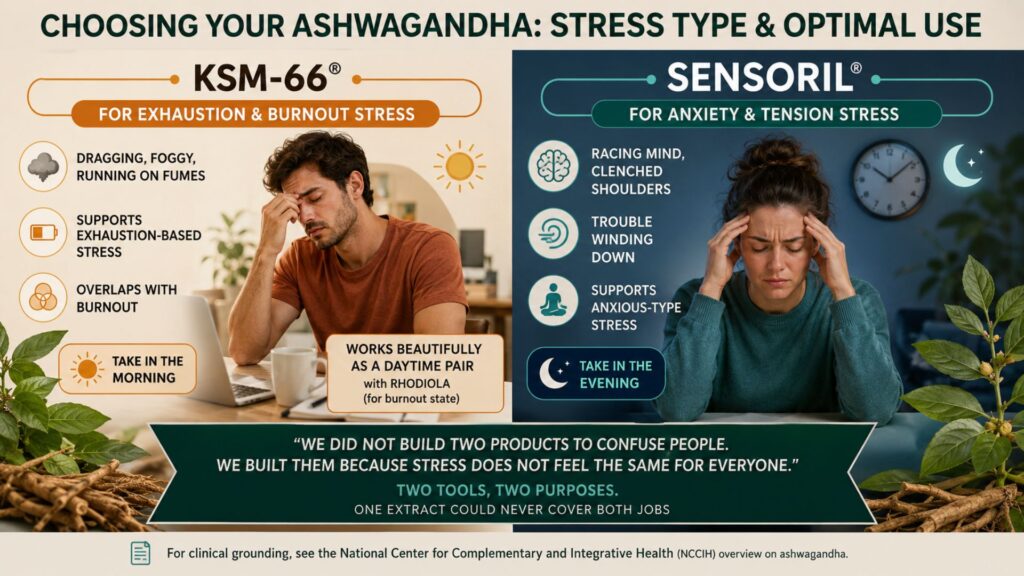
Let me be direct, because vague advice helps no one. If you are dragging through your days, foggy, depleted, running on fumes but not exactly anxious, go with KSM-66 and take it in the morning. It supports the kind of stress that looks like exhaustion. This overlaps heavily with the burnout picture, and if that rings a bell, the deeper look at rhodiola for the burnout state is worth reading alongside this, since the two herbs often work beautifully as a daytime pair.
If your stress shows up as a racing mind, clenched shoulders, or trouble winding down at night, Sensoril is your extract. Take it in the evening and let it do what it does best.
As one supplement formulator told me last year, and I am paraphrasing only slightly, “We did not build two products to confuse people. We built them because stress does not feel the same for everyone, and one extract could never cover both jobs.” That is the honest framing. Two tools, two purposes.
For the clinical grounding behind ashwagandha’s stress and cortisol effects, the National Center for Complementary and Integrative Health keeps a sober, hype-free overview that I point clients to constantly.
The Mistake That Cancels the Whole Thing Out
One last warning, and it matters. Some people, having read this far, will think the obvious next move is to take both. Energy in the morning, calm at night, best of both worlds. Occasionally that works. Often it muddies the picture, especially when you are also layering in other herbs and cannot tell which one is doing what.
Ashwagandha, whichever extract, fits inside a larger plan for natural support for chronic stress, not on top of a pile of random supplements. And if you are tempted to build a bigger routine around it, doing that thoughtfully rather than hopefully is its own skill, which is exactly what a careful approach to stacking adaptogens safely is built to protect. Start with one extract, matched to your actual goal, and give it a solid eight to twelve weeks before you judge it.
The real lesson in the KSM-66 versus Sensoril debate is not that one wins. It is that the supplement industry has quietly been selling you two answers to two different questions and letting you figure out the difference on your own. Now you know the difference. So here is what I would ask before you check out: have you actually named what your stress feels like, or have you been buying a solution to a problem you never quite defined?